With the charisma of Ibn Salman and the youth of Sharia, this is how al-Zaydi charmed Trump.
With the charisma of Ibn Salman and the youth of Sharia, this is how al-Zaydi charmed Trump.
2026-07-17
 Shafaq News – Special Translation
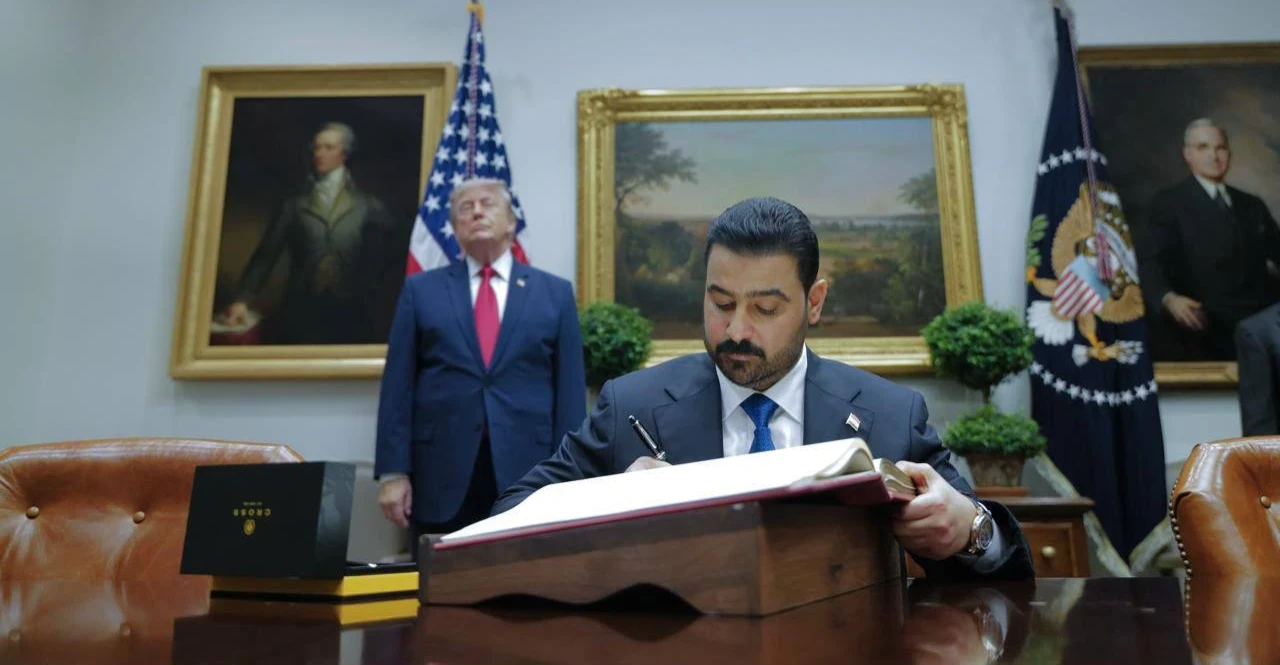
The British newspaper ” Financial Times ” believes that Iraqi Prime Minister Ali al-Zaidi succeeded in achieving the most important goals of his first visit to Washington, after he managed to win the favor of US President Donald Trump, who showered him with praise in the same way he had previously praised Saudi Crown Prince Mohammed bin Salman and Syrian President Ahmed al-Sharaa, at a time when doubts remain about al-Zaidi’s ability to implement the major pledges he made to the US administration.
The newspaper reported, in a report titled “Handsome” and “Brave Fighter”… The new Iraqi leader is courting Washington, translated by Shafaq News Agency, that al-Zaidi is now presenting himself as the Iraqi version of the model of Arab leaders who have succeeded in building a personal relationship with Trump, relying on personal charisma, economic promises, and political rapprochement with Washington.
She added that Trump described al-Zaidi during their meeting as a “great hero,” a “great fighter,” and a “big admirer of America,” and also called him “strong, amazing, and handsome”—descriptions the US president had previously used for Ahmed al-Sharaa and Mohammed bin Salman, as part of his well-known style of dealing with leaders he favors.
The newspaper noted that US envoy Tom Barrack, who had developed a close relationship with al-Zaidi, played a key role in arranging the meeting with Trump, considering that the Iraqi prime minister arrived in Washington at a very sensitive moment, as Baghdad tries to improve its relations with the United States without losing its channels with Iran.
One task
According to the report, al-Zaidi told close associates within the Iraqi delegation that he had accomplished his “sole mission” during the visit, which was to build a “friendship” with Trump.
The newspaper quoted Michael Hanna, a researcher at the International Crisis Group, as saying that Trump “was impressed by al-Zaidi’s appearance, his manner of speaking, and the relationship that developed between them, which represents a big step forward.”
She added that al-Zaidi addressed Trump, conveying to him the greetings of “the oldest civilization in the world,” in a message aimed at building a personal relationship with the American president, who attaches great importance to this type of communication.
Ibn Salman and Sharia
The Financial Times noted that al-Zaidi was following the same approach adopted by a number of Arab leaders, most notably Saudi Crown Prince Mohammed bin Salman and Syrian President Ahmed al-Sharaa, who succeeded in establishing a direct relationship with Trump by addressing his political and economic priorities and personality.
The researcher at Chatham House, Renad Mansour, was quoted as saying that the ruling elite in Iraq “had absorbed Trump’s tendency to get close to strong and charismatic men, and al-Zaidi knew how to exploit that.”
Mansour added that “there is a degree of political theater being employed to send messages that align with the priorities of the Trump administration. This does not necessarily mean that the goals are not genuine, but the rhetoric is clearly designed to suit the American public.”
The newspaper also quoted an Iraqi politician, who asked not to be identified, as saying that al-Zaidi is largely emulating the experience of Ahmed al-Sharaa, who succeeded in building an unexpected relationship with Trump, before Syria later received an American declaration removing its name from the list of state sponsors of terrorism.
Big promises
Despite the American praise for the visit, the newspaper noted that al-Zaidi made significant pledges, most notably to proceed with disarming armed factions, an issue that Washington considers central to its strategy to limit Iranian influence within Iraq.
However, the report clarified that critics of al-Zaidi believe that these promises may be difficult to implement, especially since most of the armed factions that he pledged to disarm were at the same time among the forces that supported his rise to the premiership.
The newspaper added that some analysts believe that making bold pledges that are well-received in Washington, despite the complexity of implementing them internally, has become part of the approach taken by a number of regional leaders in dealing with the Trump administration.
The report highlighted the irony that accompanied the visit, as al-Zaidi had participated, just days before his meeting with Trump, in the funeral ceremonies for Iranian Supreme Leader Ali Khamenei, which witnessed a large turnout in Najaf.
The newspaper saw this scene as reflecting the extent of the competition for influence within Iraq, but it did not prevent al-Zaidi from maintaining his relationship with Washington, as he avoided any direct criticism of Iran during his meeting at the White House, and instead focused on economic issues, investment, the future of bilateral relations, as well as the planned withdrawal of US forces in September.
Michael Hanna was quoted as saying that al-Zaidi’s participation in the funeral was supposed to have upset Trump, “but ironically, it did not affect the personal relationship that had formed between them.”
Testing the Promises
Despite the positive atmosphere, the newspaper stressed that the true success of the visit will not be measured by the warm reception, but rather by al-Zaidi’s ability to translate his pledges into practical steps, whether in the matter of armed factions or in attracting American investments.
She added that some factions have expressed their willingness to integrate into the armed forces, but the factions closest to Iran still refuse to do so, which could threaten any major investment projects.
She also noted that there are hardline Republican voices in Washington calling for more concrete Iraqi steps, citing criticism from Congressman Tim Burchett, who said after the meeting: “I wasted my morning listening to the Iraqi prime minister, and he said nothing,” while Representative Joe Wilson wrote: “Talk is cheap.”
The Financial Times concluded its report by noting that al-Zaidi’s experience in winning over Trump, like that of Ahmed al-Sharaa before him, has become a matter of interest in the region, to the point that some Lebanese officials, according to the newspaper, jokingly said that President Joseph Aoun might need to contact al-Zaidi and al-Sharaa for advice before his anticipated visit to Washington.
shafaq.com
