Iraq plans to increase tourism’s contribution: 10 million visitors and 1.5 million jobs
Iraq plans to increase tourism’s contribution: 10 million visitors and 1.5 million jobs
2026-08-15
 Shafaq News – Baghdad
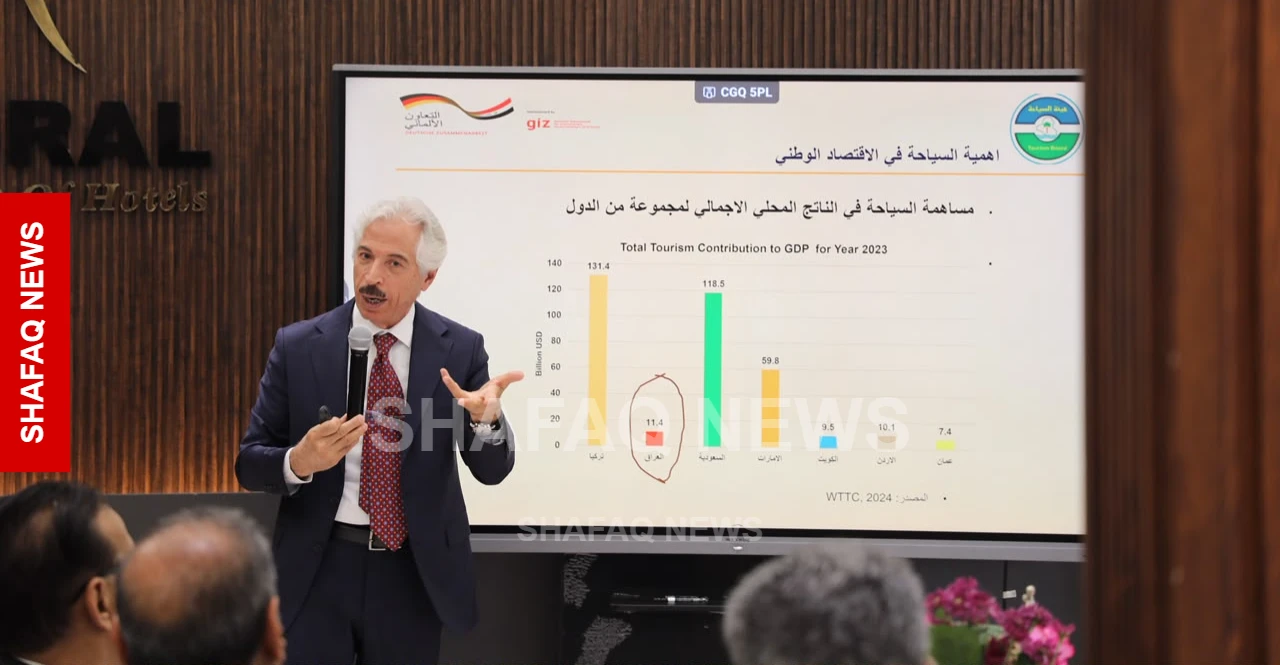
The Tourism and Antiquities Authority in the Ministry of Culture, in cooperation with the German Agency for International Cooperation, organized a workshop on Saturday to prepare a national strategy for the development of the Iraqi tourism sector until the year 2035, with the participation of a group of officials, stakeholders and academics.
Matthias Bach, head of the Economic Transformation Promotion Department at the German Agency for International Cooperation, noted in his speech during the workshop, which was attended by a correspondent from Shafaq News Agency, that “Iraq has amazing tourist sites, from ancient heritage and modern landmarks side by side, and according to the vision, Iraq is the oldest treasure and the newest discovery.”
He added: “The Vision Paper sets ambitious goals for 2035, which are for the tourism sector to contribute 10% to the GDP, provide 1.5 million jobs, and receive 10 million visitors,” explaining that “achieving these goals requires coordinated actions, as the Vision Paper itself calls for a single joint strategy between the government and the private sector, and this is the reason for holding the workshop today.”
Matthias Bach noted that “this workshop is the first of five workshops in Baghdad, Erbil, Karbala, Mosul and Basra,” explaining that “the future of the tourism sector in Iraq will depend on the cooperation of the public and private sectors and their cooperation together to make the tourism strategy a success.”
For his part, Deputy Minister of Culture Qasim Mohsen told Shafaq News Agency that “Iraq is going through major challenges, especially on the financial side,” explaining that “everyone knows that the country’s economy is a rentier economy, and that 90% of its revenues are obtained from oil sales.”
He continued, saying: “It is important to attract tourists and inform them about the tourist attractions, because Iraq possesses many of these attractions that any other country dreams of,” pointing out “the existence of a historical legacy, cultural, religious and natural foundations in this country, all of which are factors that attract tourists.”
Mohsen stressed “the importance of employing the various tourism sectors in a positive and effective manner, in order to revive the Iraqi economy and accelerate the wheel of economic development, especially since Iraq has archaeological sites listed on the World Heritage List.”
For his part, tourism advisor Omar Al-Alawi noted “the existence of a strange paradox in a country that possesses all the elements of tourism.”
Al-Alawi told Shafaq News Agency that “Iraq, in addition to having two rich rivers, is also distinguished by diverse terrains that vary from one governorate to another,” stressing that “tourism in this country was never a focus of previous government programs after 2003, and was not included as an industry and source of national income except for a simple initiative included in the first five-year plan for the period from 1975 to 1977.”
He explained: “This initiative resulted in the operation of a number of tourist facilities with the aim of revitalizing domestic tourism,” adding that “the paradox lies in the fact that the country, with its rich civilization, does not possess a tourist heritage due to the absence of tourist projects.”
He stressed that “the vision that is currently being adopted is an Iraqi product, achieved through the efforts and cooperation of many parties, including the Tourism Authority, universities, and the Organization for Development and International Cooperation. It was also based on a technical study that noted the benefit of the experiences of major Spanish tourism companies.”
The workshop included the attendance of academics and university professors to contribute their insights and expertise to the development of a scientific vision for preparing the tourism strategy.
Meanwhile, Mohammed Al-Obaidi, Dean of the College of Tourism Sciences at Al-Mustansiriya University, explained that “the college’s participation is important and effective for developing the Iraqi tourism sector.”
Speaking to Shafaq News Agency, he pointed out that “the proposals that will be put forward in the college departments will end with the adoption of outputs and recommendations, which will be presented to tourism sector officials, within a scientific vision aimed at preparing a sound and well-thought-out strategy for the development of this vital sector.”
In addition, artist Hind Kamel noted the “lack of domestic artistic tourism in Iraq,” explaining that “cinema and theater in Iraq are suffering from severe stagnation, despite the recent opening of some cinemas in some malls within the capital, Baghdad.”
She added, during her interview with Shafaq News Agency, that “Iraq is currently witnessing a trend towards activating and promoting tourism of all kinds,” stressing the importance of “strengthening artistic, cultural and civilizational tourism within an Iraqi artistic framework that enhances the country’s cultural and economic standing.”
The tourism sector in Iraq suffers from major challenges, most notably the security aspect, and the lack of real plans to revive Iraqi tourism and its cultural and economic role in supporting the general budget, if the facilities and services that would encourage Arab and foreign tourists to visit Iraq and enjoy its heritage and civilization were provided.
shafaq.com
