Two withdrawals separated by a return: Iraq faces a test of security and weapons.
Two withdrawals separated by a return: Iraq faces a test of security and weapons.
2026-09-30
 Shafaq News – Baghdad/Washington
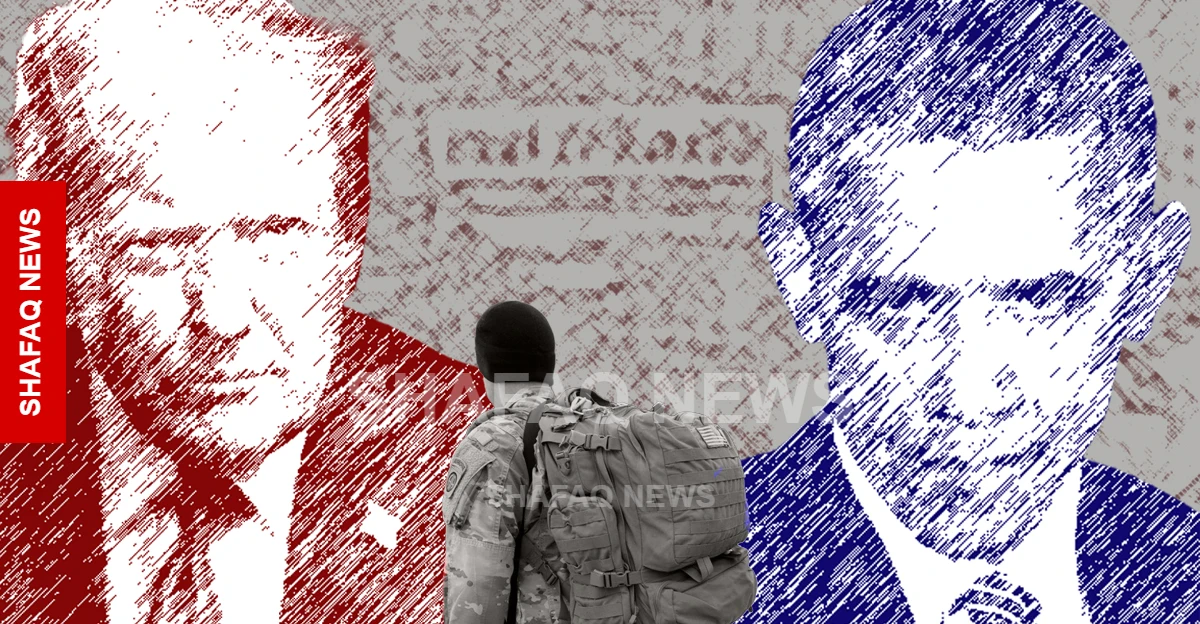
In December 2011, the last American convoy crossed the Iraqi border into Kuwait, ending a military deployment that began with the invasion of Iraq. Nearly fifteen years later, Washington announced on Wednesday the end of another mission in the country, this time from Erbil Air Base, from which coalition forces and equipment departed.
Between the two departures, US forces returned to Iraq to fight ISIS, and their size and role changed, while the state’s ability to manage its security remained the most pressing question after the departure.
When President Barack Obama announced the withdrawal of his forces on October 21, 2011, there were about 39,000 American soldiers still in Iraq. In September 2024, when the plan to end the coalition mission, which was to be completed under President Donald Trump, was announced, the size of the declared American force was about 2,500 soldiers.
The two figures do not refer to the number of people who left on the last day of each withdrawal, as the 39,000 were what remained in 2011 from a much larger deployment leading to a complete withdrawal.
The difference in numbers reveals the difference in missions. Obama’s withdrawal came at the end of a war launched by the United States in 2003 to overthrow Saddam Hussein’s regime, while today Washington is ending its military role within a coalition that was formed after the fall of Mosul to ISIS in 2014.
In both cases, the withdrawal of the forces was preceded by the announcement of the end of their combat role, in 2010 in the first case, and at the end of 2021 in the second, when the coalition’s mission officially shifted to advising and assisting.
The deadline that Obama fulfilled was set before he took office. The security agreement concluded by President George Bush and Prime Minister Nouri al-Maliki in 2008 stipulated the withdrawal of American forces by the end of 2011, and negotiations later faltered on keeping an additional force, especially regarding the legal protection of American military personnel.
In his speech announcing the withdrawal, Obama promised a normal relationship between two sovereign states and said that his country would continue to explore training and equipping Iraqi forces. However, the fall of Mosul less than three years later prompted Baghdad to request international military assistance, and American forces returned under the leadership of a new coalition.
The initial withdrawal alone is not enough to explain the rise of ISIS, as it was intertwined with Iraqi political and security crises and the war in Syria. Nevertheless, the return of troops in 2014 made the question of the capabilities of the Iraqi army and the continuation of intelligence support an inseparable part of any discussion of a subsequent American withdrawal.
The second withdrawal plan also began under a president who preceded the one completing it. In September 2024, the Joe Biden administration and the government of Mohammed Shia al-Sudani agreed to end the coalition’s military mission in Iraq by September 2025, while continuing to support operations against ISIS in Syria launched from Iraq until at least September 2026, depending on field conditions and consultations.
After the evacuation of coalition sites in federal areas, including Ain al-Asad base, according to the announcement by the Iraqi Supreme Military Committee last January, the sites in the Kurdistan Region remained the last stop.
A U.S. military official said most of the remaining troops would be redeployed to Jordan and other countries in the region, and that the equipment being moved included air defense systems.
The Pentagon announced today the end of Operation Inherent Resolve in Iraq, saying that the withdrawal of troops and equipment from the Erbil base represents the end of the coalition’s military mission in the country, but stressed that targeted training and intelligence support for Iraqi partners will continue, while Iraqi forces take the lead in operations aimed at securing the country and pursuing ISIS cells.
In Baghdad, Prime Minister Ali al-Zaidi celebrated the end of the mission in the presence of the coalition forces commander and Iraqi military leaders. He said that the end of the military coalition’s presence did not mean the end of the confrontation with terrorism, and pledged to continue security cooperation with the countries that participated in it.
Al-Zaidi had described September 30, during his meeting with the commander of the US Central Command, Admiral Brad Cooper, in August, as the deadline for departure. US Secretary of Defense Pete Hegseth also confirmed, during his talks with the Prime Minister in Washington, his country’s commitment to implementing the 2024 understandings.
However, the end of the military mission inside Iraq does not end the international coalition as a framework for confronting ISIS. In an exclusive statement to Shafaq News at the end of August, a senior White House official spoke of reducing military operations and transitioning to a permanent bilateral security partnership.
The form of this partnership, particularly what Washington will provide in terms of training, information, maintenance and armament, remains subject to arrangements agreed upon by the two countries after the departure.
The departure of the coalition forces remains separate from the presence of Turkish forces, as Baghdad and Ankara announced an agreement to gradually hand over the Bashiqa-Zilkan camp to the Iraqi government according to an agreed mechanism and timetable.
With the coalition’s departure, Baghdad’s attention is turning to the issue of weapons, which some factions have linked to the American withdrawal.
MP Abu Turab al-Tamimi told Shafaq News Agency that the government can resolve the issue if the withdrawal is completed, and suggested that there are understandings with Washington that help it to do so, without providing details to prove this assessment.
On the other hand, a source within the coordination framework warned that setting a deadline could complicate negotiations with the faction leaders.
The government’s deadline for restricting weapons does not end today. The plan presented by Al-Zaydi begins with the factions refraining from launching attacks for 90 days, followed by the process of handing over weapons, to be completed by June 30, 2027.
This leaves approximately nine months between the end of the coalition’s mission and the announced date for completing this file.
Discussions about weapons are taking place in more than one direction. Al-Tamimi distinguished between two draft laws concerning the structure of the Popular Mobilization Forces and the service and retirement of its members, and the “sovereignty” proposal related to regulating the weapons of the factions and the mechanism for managing them in coordination with the Popular Mobilization Authority.
In response to Shafaq News, the US State Department said it supports al-Zaidi’s efforts to extend state authority and prevent attacks inside or from Iraq.
Miles Caggins, the former military spokesman for the international coalition, believes that the agreement between Baghdad and Washington and the decline in ISIS’s ability to control territory paved the way for the withdrawal, along with the political pressure exerted by pro-Iranian parties to end the American presence.
According to his assessment, training, advice, and cooperation in the maintenance of F-16 fighter jets and C-130J aircraft can continue without a permanent deployment of US forces at Iraqi bases.
Kagenz says Washington is not asking Iraq to close its borders with Iran, but wants to limit what he describes as Tehran’s influence within Iraqi institutions and the activities of armed groups supported by it.
He believes that bringing these groups under state control is more difficult than disarming them of their missiles and drones because they have political, economic, and social networks. He warned of potential American retaliation if attacks on American and international interests, or on the Kurdistan Region and neighboring countries, continue.
In the Kurdistan Region, the immediate concern is what will replace the coalition’s capabilities, and days before the withdrawal date, the head of the Kurdistan Democratic Party, Masoud Barzani, warned against a repeat of what followed the withdrawal of US forces in 2011.
In a television interview, he recalled the discussions from that year regarding the ability of Iraqi forces to protect the country, expressing his fear of a return to the scenario of ISIS’s rise, although he acknowledged the difference in current circumstances.
In contrast, the Prime Minister of the Kurdistan Region, Masrour Barzani, stated in remarks republished by his office on September 27 that the withdrawal comes at a sensitive time and that leaving the region without defensive systems is a cause for concern. Today, he thanked the coalition countries, affirming the readiness of Iraqi forces and the Peshmerga to face the challenges after the mission’s conclusion.
Kurdish leader Sirwan Barzani also warned, in an interview with Reuters, of the impact of losing intelligence, logistical support and drones.
In contrast, the spokesman for the Commander-in-Chief of the Armed Forces, Major General Sabah al-Nu’man, said that Baghdad is close to obtaining air defense systems from South Korea, Turkey and the United States, as part of plans that include protecting the region’s airspace.
In his speech today, Al-Zaidi linked the end of the coalition’s mission to Iraq assuming full responsibility for its security.
He said: “There is no weapon outside the umbrella of the law, and no power outside the institutions of the state.”
His government will have until next June to implement the timetable it set for inventorying weapons, after the last coalition soldiers left their Iraqi bases.
shafaq.com
