Through various channels, Al-Sadr continues to support Al-Zaydi’s efforts to “monopolize weapons” in Iraq.
Through various channels, Al-Sadr continues to support Al-Zaydi’s efforts to “monopolize weapons” in Iraq.
2026-08-30
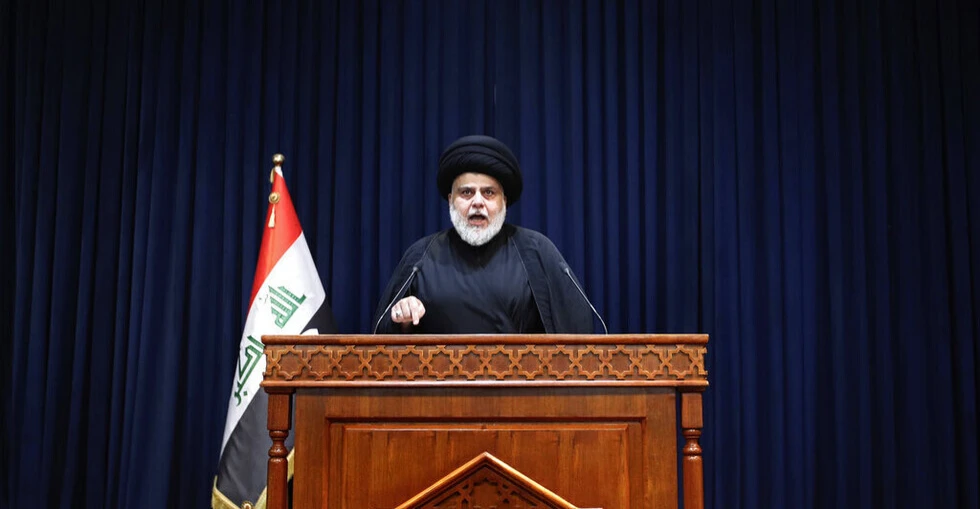 Shafaq News – Baghdad
A senior official in the political body of the Shiite National Movement revealed on Sunday that the movement’s leader, Muqtada al-Sadr, supports Prime Minister Ali al-Zubaidi’s steps aimed at restricting weapons to the state, stressing the continuation of communication to follow up on developments in the file and to work on overcoming obstacles that may hinder its implementation.
The official told Shafaq News Agency that “communication between al-Sadr and the government is taking place through multiple channels, some direct and others indirect, with the aim of continuously monitoring the progress of government procedures related to the issue of restricting weapons,” explaining that “al-Sadr’s position is based on supporting the principle of the state’s monopoly on weapons and ending any manifestations of armament outside official institutions.”
He added that “Al-Sadr confirmed his readiness to provide various forms of political and popular support to Al-Zaidi and his government, in order to make this mission a success, especially with the approaching date set by the government to resolve the issue on September 30th.”
The official explained that “the Shiite National Movement views the monopoly of weapons as a fundamental step to consolidate the authority of the state and enhance internal stability,” noting that “the government’s success in implementing its commitments within the announced timeframe would enhance confidence in its ability to manage sensitive security files away from political pressures and rivalries.”
He stressed that “Sadr’s support is not limited to the political position, but includes a willingness to contribute to providing a political and popular environment that helps the government implement its procedures,” while emphasizing at the same time the need for the process to be carried out according to a legal and institutional path that preserves the prestige of the state and prevents any slide into internal conflict.
The official concluded by saying that “the continued communication between al-Sadr and the government comes within the framework of keenness to overcome obstacles and reach the September 30 deadline without postponement or backtracking on the announced commitments.”
The resigned members of the Sadr bloc in the Iraqi parliament held a consultative meeting in Baghdad, at the invitation of the leader of the Shiite national movement, Muqtada al-Sadr.
A source in the Shiite National Movement told Shafaq News Agency that the meeting, which was held on Friday night, was supervised and attended by the head of the resigned Sadr parliamentary bloc, Hassan Al-Adhari, and was dedicated to informing the former MPs of a number of directives from Al-Sadr.
A private source revealed to Shafaq News Agency a new move led by one of the prominent leaders in the coordination framework to open channels to reach “Al-Hanana”, the residence of Al-Sadr in Najaf, in an effort to convince him to return to political participation, without recording a response so far.
The roots of the rift between Muqtada al-Sadr and the Coordination Framework forces go back to the period after the parliamentary elections in October 2021, when the Sadr bloc topped the results with 73 seats, and Sadr sought to form a “national majority” government that would exclude a number of his Shiite opponents, foremost among them the Coordination Framework forces.
However, his project faltered after months of political deadlock, before he directed his 73 deputies to resign from the House of Representatives in June 2022, which allowed the framework forces to later become the largest bloc and proceed with forming the government.
The dispute then escalated to an unprecedented level, as Sadr’s supporters stormed the Green Zone and the parliament building in the summer of 2022, in protest against the framework’s move to form a government and the nomination of Mohammed Shia al-Sudani for its presidency. Sadr demanded the dissolution of parliament and the holding of early elections.
On August 29 of the same year, he announced his retirement from political work, leading to armed clashes in Baghdad between his supporters and rival groups, before al-Sadr intervened and called on his followers to withdraw.
Since then, al-Sadr has remained outside the official political institutions, and he reinforced his boycott during the parliamentary elections held on November 11, 2025, confirming on election day that his movement was “boycotting” and that it did not support any of the parties or candidates, linking his position to the rejection of corruption, subservience, and uncontrolled weapons.
Prior to the elections, the framework forces had discussed conditions put forward by al-Sadr for his return, including restricting weapons to the state, carrying out political reforms, and reducing power-sharing.
Despite his continued distancing from direct party involvement, al-Sadr remained a prominent figure in political and security matters, particularly the issue of weapons. In May 2026, he announced the disassociation of the Peace Brigades from his movement and the integration of its members into the state, and called on other factions to distance themselves from party affiliations.
shafaq.com
