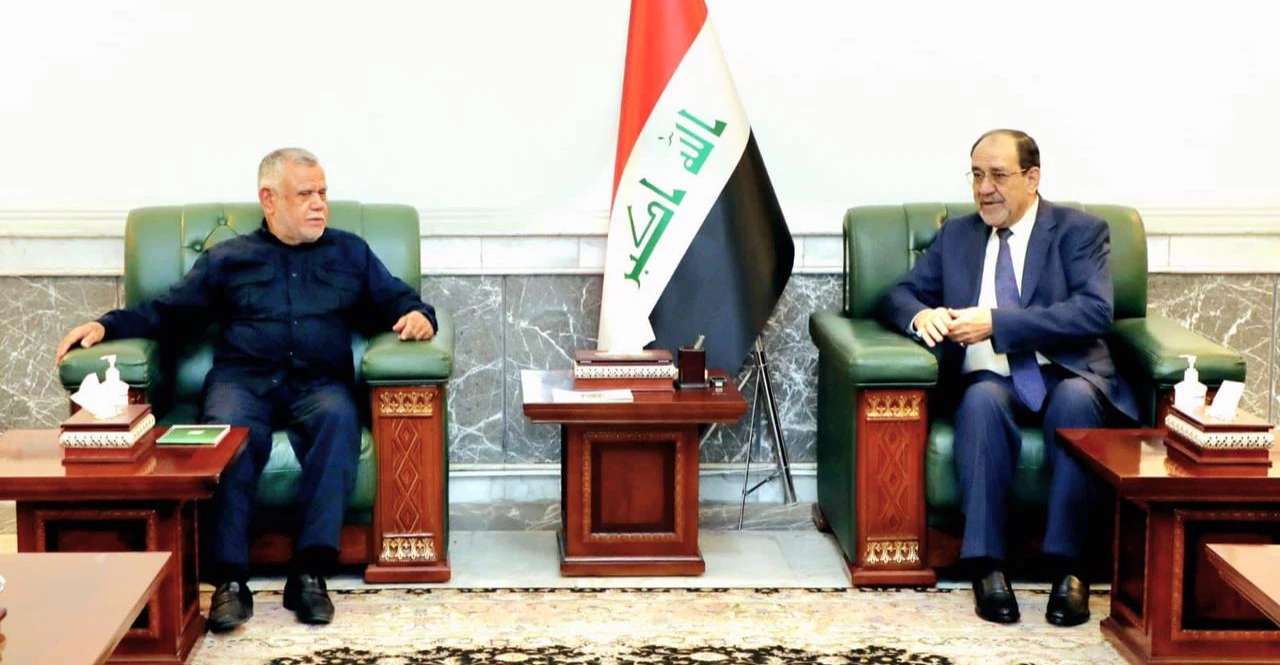
The weapons file: Al-Maliki announces the imminent work of the “inventory committee,” while Al-Amiri calls for calm and warns against “haste”.
The weapons file: Al-Maliki announces the imminent work of the “inventory committee,” while Al-Amiri calls for calm and warns against “haste”.
2026-08-18
 Shafaq News – Baghdad
Nouri al-Maliki, head of the State of Law Coalition, announced on Tuesday that the committee formed to restrict weapons to the state by the coordinating framework that includes the ruling Shiite political forces in the country will begin its work soon in coordination with the Iraqi government, with the aim of finding appropriate mechanisms to implement this process.
This came during his meeting today at his office with the Chargé d’Affaires of the United States Embassy in Iraq, Joshua Harris. During the meeting, they discussed the future of bilateral relations between Iraq and the United States, and ways to strengthen and develop them in various fields, in line with the Strategic Framework Agreement between the two countries, and to preserve common interests and Iraq’s sovereignty and independence, according to a statement issued by al-Maliki’s office.
Al-Maliki stressed the importance of addressing this issue through dialogue and understanding, in a way that ensures a unified national position and preserves Iraq’s security and stability, emphasizing that the state and its constitutional institutions are the authority in managing security and military matters.
In a related context, the Secretary-General of the Badr Organization, Hadi al-Amiri, called on all parties to adopt a language of “moderation and calm, avoid escalation in positions, and reject everything that would create gaps and fuel internal disputes” in Iraq.
In a statement, Al-Amiri called on “everyone to adhere to the principle of prioritizing the national interest, based on a profound vision, a firm foresight, and a sincere commitment to preserving the guarantees of comprehensive security for the people, and ensuring the integration of all elements of the state’s foundations, represented by its executive, legislative, judicial, and security institutions.”
He expressed what he described as “firm confidence in the good intentions, sound judgment, and certain commitment to ensuring the national dimension of both Prime Minister Ali al-Zaidi and the men of the resistance, and the readiness of everyone to bear their moral, national, and legal responsibilities,” while warning at the same time “of the consequences of hasty, ill-considered, or provocative actions, hoping to abandon the unjustified inflammatory language in some statements, declarations, and media events, and to avoid misjudging the situation and inaccurate calculations.”
Al-Amiri also expressed his hope that all those concerned with the issue of “restricting weapons to the state” would act with a spirit of national responsibility, and not give an opportunity to external parties seeking to find pretexts to extend their hegemony, maintain their dominance, and insist on confiscating Iraqi decision-making in security, political, and economic matters.
This comes as Kataib Hezbollah escalated its rhetoric against Iraqi Prime Minister Ali al-Zubaidi on Monday night, setting three conditions before entering into any understanding with the government regarding the weapons of the factions, foremost among them the complete withdrawal of US forces from Iraq, while threatening to respond to what it described as “provocative actions” that it said the government was carrying out against members of the factions and their families.
Abu Mujahid al-Assaf, the security official of Kataib Hezbollah, said in a statement seen by Shafaq News Agency that the conditions of what he described as the “Islamic Resistance” for any approach with the government to regulate the weapons file begin with the “complete and real withdrawal” of American forces from Iraqi lands and airspace and a guarantee that they will not return, in addition to what he described as liberating the political and economic decision from American hegemony.
He added that the second condition is the withdrawal of Turkish forces from northern Iraq, while his third condition is the demand to dissolve the Peshmerga forces.
Al-Assaf directed sharp criticism at Al-Zaidi, saying that the factions had waited for more than one hundred days hoping that the Prime Minister would deal with the complexities of the internal, regional and international situation, before accusing him of not listening to the advice of political forces, and of relying on what he described as the advice of other parties and the American envoy Tom Barak.
The security official of the brigades hinted at the possibility of responding to the government measures, accusing the authorities of carrying out raids on homes and terrorizing the families of the dead, wounded, and members of the factions. He said, “Our patience is running out with regard to the provocative and irresponsible actions,” before adding that the brigades may resort to the principle of “an eye for an eye, and the one who starts is the most unjust.”
At the end of his statement, Al-Assaf called on those he described as “the elder brothers and their wise men” to intervene in order to address what he called the “security distortion” caused by the Prime Minister, warning against being drawn into developments that threaten stability.
This comes about six weeks before the end of the September 30 deadline set by the main political forces to end armed activity outside the official framework.
The State Administration Coalition had affirmed on August 5 the necessity of restricting weapons to official institutions, and considered entities that engage in activities threatening the country’s security outside the framework of the state as “outlaws,” warning that any armed activity after September 30 would be dealt with according to the anti-terrorism law.
During a meeting held Monday evening, attended by the President of the Republic, the Prime Minister, the Speaker of Parliament, and the Head of the Supreme Judicial Council, the four presidencies reiterated the commitment to restricting weapons to the state, and linked proceeding with this course to the start of the withdrawal of international coalition forces and the strengthening of the capabilities of the Iraqi armed forces.
The escalation also coincided with government moves on a number of issues related to the influence of the factions, including the formation of a government committee to follow up on the Jurf al-Sakhr file north of Babylon, which includes representatives from the Ministries of Interior, Justice and Agriculture and the Popular Mobilization Forces.
The committee had begun a field operation in the area where Hezbollah brigades hold a portion of the security file.
Al-Assaf had announced last June that Kataib Hezbollah and other factions do not intend to hand over their weapons at the present stage, linking their organization to the end of the foreign military presence and the violation of airspace and what he described as the confiscation of the political decision, while other factions, including Asaib Ahl al-Haq and Kataib al-Imam Ali, expressed support for the government’s approach to organizing weapons and confining them to the hands of the state.
The developments come days after an unannounced visit by Iranian Quds Force commander Ismail Qaani to Baghdad, during which he met with leaders of the coordination framework and armed factions.
Sources told Shafaq News that Qaani called on the factions not to hand over their weapons at the present stage, but at the same time warned them against being drawn into an armed confrontation with the government, and urged them to seek a political settlement to the issue.
shafaq.com
