Removing zeros from the Iraqi dinar: monetary reform or cosmetic makeover?
Removing zeros from the Iraqi dinar: monetary reform or cosmetic makeover?
2026-08-17
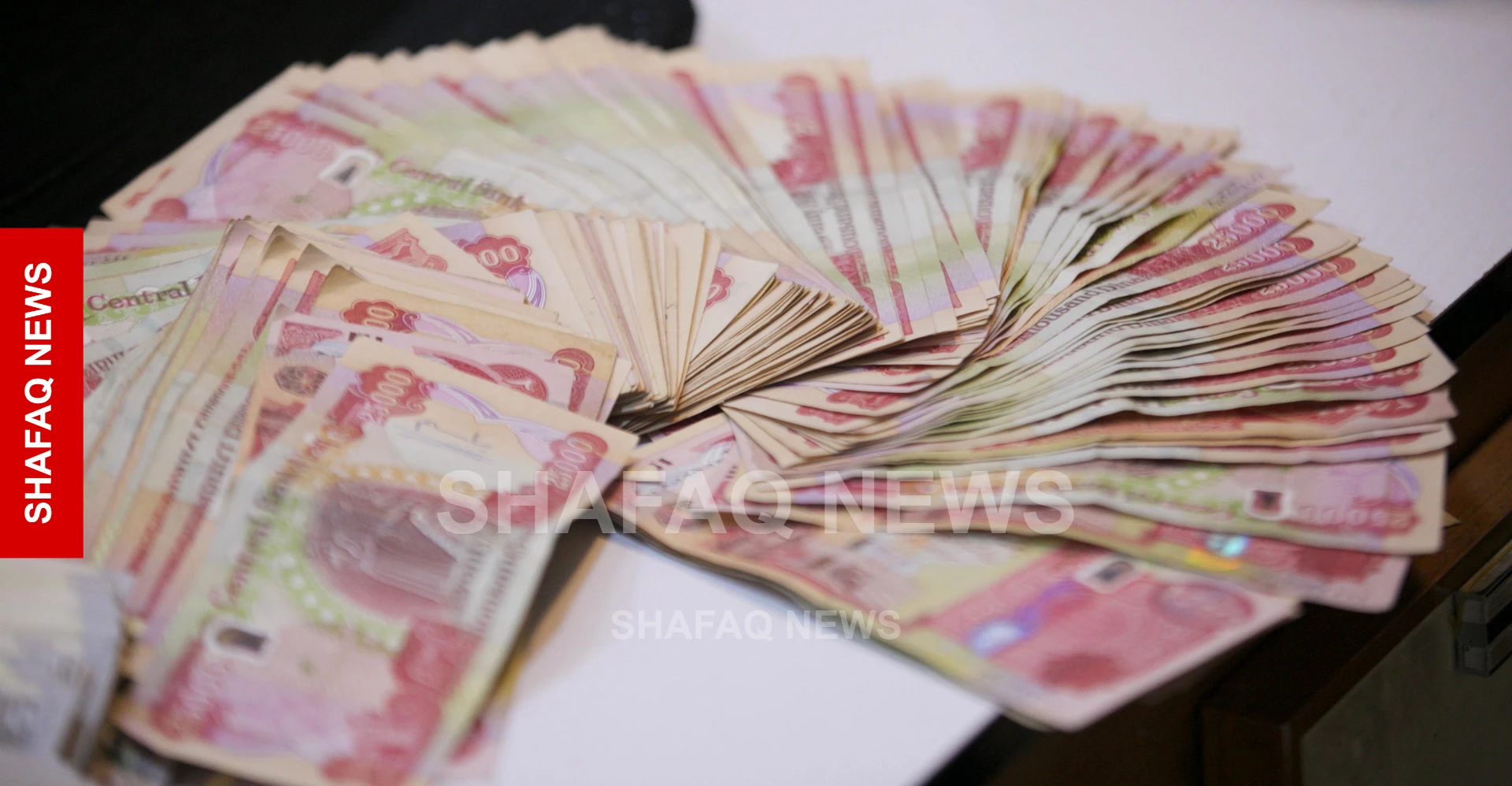 Shafaq News – Baghdad
Talk has resurfaced about the project to remove zeros from the Iraqi dinar, after years of it remaining under study, amid a liquidity crisis facing the government and pressure on financing expenditures and salaries, and in light of a broader discussion about looted funds and the size of the cash circulating outside the banking system.
Supporters argue that renaming the currency could simplify transactions and help regulate cash, while economists warn against turning it into a cure for a financial crisis that the new figures cannot address.
On Saturday, Iraqi Communications Minister Mustafa Sanad sparked widespread controversy after revealing a government decision to remove zeros or change the currency, linking the move to the problem of looted funds from the state, which he estimated at about 8 trillion dinars, in an attempt to make those funds useless when moving to the new currency.
But the statement came after the Iraqi government spokesman, Haider al-Aboudi, denied on June 22, 2026, the existence of any government intention or plan to change the national currency or remove three zeros from the Iraqi dinar, stressing that the news circulating in this regard is false and is not based on any official decisions.
The project to remove three zeros dates back many years, as the Central Bank began studying the idea in 2007, and its former governor, Ali Al-Alaq, said in 2024 that the project “is still ongoing,” without specifying a date for its implementation.
But the issue resurfaced strongly this August, with parliamentary talk of including the “Zero Removal Law” within a package of economic measures, and then proposing other options including changing the currency or issuing new denominations.
Deletion timing
In this context, economic researcher Ahmed Eid believes that introducing the project at the present time is “economically inappropriate” because Iraq is facing financial pressures, a shortage of liquidity, and an increase in government obligations, while the priority should be to address the causes of the crisis, not to change the nominal form of the currency.
Eid told Shafaq News Agency that removing zeros “does not provide new liquidity, does not fund salaries, and does not reduce the deficit and public debt,” nor does it raise the purchasing power of the citizen or the real value of the dinar.
“If three zeros were removed, 1000 old dinars would become a new dinar, and salaries, prices, savings, debts, and contracts would be renamed in the same proportion, without the real wealth changing,” according to Eid.
The economist warns that the timing could exacerbate the risks, especially in an economy that relies heavily on cash transactions, with weak financial literacy and market oversight, which could open the door to price manipulation, speculation, and confusion in contracts, savings, and transactions.
He emphasizes that the objection “is not to the principle of removing zeros” as a monetary tool that can be used in appropriate circumstances, but rather to linking it to the current financial crisis, because changing the numbers does not address the real imbalances in the economy.
Zero removal mechanism
For his part, economic journalist Salam Zeidan says that the main function of removing zeros is to reduce the number of digits and facilitate calculations; instead of the budget being approved with figures amounting to trillions of dinars, it becomes billions, and a salary of one million dinars, for example, becomes 100,000 of the new unit if the deletion is limited to one zero in the example, or one thousand when three zeros are deleted.
During his interview with Shafaq News Agency, Zaidan stressed that the process “will not address any imbalances in the economy,” noting that those who possess illicit funds may convert them into gold, silver, real estate, or dollars before the exchange, which are assets that can be traded in the parallel market, thus limiting the ability of changing banknotes alone to uncover corrupt funds.
In practical terms, any project will need to print new papers, update banking, ATM, electronic payment, government and corporate accounts systems, as well as set a period for dealing in both currencies and clarify prices, contracts and salaries for people.
In light of these facts, the reality of the financial crisis emerges, in which the talk of removing zeros comes. Mustafa Hantoush, a specialist in financial and banking affairs, says that the current spending is carried out according to the rule of 1/12 of the actual spending of the previous year, which allows spending within a ceiling of approximately 152 trillion dinars from the year 2025, but reaching this level of spending will be difficult in light of the current revenues.
Hantoush adds to Shafaq News Agency that the government is seeking financial control and limiting spending to basic and essential expenditures, while resorting to debt through the Central Bank and deducting remittances to cover a deficit estimated at about 6 trillion dinars per month, in light of a sharp decline in oil revenues, due to the repercussions of the closure of the Strait of Hormuz.
Iraq relies on oil to provide the largest share of its budget revenues, making public finances highly vulnerable to a decline in exports or a drop in prices.
Therefore, experts believe that reforming spending, diversifying revenues, and revitalizing the productive and banking sectors are more effective in stabilizing the dinar than changing its unit of account.
Objectives and risks of deletion
The removal of zeros may have other objectives related to the future of the currency and the volume of money circulating in the market. Economist Karim Al-Hilou believes that the three zeros have historically been associated with periods of wars and sanctions, and that the project to remove them was previously proposed, including during Nouri Al-Maliki’s term, but it was not implemented.
Al-Hilu believes, in his interview with Shafaq News Agency, that printing a new currency may aim to give the currency “new strength,” in addition to trying to uncover the money in the market, but he acknowledges that a large part of the money of those accused of theft may be in the form of gold, dollars and real estate, and not Iraqi currency.
He warns that requiring citizens to prove the source of their funds when handing over the old currency could create widespread disruption if precise mechanisms are not put in place, saying that the market could grind to a halt if the measures are implemented suddenly.
However, the economist believes that the decision may become inevitable despite its difficulties, and that its success could strengthen the dinar.
This vision is consistent with proposals that were recently put forward to bring back part of the cash outside the banks to the banking system. In one of the proposals, the cash mass was estimated at about 113 trillion dinars, of which about 106 trillion are outside the banks, with talk of targeting the withdrawal of about 10 trillion dinars and returning it to the banking cycle.
The concerns do not stop at the financial aspect. In 2025, experts warned that removing zeros would require months of preparation, banking and security controls, monitoring of borders, airports, and sources of funds. They also called for protecting the purchasing power of employees and launching awareness campaigns.
In 2024, experts argued that the project needed exchange rate stability and political stability, while others warned of the costs of printing the new currency and the risks of counterfeiting, money laundering, and social unrest.
One of the demands at the time was to strengthen the productive sectors, because the strength of a currency does not come from the number of zeros, but from an economy capable of producing goods and services.
shafaq.com
