Red alert for Iraqi palm trees: A deadly weevil strikes more than 7 governorates
Red alert for Iraqi palm trees: A deadly weevil strikes more than 7 governorates
2026-10-04
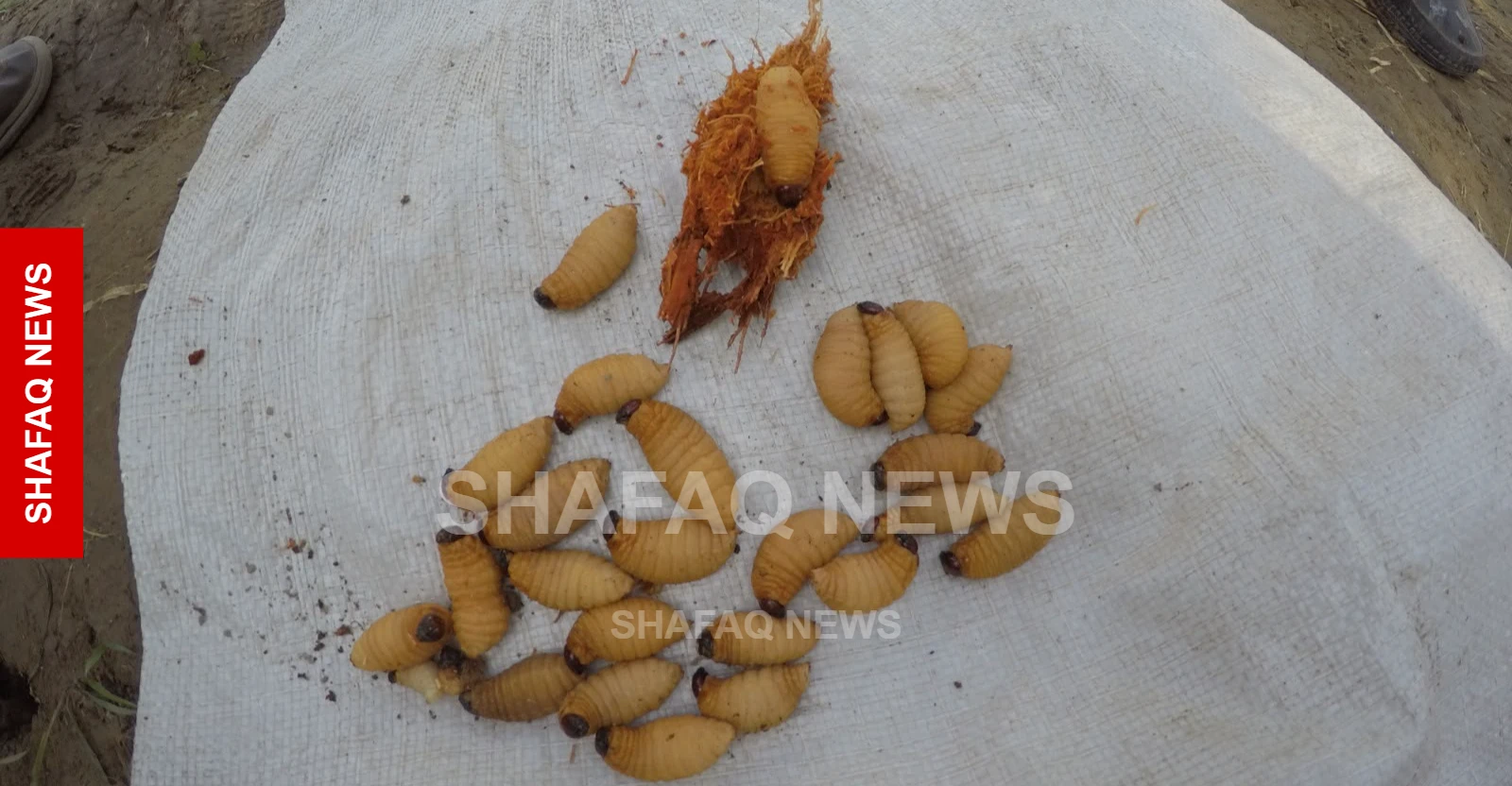 Shafaq News – Najaf
Among the palm trunks that extend over vast areas of Iraqi agricultural land, a pest is hidden that is not easily seen in its early stages, but it may destroy the palm from the inside before signs of infection appear on its surface. It is the red palm weevil, an insect that moved into Iraq across the borders and infected offshoots, before its infections were recorded in more than seven governorates and in varying proportions.
The danger of the weevil does not stop at the loss of a palm tree or orchard. Iraq, whose name is associated with date production and its historical wealth of palm trees, faces an agricultural and economic challenge that, according to specialists, requires intensifying monitoring and control operations and preventing the transfer of infected offshoots between governorates.
In Najaf Governorate, where palm cultivation extends over approximately 31,000 dunams, agricultural teams are constantly moving to monitor the orchards, install hormonal traps, detect infestations and treat them, in an attempt to prevent the pest from turning into widespread hotspots.
From Safwan to the orchards of Iraq
Amir Sahib al-Haddad, head of the prevention department at the Najaf Agriculture Directorate, told Shafaq News Agency that “the red palm weevil is of Indian origin and is considered one of the dangerous insects and pests that can be described as a cancer that affects palm trees, and it was widespread in a number of neighboring countries.”
He points out that “the entry of this pest into Iraq began in 2019 from Basra Governorate, specifically in the Safwan area, and since then the staff of the Plant Protection Department have carried out daily control work and continuous activities to limit its spread.”
But the disease has returned to register its presence in other governorates, as Al-Haddad explains, “The infections began to appear in 2025 in some areas of the governorates, and were recorded in Najaf Governorate during the month of July of the same year in the Al-Haydariya area, specifically in the Al-Munaythir area.”
Since the infection was recorded, the staff of the Plant Protection Department, with direct support and guidance from the Plant Protection Department, have begun “surveying, detection and investigation operations,” according to Haddad.
The data relied upon by the agricultural protection teams reveals that the infection has been recorded in more than seven Iraqi governorates, at varying rates, especially in areas close to the infected hotspots.
Al-Haddad continues, saying that “the infection is recorded in more than seven governorates, at varying rates, especially in areas adjacent to the infected areas.”
Among the areas that require coordination between more than one governorate is the Al-Munaythir area, which borders the governorates of Babylon, Karbala and Najaf, where agricultural staff work jointly on detection, monitoring and control operations.
The weevil does not need to travel long distances to threaten a new orchard; the biggest problem may be in a means that originally appeared to be part of the orchard development process, the “seedling”.
Al-Haddad confirms that “the main factor in the process of transmitting the pest is the infected seedlings from the areas where the infection was recorded.”
For this reason, the agricultural authorities have taken special measures for transporting seedlings, including issuing a health certificate after subjecting them to sterilization processes using specialized pesticides before transporting them from one governorate to another or from one region to another.
He adds that “the dipping or spraying operations continue for three days, after which an official permit is issued within a specific time for transporting the seedlings, with the aim of limiting the spread of the pest.”
A palm tree that may appear healthy
The most serious problem with this disease, according to specialists, is that the infection may start from within, while its symptoms are not clear in its early stages.
Al-Haddad explains that the weevil “feeds on the trunk of the palm tree and enters through weak areas, such as the offshoot or the pruning,” indicating that “unfair pruning of palm trees can provide weak areas that attract the insect and help it to enter.”
After entering, the larvae begin to feed inside the trunk of the palm tree, which leads to its being emptied from the inside, according to Haddad, who explains that the infestation cycle may continue for a long time before its results become clearly visible.
In some cases, the infection may reach a stage where the palm tree loses its ability to withstand the strain, and is exposed to falling or sudden death.
In one of the recorded outbreaks in the Al-Bu Munaytham area, the infection appeared in 28 palm trees, according to the head of the prevention department in Najaf Agriculture.
Al-Haddad confirms that 25 palm trees were treated using the therapeutic method, while three advanced cases fell as a result of the strong winds, and were empty of their contents due to the injury, indicating that “the cases that were treated showed good recovery results, and work is continuing through follow-up and monitoring.”
Traps monitor the insect before it spreads
Controlling the weevil does not depend solely on treating infected trees, but begins with monitoring the presence of the insect in orchards.
Al-Haddad explains that the prevention department was carrying out, even before this pest was recorded, central campaigns to distribute specialized pheromone traps that attract the insect and monitor its presence or spread.
According to him, the staff continue to set up and monitor the traps, whether the insect is found or not, with the aim of ensuring the safety of agricultural areas, in addition to responding quickly to any report from farmers.
This procedure is becoming increasingly important because there are other pests whose symptoms may resemble those of the red palm weevil. Al-Haddad explains that Iraq has recorded six types of palm borers, and some of their symptoms may be similar, making diagnosis of infestation by a specialized agricultural engineer essential before choosing a method of control.
Although the weevil’s ability to move naturally is not over vast distances, its presence in large numbers inside the trunk of the palm tree increases the likelihood of its spread.
Al-Haddad also says that the weevil “travels short distances, ranging between 500 meters and one kilometer in ideal conditions,” noting that weather conditions and winds can help it travel.
But the greatest danger begins when the insect population accumulates inside the trunk of the palm tree, and the larvae turn into adult insects capable of flying and spreading.
He also says that the larva appears as a “white worm with a black head,” indicating that early detection and treatment according to the approved control protocol can stop its life cycle before it reaches adulthood, and that early detection and early treatment limit its spread, and this is proven to us and has given good results.
The weevil has the ability to produce several generations when the right conditions are available, as Haddad points out that “more than five to six generations” have been recorded, which means that a delay in discovering the infestation may allow its numbers to multiply inside the palm tree and subsequently spread to other trees.
While agricultural protection teams in Najaf continue their surveying, detection, trapping, and free treatment operations for registered cases, the battle with the red palm weevil appears to be larger than the borders of one governorate, given that it has been recorded in more than seven governorates.
With Iraq possessing vast areas of palm groves and dates being linked to its agricultural and economic status, controlling the pest does not depend on treating the infected palm only, but requires an integrated system starting from preventing the transfer of infected offshoots, tightening inspection and monitoring, raising farmers’ awareness, rapid reporting, early detection, and reaching the safe treatment and destruction of advanced cases, as well as preventive measures.
In Najaf, which has about 31,000 dunams of palm trees, the traps scattered among the orchards seem to serve as an early warning system; every insect that is spotted could mean the discovery of a danger before it turns into a hotspot, and every day of delay in detecting the infestation could give the weevil a new opportunity to reproduce and spread.
shafaq.com
