Organizing and containing the situation instead of dismantling it: The framework committee’s meeting with the factions paves the way for a peaceful September 30th.
Organizing and containing the situation instead of dismantling it: The framework committee’s meeting with the factions paves the way for a peaceful September 30th.
2026-09-03
 Shafaq News – Baghdad
On Thursday, the Reconstruction and Development Coalition revealed the latest details of the meetings of the tripartite committee formed by the Coordinating Framework for Dialogue with the factions regarding the handover of their weapons.
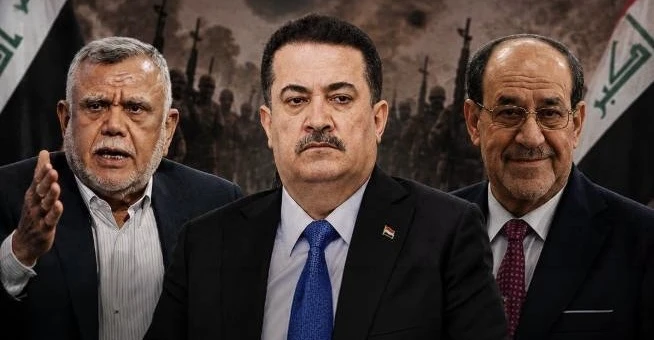
Last week, the coordination framework formed a tripartite committee comprising Mohammed Shia al-Sudani, Nouri al-Maliki, and Hadi al-Amiri, in order to contain the repercussions of restricting weapons to the state, especially after the media escalation and scaremongering witnessed in the Iraqi arena regarding this issue.
The tripartite committee has held many dialogues and discussions with the factions concerned with the issue of restricting weapons over the past few days, according to Khaled Walid, a member of the political bureau of the coalition.
Walid told Shafaq News Agency that the committee supports the Iraqi government’s measures, headed by Ali al-Zaidi, regarding the disarmament of factions, under a mandate from the State Administration Coalition and the Coordination Framework.
According to Walid, the tripartite committee continues to hold meetings with the factions, and all indications are positive regarding containing the issue of restricting weapons, leading up to September 30th, which will be an important pillar in the process of regulating weapons outside the framework of the state, and the state’s authority to declare peace and war, especially since on this day the presence of the international coalition will end in Iraq, which is considered one of the most prominent causes of the presence of weapons outside the framework of the state.
According to the vision of a member of the political bureau of the Reconstruction and Development Coalition, after September 30, the state institutions will have many procedures and directives to preserve the country’s sovereignty, prevent targeting of neighboring countries, and ensure that there is no gap in the Iraqi scene that may allow the Iraqi interior to be exposed to any attack or interference in its affairs.
Walid concluded his remarks by saying that “the results of the tripartite committee meetings confirm that there is an ability to contain any escalation and prevent any escalation in the coming days, and the issue of weapons outside the framework of the state will be completely resolved after September 30, and any collapse in the internal Iraqi situation will be prevented.”
Both Maliki and Amiri agree on the need to “organize and contain” the weapons of the factions, and that the issue of “disarmament” can affect the other side (the armed factions) as a label.
It is worth noting that the state’s monopoly on weapons does not have the consensus of the Iraqi factions, as the Al-Nujaba Movement, Kataib Hezbollah, Kataib Sayyid al-Shuhada and other factions announced their refusal to give up their military capabilities on September 30, the date set by the Iraqi government, which coincides with the end of the international coalition’s military presence in Iraq, as these factions link the future of their weapons to the withdrawal of foreign forces.
The State Administration Coalition, which includes the most prominent Shiite, Sunni and Kurdish political forces in Iraq, had warned that any armed activity outside the framework of the state after September 30 would be dealt with according to the anti-terrorism law.
shafaq.com
