Exclusive: Iraqi Minister of Agriculture: We have achieved self-sufficiency in wheat and exported seven crops.
Exclusive: Iraqi Minister of Agriculture: We have achieved self-sufficiency in wheat and exported seven crops.
2025-10-01 06:19
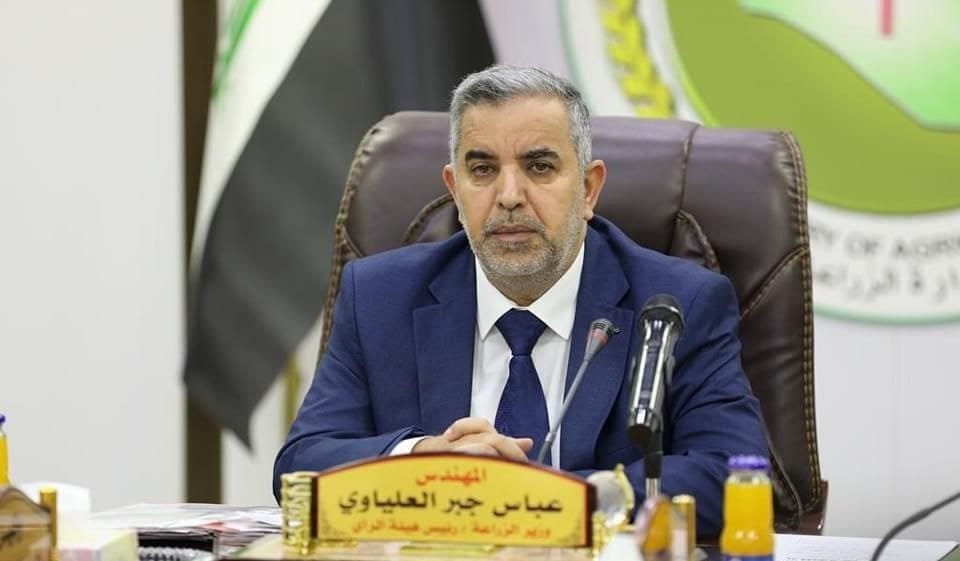 Shafaq News – Baghdad / Special Interview
On Wednesday, Agriculture Minister Abbas Jabr revealed the ministry’s methods to address the water scarcity crisis and support agriculture. While noting the achievement of self-sufficiency in a number of crops, most notably wheat, he also revealed the export of seven crops for the first time in the country.
In an exclusive interview with Shafaq News Agency, Jabr said, “The Ministry of Agriculture has relied on two main technologies to address the water scarcity crisis. The first is intensive exploitation of desert lands using pivot irrigation devices, fixed sprinklers, and modern drip systems. The second is the use of drought-resistant seed and crop varieties.”
The minister explained that “these two steps had a significant impact on increasing local production and providing a surplus for export.”
He added, “The Ministry’s success was represented by achieving self-sufficiency in wheat production, with production in the first year reaching 5.3 million tons, in the second year more than 6 million tons, and in the third year more than 5 million tons, which represents a record in Iraq’s agricultural history.”
He pointed out that “this achievement came as a result of investing in vast desert lands that exceeded four million dunams, using more than 13,000 sprinklers distributed to farmers and agriculturalists over a ten-year period, with a 30% financial support to ease the burden on farmers, with each sprinkler being sold for 45 million dinars instead of 60 million.”
The minister affirmed that “self-sufficiency has been achieved in 13 agricultural products, including vegetables and fruits. For the first time, Iraq has exported seven agricultural products, including dates, potatoes, and animal feed, to the Gulf states and Europe. Export volumes reached approximately two million tons in 2024.”
Iraq has also achieved self-sufficiency in egg products and cut-up meat, according to the Minister of Agriculture, who confirmed “closing the borders to imports to ensure the availability of local products.”
The Ministry of Agriculture has begun establishing a strategic red meat project through cattle breeding in cooperation with the Sahara Karbala Company, Jabr explained, noting that “this project will be one of the largest to meet local needs upon completion.”
The Minister concluded his remarks by emphasizing that “these achievements represent a true turning point for the agricultural sector,” emphasizing “the Ministry’s continued support for farmers and peasants, and its investment in modern technologies to address the challenges of climate and water scarcity, ensuring food security and self-sufficiency for Iraq.”
The Turkish Cereals and Pulses Association in Southeast Anatolia confirmed on Wednesday that Iraq was the main reason for the decline in Türkiye’s flour exports during the first eight months of 2025.
Turkey’s wheat flour exports fell by 35% compared to the same period last year, reaching 1.5 million tons, while revenues fell by 33.7% to $575.5 million, said Celal Kadoğlu, head of the association.
He added that the decline is attributed to Iraq’s support for local wheat and flour production, which impacts one of Turkey’s largest markets, in addition to tightening import regulations and customs delays that have disrupted Turkish shipments.
Kadoğlu explained that investments by local Iraqi factories in expanding their production capacity have contributed to the market losses of Turkish products. He emphasized that controlling the factors driving up production costs, accelerating the search for new markets, and strengthening political and trade dialogue with Iraq will help restore export momentum.
shafaq.com
