Diyala: Delayed salaries revive “debt ledgers” and paralyze market activity
Diyala: Delayed salaries revive “debt ledgers” and paralyze market activity
2026-08-01
 Shafaq News – Diyala
With the delay in paying salaries in most state institutions, the last days of the month have turned into a heavy waiting period for thousands of families who depend on a fixed government income, while the effects of the crisis have begun to go beyond homes to be reflected in the markets, where purchasing activity has declined and requests for selling on credit have increased, amid fears that the current delay will turn into a recurring pattern during the coming months.
In the markets of Baquba, the capital of Diyala Governorate, shop owners do not need an official announcement to know whether salaries have been released or not, as the movement of shoppers reveals this quickly. The commercial streets regain their activity after the salaries are disbursed, and return to stagnation whenever their disbursement is delayed, in a governorate where a large part of the local economy depends on what employees and retirees spend.
Debts before salaries
As for the employee, a delayed salary does not just mean a change in the date of receiving money, but rather a disruption of a whole series of obligations that begin with loan and advance installments, and do not end with generator and internet bills, and the purchase of food and medicine.
Qaisar Al-Azzawi, a government employee, told Shafaq News Agency, “Rearranging family obligations has become a reality, after the problem of delayed salaries turned into an additional burden, and the salary itself is no longer sufficient to pay what accumulates during the waiting period in light of the high cost of living.”
According to Al-Azzawi, the problem is not just the days of delay, but the absence of a clear date on which the employee can base his decisions. Every additional day means a new debt or a postponed need, while property owners, banks, and service providers do not stop demanding their dues.
For his part, retired policeman Hadi Al-Abadi says, “A delay in salary once can be remedied, but if it is repeated during the coming months, we will have nothing left to do without, especially since we have already eliminated many unnecessary expenses.”
Shortage management
In recent years, many Iraqi families have been accustomed to distributing their salaries before they arrive, part for rent, another for food, and a third for installments and services. However, the liquidity crisis has prompted employees to make different calculations based on determining what can be dispensed with, what can be postponed, and who can be borrowed from.
Citizen Zainab Al-Khazraji, an employee and mother of a child, explained that “the delay in salaries and the large number of obligations prompted her and her husband to postpone some projects, including the maintenance of parts of the house, or the purchase of some needs and furniture. She also began to reduce outings and visits that require additional spending.”
Al-Khazraji told Shafaq News Agency: “In the past months and years, we tried to save a small amount for emergencies, but we have spent it during the last few months, and now any illness or breakdown in the house is a real problem, because we do not have extra money to deal with any unexpected circumstance.”
She notes that she “now follows the news related to salaries daily, after she used to consider the payment date a fixed matter that did not need to be followed up on,” explaining that “the multiplicity of statements and expectations increases the anxiety of employees instead of reassuring them.”
Recurring crises
The impact of the crisis is not limited to employees, but extends to their wives, children, and the way the household is managed, according to Ali Al-Rubaie, a teacher, who confirms that “his family and many families he knows have given up buying the month’s needs all at once, and have started buying food in limited quantities that are enough for two or three days.”
Al-Rubaie told Shafaq News Agency, “My family and the families of some friends had to replace some purchases with cheaper items. We also asked the children to wait to buy their needs, because the child does not understand the meaning of a liquidity crisis or a delay in funding. All he knows is that his classmates bought things that his family cannot buy for him.”
He continues, saying that “the employee no longer gets out of the crisis, but rather transfers it from one month to the next, in light of rising prices on the one hand, and delayed salaries on the other.”
In a market in central Baquba, Ali al-Qaisi, a grocery store owner, told Shafaq News Agency, “Goods are available in the shops, but they do not reflect the sales activity, which has declined significantly, after most employees and citizens reduced the quantities they buy and turned to cheaper items, while the number of those who request to record their purchases on credit until salaries are paid has increased.”
Al-Qaisi confirms that “market activity now reveals the delay in salaries before they are announced to be disbursed. When they are disbursed, customers come to pay off their debts and buy their household needs, and when they are delayed, sales decline and the debt ledger increases. Market activity also flourishes during the first ten days after the salary is disbursed, then it returns to stagnation while waiting for the next salary.”
He points out that “many shop owners do not refuse to help customers they have known for years, but at the same time they are required to pay the value of the goods to wholesalers, as well as rents, workers’ wages and electricity bills.”
Clear stagnation
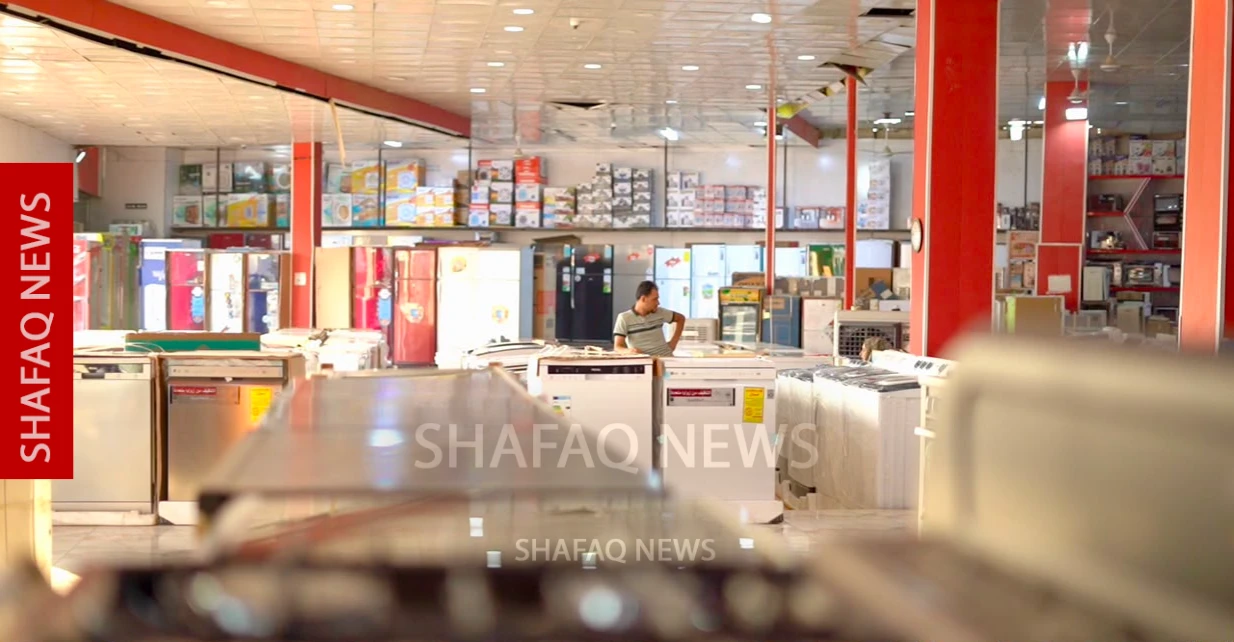
The recession appears most evident in stores that sell clothing, household appliances, phones and other goods that families can postpone buying.
In this context, Murtaza Hussein, an employee in a home appliance store, believes that “sales of this type of store are quickly affected by salary payment dates, because most customers prioritize food, rent, and services before thinking about buying electrical appliances, clothes, and other things.”
Hussein told Shafaq News Agency, “The customer comes in and asks about the price, then says that he will come back after the salary is deposited. Some of them used to buy a device from time to time, but now there are customers that I have not seen for three or four months.” He added, “The recession does not only mean a decrease in our profits, but it also threatens the continuation of some businesses, as some shops have closed their doors after their owners lost everything. Most of us now are not looking for profit, but are only trying to continue working and provide for the daily expenses and rent.”
Official statements reinforce employees’ fears that the crisis is not related to temporary banking procedures, but to a real gap between the state’s revenues and its monthly obligations, as a result of the decline in oil exports due to the Strait of Hormuz crisis.
Federal government officials, including Finance Minister Faleh Sari and Health Minister Abdul Hussein Al-Moussawi, said that “securing salaries requires approximately eight trillion dinars per month, while the available liquidity did not exceed about three trillion, which prompted the government to finance the salaries of institutions in installments, according to the available funds.”
Is it a lack of liquidity or bankruptcy?
Meanwhile, economic researcher Abdullah al-Jubouri told Shafaq News Agency that “the liquidity crisis does not necessarily mean that the state has gone bankrupt or lost its resources, but rather that it does not have, at the required time, enough cash to cover its obligations due to the repercussions of events in the region.”
According to Abdullah, Iraq’s economy is very closely tied to government spending, so delays in salaries do not only affect employees, but also reduce consumption and put pressure on markets, traders, and private sector workers, since government salaries pass through several circles within the economy; they move from the employee to the property owner, the grocer, the pharmacy, generator owners, transportation providers, and then to wholesalers and workers, and when their arrival is delayed, the entire financial cycle slows down.
Al-Jubouri believes that “the seriousness of the crisis is not measured only by the number of days of the current delay, but by the possibility of its recurrence and its transformation into a periodic situation. When an employee loses confidence in the salary payment date, his behavior changes from normal spending to cautious spending, and thus he postpones purchasing even if he has money, because he fears what the next month may bring, and this in itself increases the recession.”
The Iraqi government is looking for solutions to finance salaries, including domestic borrowing, with the possibility of resorting to external borrowing if the pressures resulting from the Strait of Hormuz crisis continue.
Al-Jubouri warns against “the continuous use of borrowing to cover operating expenses, because this may provide salaries temporarily, but it adds new obligations to the state in the form of debts and interest.”
He points out that “expanding domestic borrowing may reduce the funds available to finance the private sector and investment projects, because the government will compete with traders and investors for the liquidity available at banks,” explaining that “the government can postpone the emergence of the problem through borrowing, but it cannot eliminate it without reforming spending, increasing non-oil revenues, combating waste, and providing safer outlets for oil exports.”
shafaq.com
