Contractors in the liberated areas are demanding payment of their dues and warning of project stoppages.
Contractors in the liberated areas are demanding payment of their dues and warning of project stoppages.
2026-09-01
 Shafaq News – Anbar
The Iraqi Contractors Union called on the Prime Minister, Parliament, and Minister of Finance on Tuesday to intervene urgently to disburse the outstanding financial dues owed to companies and contractors contracted with the Reconstruction Fund for Liberated Areas, noting that the delay of some of these dues for more than two years has caused financial damage to contractors and threatened their ability to continue implementing projects.
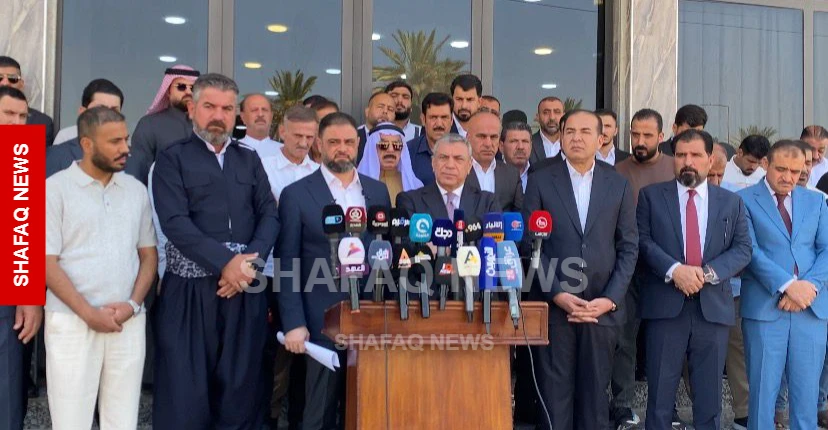
This came during a conference held in Anbar province, attended by a correspondent from Shafaq News Agency, with the participation of a number of contractors from the liberated provinces to raise their concerns and demand their rights and outstanding financial dues from the Reconstruction Fund for Liberated Areas.
The head of the Iraqi and Arab Contractors Union, Ali Fakher Sanafi, confirmed in a statement during the conference that the Reconstruction Fund for Liberated Areas has played a role in supporting the stability of the liberated governorates over the past years by implementing projects, rebuilding infrastructure, and supporting the people of these governorates who were subjected to damage and destruction as a result of military operations against groups of evil and terrorism.
He pointed out that contractors who contributed to the reconstruction of their cities and bore the burdens of implementation, financing and financial obligations cannot be left to face this crisis without real solutions.
According to Sanafi, the contractors called on the government, the House of Representatives, and the Ministry of Finance to intervene urgently and disburse the dues of companies and contractors contracted with the Reconstruction Fund for Liberated Areas, just like the rest of the contracting parties, and to do justice to this segment that had a fundamental role in the reconstruction of those areas.
In an exclusive interview with Shafaq News Agency, Snafi said that the issue of entitlements is “complex and cannot be resolved so easily.”
He added that the state is suffering from a financial crisis and a deficit in paying employee salaries, which is repeated at the beginning of each month, considering that the private sector treats him as if he were “second class”.
Snafi said the country is facing a “real crisis” after the war and the closure of the Strait of Hormuz, noting that Iraq is known for its dependence on oil.
He explained that the Prime Minister granted contractors 600 billion Iraqi dinars, of which amounts ranging between 300 and 350 billion dinars were distributed, while some ministries have not yet received their share of the amount.
He explained that the agreement stipulates allocating at least one trillion Iraqi dinars per month during the current phase, with the possibility of increasing the amount, stressing that the contractors “are optimistic,” but the first 600 billion has not yet been completed.
Snafi stressed that the crisis is not limited to the fund for the reconstruction of liberated areas, but is a “general crisis in all regions of Iraq”.
He pointed out that there is communication between the Contractors Union and the sub-unions, warning that stopping projects leads to their demise and harms the citizen, the government and the contractor, expressing that the union does not wish to reach this stage.
Snafi said that contractors “are the children of the state,” and that the relationship with it is similar, as he described it, to “father and son,” adding that disagreements may occur between the two sides, but they do not mean hatred.
He added that the contractors “did their part,” and reached a point where they wanted “only a portion of what they had provided” returned to them.
He pointed out that all projects throughout Iraq have reached completion rates of no less than 30 percent, considering this an achievement for the Iraqi contractor, but he indicated that there is no specific percentage for the stalled projects, although their number is large, and that many projects are now threatened with being stopped due to the financial deficit.
shafaq.com
