“A difficult maneuver”: Baghdad between the Turkish-American role and Iranian pressure
“A difficult maneuver”: Baghdad between the Turkish-American role and Iranian pressure
2026-08-27
 Shafaq News – Special Translation
Turkey has become more important to Iraq after the US war on Iran, according to the Arab Center in Washington, which also believes that this war has made Baghdad’s long efforts to balance between Iran and the United States more difficult, thus making its relationship with Turkey more valuable. It added that Turkish and American interests in Iraq have become closer to each other, as Ankara and Washington increasingly favor a stronger central government in Baghdad.
The American Institute, in a report translated by Shafaq News Agency, spoke of a “major shift” in Turkish-Iraqi relations during the past two years, during the era of former Prime Minister Mohammed Shia Al-Sudani, who focused on development and made the “Development Road” project linking the Grand Faw Port to Turkey and Europe one of his government’s central projects, while Ankara also began to place its security demands in a broader context of economic and political cooperation .
The report noted that the American war reinforced Turkey’s importance to Iraq, as the disruption of shipping through the Strait of Hormuz revealed Iraq’s dependence on Gulf export routes and enhanced the strategic value of alternative routes through Türkiye.
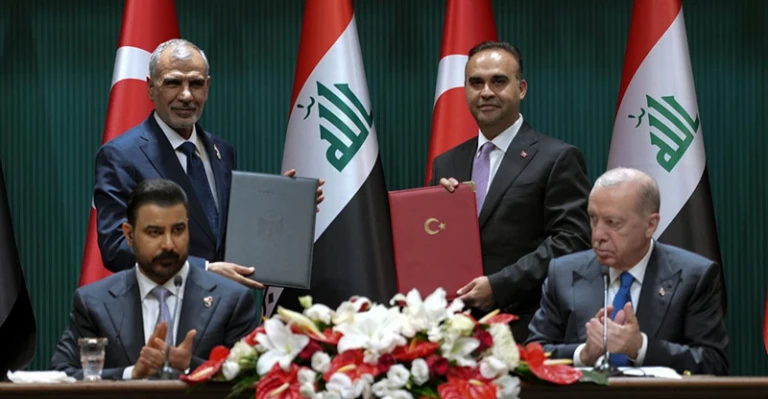
The report noted that Prime Minister Ali al-Zaidi’s visit to Ankara demonstrated the continuity of Iraq’s approach towards Turkey despite the change of government, adding that the partnership between Turkey and Iraq has deepened, increasingly aligning with American priorities in Iraq as well. However, it noted that the extent to which it can go will largely depend on politics within Iraq, where competing power centers continue to restrict Baghdad’s ability to implement deals it makes with Turkey .
The report indicated that the change in Iraqi-Turkish relations was particularly evident with regard to the security relationship, as the Turkish military presence in northern Iraq had been one of the main sources of tension between Ankara and Baghdad for two decades, with Ankara always demanding that Baghdad take a stronger stance against the Kurdistan Workers’ Party (PKK). During the term of the Sudanese government, Iraq became more responsive to these demands.
The report stated that the “Development Road” has begun to change the very nature of the Turkish-Iraqi relationship, adding that the project promises to transform Iraq from a country heavily dependent on oil exports into an integral part of a broader transit and logistics network, while for Turkey it completes its long-held ambition to position itself at the center of regional trade and communication networks .
The report continued that while Iraq provides a port for access to the Gulf, Turkey provides connectivity to European markets in addition to construction capacity and logistics services, things that were largely absent from the old relationship, which focused on security .
The report noted that the war with Iran made the “Development Route” more than just an ambitious long-term economic project, because with shipping through the Strait of Hormuz disrupted, the land link to Europe via Turkey acquired much greater strategic value .
He added that the water issue contains the biggest flaw, as Türkiye sits at the source and controls much of the flow, giving Ankara significant influence.
He pointed out that the framework agreement agreed upon during Al-Zaidi’s visit in July allows Turkish companies to carry out water infrastructure projects in Iraq funded through Iraqi oil revenues, which would bring the discussion closer to Ankara’s focus on managing Iraqi waters, but no new commitment was reached regarding the volume of water that Turkey will release.
He went on to say that, unlike security and water, the energy file involves greater interdependence, pointing in this context to the Kirkuk-Ceyhan pipeline, which provides Iraq with an export route to the Mediterranean Sea that bypasses the Gulf, while Iraqi oil is important to Turkey as a source of crude oil and as part of its ambition to become a regional energy hub.
However, the report stated that although the rapprochement between Ankara and Baghdad is real, the two governments are not the only actors contributing to shaping developments. Their growing cooperation affects the interests of other regional and local actors, while the weakness of the central government reduces its ability to implement some of the policies it agrees on with Turkey, adding that the “path of development” provides the clearest example of both problems .
According to the report, the project is part of a broader competition for regional trade routes, noting that the most pressing competition comes from Iran, which seeks, through the North-South International Transport Corridor, to direct trade through Iranian territory, while the “Development Road” will form an alternative through Iraq and Turkey while allowing Gulf trade to bypass the Strait of Hormuz, thus reducing an important source of regional and global influence for Iran.
He added that groups allied with Iran in Iraq oppose the project because it could weaken Tehran’s regional influence .
The report stated that with Iran under continued military pressure, Tehran has fewer resources to devote to its regional networks, while Washington is pushing more clearly to limit the power of armed groups allied with Iran .
Therefore, the report said that this brings American and Turkish priorities in Iraq closer together, as Washington wants to strengthen the authority of the central government by bringing the Iranian-backed factions under the effective control of the state. It added that Ankara has its own reasons for wanting a stronger government in Baghdad, as a strong central state would be able to control its territory, be a more effective partner against the Kurdistan Workers’ Party (PKK), be more able to implement the “Development Path” and other bilateral agreements, and be less vulnerable to actors that could hinder cooperation with Turkey .
The report indicated that Washington has reason to welcome Türkiye’s growing role in Iraq, especially since Ankara’s preference for a stronger central government overlaps with US priorities.
He added that for Baghdad, closer ties with Türkiye would provide an additional source of balance at a time when managing relations with Iran and the United States has become increasingly difficult.
He added that Turkey cannot replace either power, but stronger relations with Ankara give Baghdad more room to maneuver between them .
The report argued that these changes, taken together, made Turkey a more important partner for Baghdad and gave both sides a stronger interest in maintaining rapprochement, adding that the war reinforced this shift, increasing Turkey’s strategic value to Baghdad, with Turkish and American interests converging on the idea of a stronger Iraqi state.
However, the report noted that this does not amount to an Iraqi realignment towards Turkey and away from Iran, adding that Baghdad cannot afford a split with Tehran, whose political, economic and security influence inside Iraq is still significant.
The report noted that excessive pressure on Baghdad to act very forcefully against Iraqi factions could be destabilizing, undermining the stability upon which Turkey’s economic ambitions in Iraq depend.
Therefore, the US report concluded that Ankara’s interests would be more aligned with the gradual strengthening of the Iraqi state rather than a sharp geopolitical realignment.
shafaq.com
