Barzani asked Biden for help to “save the region from collapse,” and Baghdad eased the pressure
Barzani asked Biden for help to “save the region from collapse,” and Baghdad eased the pressure
9-14-2023
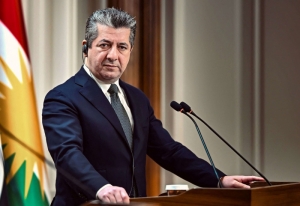 Erbil – Prime Minister of Kurdistan, Masrour Barzani, sent a telegram to US President Joe Biden complaining about the pressure exerted by the Baghdad government and asking him to intervene urgently to save the region from “final collapse.”
The Monitor Network said in a report published on Tuesday (September 12), that Barzani told President Biden, “I am writing to you now as we are at the crossroads of another crisis in our history, a crisis that I fear (the possibility) that we will not overcome easily. We are bleeding economically and politically.”
He added, “For the first time since I assumed the job of prime minister, I am truly concerned that the dishonorable campaign being waged against us (by the Baghdad government) will ultimately lead to the destruction of the Iraqi federal model that the United States has sponsored since 2003 and has been keen to continue until now.”
He warned of the “total and complete collapse of the Iraqi Kurdistan region” if President Biden did not move personally to influence the Iraqi government, saying, “We believe that your administration has great influence in Baghdad that it can use to defuse the current crisis.”
The Monitor Network reported that the message arrived at the White House on the third of this month.
Observers noted that Baghdad’s position has changed since that time, as it decided to pay part of the region’s dues, and the Kurdistan Democratic Party was invited to return to Kirkuk. This call was renewed even after the outbreak of protests in the city.
The Coordination Framework government proposed at the beginning of this month to provide an amount of 500 billion dinars on the basis that it was a “loan” to the regional government, so that it could repay it from its oil revenues. However, the regional government rejected the proposal.
Regional government spokesman Peshwa Hawramani said, “The total financial dues to the Kurdistan Region, according to the schedules of the Federal Budget Law for the year 2023, amount to one trillion and 375 billion dinars per month, of which 906 billion dinars are allocated to pay the salaries of employees of the Kurdistan Region. However, the Federal Ministry of Finance, from the first of last January until… Now, it has disbursed an amount of two trillion and 598 billion dinars only to the Kurdistan region, including 400 billion dinars for the months of October and November of 2022, while the amount allocated to the Kurdistan region until August 2023 and according to the schedules of the budget law amounts to 11 trillion dinars.
The region’s own oil revenues are subject to Baghdad’s supervision, and are part of the Iraqi export quota with OPEC. Stopping the region’s exports does not mean that the Iraqi budget has been harmed because Iraqi oil production has remained within the limits of its quota, and the Iraqi Ministry of Oil receives 85 thousand barrels of oil from the region. Daily since June 25 for local use.
While the regional government expressed its willingness to deliver the quantity that the ministry wanted according to the production capacity of local refineries, the federal government did not fulfill its commitment related to the production costs of oil and did not pay a single dinar to bear the costs of extracting, producing and transporting oil.
In the end, under American pressure, the government in Baghdad decided to disburse an amount of 500 billion dinars to the Kurdistan region as part of its dues and not a loan.
Kurdish officials are discussing with American officials to address the issue of whether the regime in Iraq is federal or central, and they say that the dealings taking place with the region are not federal, as Baghdad is keen to subject everything related to the region to its control.
By offering to allow the Kurdistan Democratic Party to return to Kirkuk, the government of Muhammad Shia al-Sudani tried to appease him, so that he would not complain about Baghdad’s mistreatment of the region, and to find a basis for sharing influence in the city. However, the declared position of the coordination framework still considers the region to be subject to the central administration in Baghdad. The region is demanding money it does not deserve.
State of Law coalition member Jassem Muhammad Jaafar said that Masrour Barzani’s recent statements regarding the relationship between the region and the center reflect the regional government’s fear of the Kurdish people’s revolt against it, and that it is due to “illegitimate and illegal demands regarding taking amounts from Baghdad.”
He added, “Instead of his provocative statements, Masrour Barzani should have fulfilled the promises made regarding the budget and returned the amounts of oil sold during (smuggling) to Turkey instead of lamenting what happened in Kirkuk, and to know the mistake they put themselves into when they signed a contract with Turkey without consulting the government.” “Federal.”
The head of the Kurdistan Democratic Party, Masoud Barzani, criticized the Iraqi Parliament’s approval to approve the state budget, and considered it illegal and unconstitutional, and believed that it further deepened the dispute with the region.
He said, “The Iraqi federal government and the Kurdistan Regional Government reached a good and positive agreement to resolve the dilemmas in order to consolidate the foundations of stability in the country and serve the people. However, what some political parties did was irresponsible behavior aimed at undermining the entity of the Kurdistan region.”
rawabetcenter.com
