Fuad Hussein: Three factions have begun handing over their weapons, and Baghdad has expanded its electrical interconnection with countries in the region.
Fuad Hussein: Three factions have begun handing over their weapons, and Baghdad has expanded its electrical interconnection with countries in the region.
2026-10-01
 Shafaq News – Washington
Mustafa Hashim
Iraqi Foreign Minister Fuad Hussein revealed on Thursday a government plan that includes a timetable extending until June of next year to control the weapons of armed factions and integrate them, stressing that the implementation of the plan has already begun with the announcement by factions of their support for the Prime Minister’s policy and the handover of their weapons.
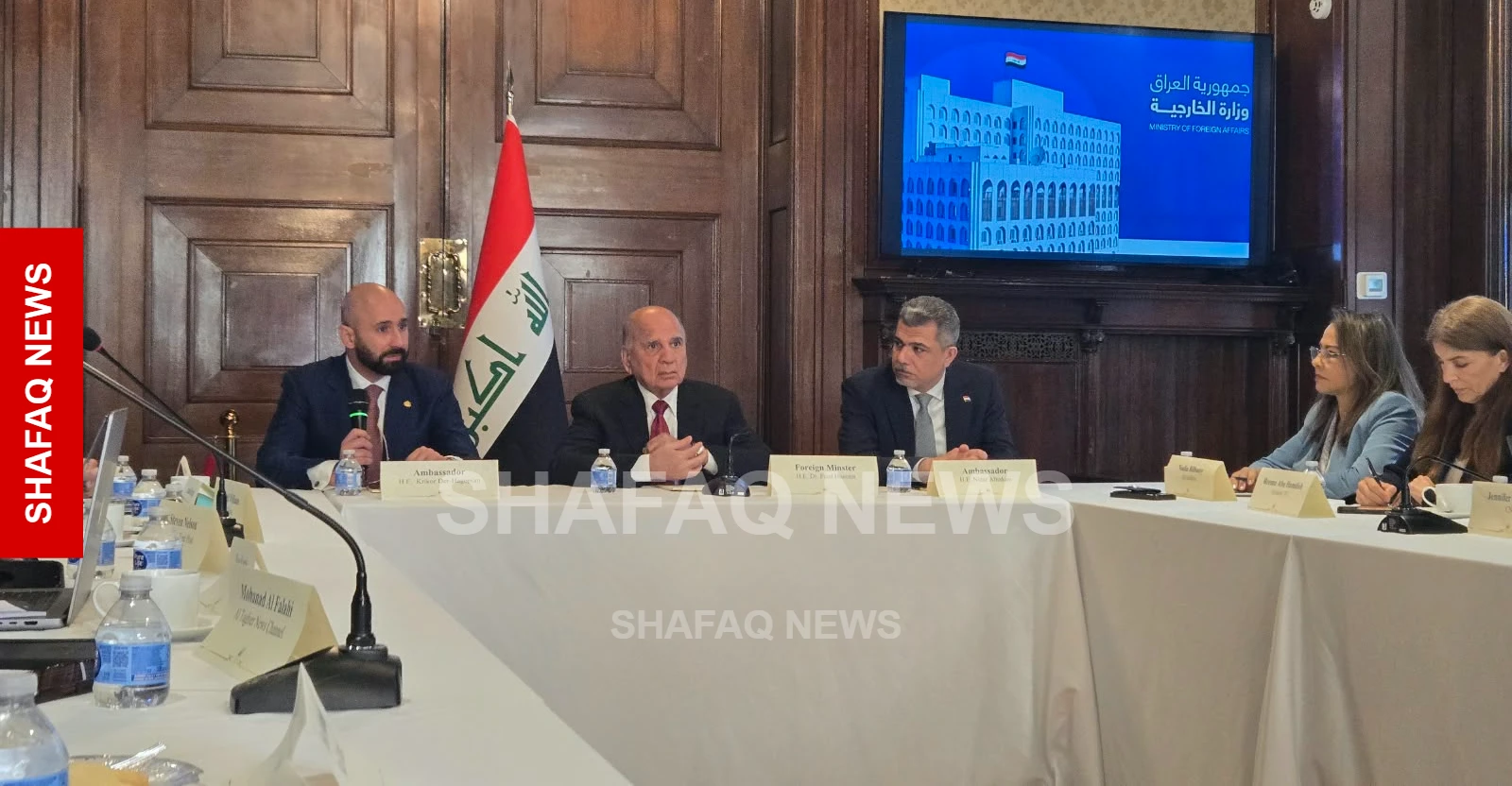
During his meeting with journalists at the Iraqi embassy in Washington, including a correspondent from Shafaq News Agency, Hussein said that three out of seven factions had announced their compliance with the plan and had begun handing over their weapons to the Iraqi armed forces, expecting other factions, including the Sayyid al-Shuhada Brigades, to join the agreement soon.
He explained that this step comes within the framework of an internal Iraqi constitutional entitlement and commitment to end the phenomenon of uncontrolled weapons, and enjoys the consensus and support of the majority of political leaders in Baghdad, even with its coinciding with external pressures or influences.
Regarding security relations with the United States, Hussein stressed that the end of the international coalition’s mission will open the door to building direct bilateral security relations with Washington and other Western countries, including Britain and France, based on the Strategic Framework Agreement signed between Iraq and the United States.
Regarding mediation between Washington and Tehran, Hussein added that Baghdad has relations with both sides and supports the path of negotiations aimed at reducing escalation and resolving the conflict peacefully, away from the military option. He pointed out that Iraq is in contact and coordination with other mediating countries, including Oman, Qatar and Pakistan, and that Baghdad is ready to play a direct mediation role if the two parties officially request it.
Regarding the Peshmerga forces and the disputed areas, he continued, saying that the Peshmerga are a constitutionally recognized part of the Iraqi defense system, noting that there is close field coordination with the federal forces to prevent any security vacuum that ISIS might exploit in the shared areas, Kirkuk and Diyala.
The Iraqi minister stressed that Baghdad is responsible for protecting the Kurdistan Region and equipping its forces to confront threats, revealing ongoing security and diplomatic communication with Riyadh regarding the investigation into the targeting of Saudi pipelines, with a security team being sent to Saudi Arabia and the initial investigation results being presented.
According to Hussein, initial findings showed that the attack originated from Iraqi territory, about 13 kilometers from the Iranian border, with Tehran being asked to provide additional information.
Regarding the Turkish military presence, Hussein pointed out that the Turkish presence in the Bashiqa camp and the Sinjar area was discussed with the Turkish side during the New York meetings, noting that there were understandings regarding the withdrawal of Turkish forces from Bashiqa within a specific time period.
He also touched on the challenges facing Iraqi oil exports as a result of tensions in the Strait of Hormuz, noting that Iraq currently exports about 3.5 to 3.6 million barrels per day through the Strait of Hormuz.
According to Hussein, the tensions and risks of the Strait being closed have prompted Iraq to rethink its pipeline policy through neighboring countries, with the aim of diversifying export routes. He explained that Iraq held lengthy talks in Damascus to revive the Iraqi pipeline passing through Syria to the port of Banias.
He noted the interest and investments from international companies, including Chevron, as well as Gulf companies, adding that Iraq also discussed the oil pipeline project towards the port of Aqaba in Jordan, as part of its efforts to provide alternative routes for exporting crude oil.
Hussein said that the pipeline extending through the Kurdistan Region to the Turkish port of Ceyhan was recently resumed after being halted due to legal problems, stressing that the pipeline is currently exporting about 200,000 barrels per day, with a plan to raise the quantities to 350,000 barrels per day, and a future goal of 700,000 barrels per day, in conjunction with the resumption of production operations by foreign companies.
Regarding the energy file, gas and electricity imports, and regional interconnection, Hussein confirmed that gas import contracts from Iran date back to 2013, with the aim of operating major power plants, in addition to Iraq previously importing about 1200 megawatts of electricity, adding that those supplies have witnessed interruptions and declines.
He noted Iraq’s move to reduce dependence on external energy sources by investing in associated gas locally and using it to generate electricity, considering that Iraq is working on diversifying electricity sources and expanding regional electrical interconnection, and that Baghdad has begun importing quantities of electricity through the Jordanian network, and has also opened the door to interconnection with Egypt.
He noted that Iraq is in discussions with Türkiye to import electricity and expand supplies, which previously amounted to about 600 megawatts.
Hussein concluded his remarks by saying that “Iraq is also seeking to activate the electrical interconnection project with the Gulf countries via Kuwait,” indicating that he “made contacts with the Kuwaiti Foreign Minister to arrange a visit for the Iraqi Minister of Electricity to Kuwait, to follow up on the project of extending the network and supplying Iraq with energy.”
On Wednesday, the Commander-in-Chief of the Armed Forces, Iraqi Prime Minister Ali Faleh al-Zaidi, announced the official end of the international coalition’s mission in the country, expressing his gratitude to the coalition countries for their support of the security forces during the fight against terrorism.
While US President Donald Trump announced the departure of the last American troops from Iraq, considering that it was time for Americans to return home, he praised Prime Minister Ali al-Zaidi, whom he described as “great,” noting that he had supported him from the beginning.
This comes at a time when the Al-Zaidi government has placed the issue of restricting weapons within a separate timeframe from the withdrawal of the coalition.
On September 21, al-Zaydi announced a plan that begins with a 90-day truce, during which the factions would refrain from launching attacks, in exchange for guarantees that they would not be subjected to American attacks, after which the process of handing over weapons would begin and be completed by June 30, 2027.
shafaq.com
