Worth $2.6 billion: Parliamentary move to reclaim Iraqi oil pipeline “sourced” in Saudi Arabia
Worth $2.6 billion: Parliamentary move to reclaim Iraqi oil pipeline “sourced” in Saudi Arabia
2026-08-01
 Shafaq News – Baghdad
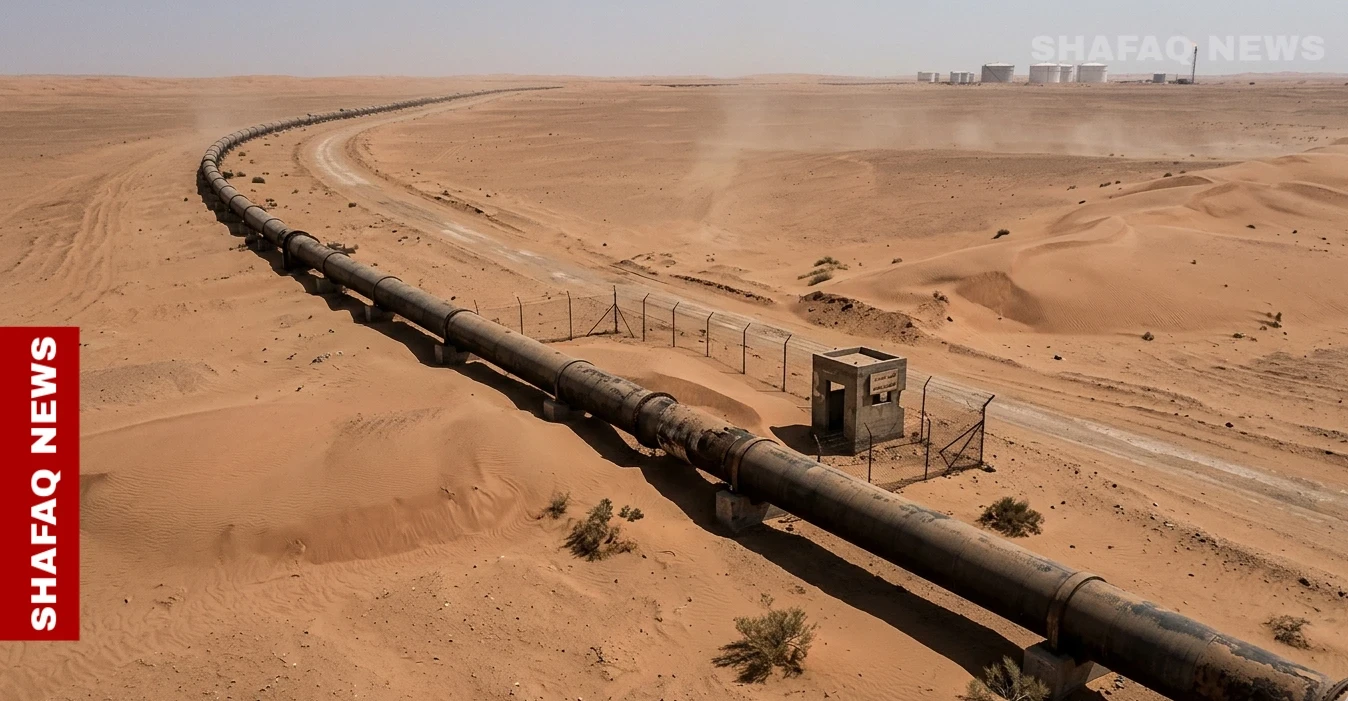
On Saturday, Saud Al-Saadi, the deputy head of the “Rights” parliamentary bloc, submitted an official parliamentary question to Prime Minister Ali Al-Zaidi regarding the ownership of the Iraqi oil pipeline passing through Saudi territory (the Zubair-Khurais-Yanbu Al-Bahr line), demanding a statement of the measures taken to restore its ownership or to claim compensation.
Al-Saadi explained in the documents obtained by Shafaq News Agency that the 1,568-kilometer-long pipeline with its giant tanks on the sea was built with Iraqi funds amounting to 2.6 billion US dollars, and is considered the property of the Iraqi people based on Article (111) of the Constitution.
Al-Saadi questioned the reasons for the silence of the Cabinet and the Ministry of Oil regarding the Saudi side’s official seizure and confiscation of the pipeline and tanks since 2004 without collecting the construction costs, pointing out that part of this strategic pipeline was used to transport gas within Saudi Arabia.
The MP on the Parliamentary Integrity Committee demanded, through his documents, the disclosure of the government’s plan to establish Iraq’s sovereign and oil rights, and the possibility of demanding from Riyadh the amounts of money spent or compensation for the use of parts owned by Iraq, stressing the need to respond within 15 days in accordance with the law of the House of Representatives and its formations.
This comes in conjunction with what a source in the Ministry of Oil revealed on April 26, 2026, about the existence of major difficulties preventing the resumption of Iraqi oil exports through the pipeline extending towards the Saudi port of Yanbu.
The source told Shafaq News Agency at the time that “the most prominent of these challenges is the Saudi side’s insistence on its right to use the part located within its territory to transport its own oil,” indicating that “restarting the pipeline requires reviving the bilateral agreement regulating it between the two countries, something which has not yet seen any positive signs from the Saudi side, making a return to work on it in the near future unlikely.”
The source added that “the pipeline’s infrastructure has been neglected for more than three decades, which necessitates extensive rehabilitation operations that include replacing large parts of it, which requires huge financial allocations in the event of reaching a joint agreement to restart it.”
He pointed out that “Iraq, in light of these challenges, continues to rely on alternative means of transport, including land tankers to transport oil through Jordan and Syria, until permanent and stable solutions are found for the issue of exporting via the joint pipeline.”
The Iraqi-Saudi pipeline is one of the crude oil transport lines, extending for about 1,568 kilometers, starting from the city of Zubair in southern Iraq, passing through the city of Khurais in eastern Saudi Arabia, and reaching the port of Yanbu on the Red Sea.
The pipeline was permanently shut down in 1990 following the Iraqi invasion of Kuwait, before Saudi Arabia took control of it in 2001.
shafaq.com
