Two questions are puzzling Iraqis: Will US forces withdraw, and what will be the repercussions?
Two questions are puzzling Iraqis: Will US forces withdraw, and what will be the repercussions?
2025-05-22 04:06
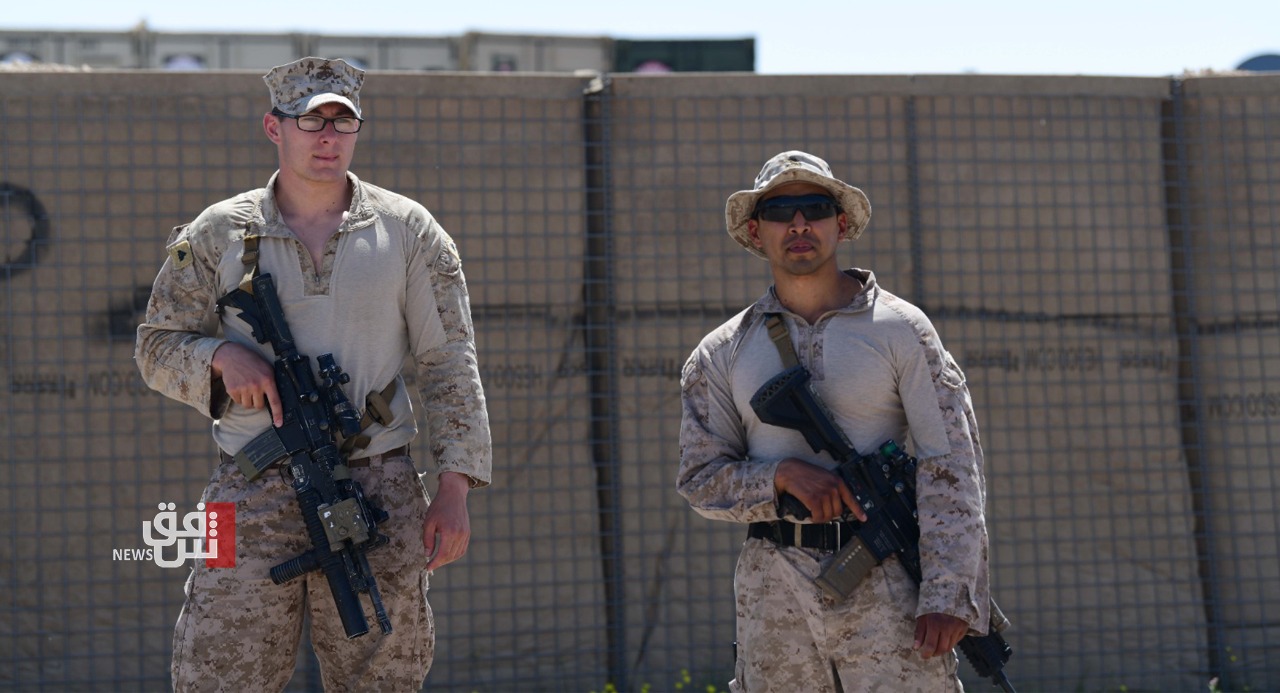 Shafaq News/ The Quincy Institute concluded that there are two main questions prominently among Iraqis: Will foreign forces leave? And should they? The institute noted that Iraqis’ “complex and contradictory” views reveal the extent to which the uncertain future weighs on a nation still “incapable” of achieving national consensus. It added that Iraq’s reliance on US forces has hindered the development of its army.
The American Institute began its report, translated by Shafaq News Agency, by raising the question: “Why might US forces remain in Iraq indefinitely?” It presented a sketch of the scene at the Arab Summit a few days ago, where Arab leaders were welcomed in a city designed to leave a distinctive impression. As they entered the capital from Baghdad International Airport, they passed by the memorial that represents the site of the US raid on January 3, 2020, which killed Iranian Quds Force commander Major General Qassem Soleimani and the deputy head of the Popular Mobilization Forces, Abu Mahdi al-Muhandis.
The report noted that the US raid was carried out on Iraqi territory without the approval of the Iraqi government, which has intensified calls for the withdrawal of US and coalition forces. These demands continue to resonate strongly within the corridors of power in Iraq and on the Iraqi street.
The end of “Hard Resolve”
The report explained that the Combined Joint Task Force (CJTF), which has been leading Operation Inherent Resolve since 2014 to combat ISIS in Iraq and Syria, agreed, after delayed negotiations, to end its mission and disband its leadership in September 2025. However, it added that this does not mean a complete end to the foreign military presence in Iraq, as the agreement stipulates the continuation of military operations in Syria from an unspecified location until September 2026, in addition to a clause that allows for the establishment of “bilateral security partnerships in a manner that supports Iraqi forces and maintains pressure on ISIS.”
The report continued, “These two provisions—the continuation of operations in Syria from an undisclosed location, likely in the Kurdistan Region, and bilateral security partnerships within Iraq—are clearly dividing Iraq.”
While the report noted that some Shiite political and religious factions, particularly those backed by Iran, are demanding a complete and immediate withdrawal, others believe international military support remains necessary given the continued threat of ISIS and regional instability, particularly in Syria.
Shiite factions
The report quoted a former senior Iraqi government official as saying, “Some Shiite factions want coalition forces to remain for a long time, and pro-Iranian militias echo Tehran’s rhetoric. However, they are currently waiting for the outcome of the Iranian-American negotiations.”
He added, “At the same time, these militias fear Israeli assassinations of their leaders. Meanwhile, the Sudanese prime minister is talking in two faces. The Sunnis and Kurds, on the other hand, want foreign forces to remain, not only because of the ISIS threat, but also to counterbalance Iranian influence.”
However, the report stated that “there are those who believe that the presence of foreign forces does not represent a factor of stability, but rather a source of insecurity and foreign interference.”
In this context, the report quoted former minister and MP Dhiaa al-Asadi, who previously led the Sadrist movement’s Ahrar bloc, as saying, “The presence of foreign forces has never been a source of stability. Even if there are existential challenges threatening Iraq’s stability, confronting them requires national unity and regional and international cooperation, not a violation of international law and state sovereignty. For these reasons and others, most Shiite forces insist on the withdrawal of US forces as quickly as possible.”
Sunni position
In contrast, the report stated that Sunni Muslim positions range from indifference to cautious pragmatism, adding that many Iraqis, across their diverse sects and political orientations, support reaching an understanding on strategic arrangements through negotiation, rather than a hasty withdrawal.
He continued, “These complex and sometimes contradictory views demonstrate the weight of an uncertain future on a nation that is still unable to achieve national consensus.”
After noting al-Asadi’s doubts about the feasibility of any negotiations as long as foreign forces remain in the country, the report quoted him as saying, “All justifications and arguments for this presence lack a logical basis, and decisions must be based on the full national interest of Iraq, not on partisan, sectarian, or nationalist visions.”
Therefore, the report stated that “at the core of the debate surrounding the continued presence of foreign forces, two fundamental questions arise: Will the forces leave? And should they leave?” The report added that the answer to this question is “conditional and ambiguous,” but what is certain is that all foreign forces will withdraw if the Iraqi government requests it.
After recalling the call made by former Iraqi Foreign Minister Hoshyar Zebari to the international community during the ISIS invasion, requesting assistance in 2014, the report stated that this call was not a formal treaty or status of forces agreement, as occurred in 2009, but rather an emergency step to salvage the situation.
ISIS threat
Now, the report says, 11 years after that call, few people see ISIS as an “existential threat,” adding that the group’s remaining sleeper cells or extremist elements are being dealt with by Iraqi forces, having been trained and armed by coalition forces.
The report continued, stating that the coalition’s mission was to provide advice and support until Iraqi forces were able to independently defeat ISIS, a situation that had been achieved years earlier. Therefore, many believe the time has come to end the foreign presence and withdraw the invitation extended to the coalition.
While the report questioned whether foreign forces should completely leave, it continued, saying that there is still a need for continued security cooperation in the long term, which may require a foreign presence on the ground. It noted that the new security agreement stipulates the formation of a military committee to review these issues on a regular basis, and allows for the possibility of some forces returning or remaining if necessary.
However, the report quoted al-Asadi as believing this was not necessary, adding that “creating a strong national army capable of defending the country is easier and better than relying on external support.” He added that self-reliance was the right choice after the bitter lessons Iraq learned from the five-year war against ISIS.
However, the former Iraqi official disagrees with al-Asadi on this point. The report quotes him as saying, “The responsible Iraqi position is to maintain a coalition force presence, but with technical and intelligence missions in cooperation with Iraqi counterterrorism forces, not as combat forces stationed in bases.”
He emphasized that “Iraqi forces are capable of dealing with a mid-level insurgency, but they are not capable of confronting a terrorist army like what happened in 2014. At its peak, ISIS fighters numbered approximately 100,000 on the Iraqi-Syrian front, and the army alone is incapable of confronting such a large force.”
Therefore, the report says that both al-Asadi and the former official’s views hold some merit, explaining that “the threat from ISIS has receded,” and that there is no need for a massive foreign force, especially since Iraq ranks sixth among the most powerful armies in the Middle East according to the Global Power Index, surpassing the UAE, Jordan, and Qatar. However, there are still significant gaps in the Iraqi army’s capabilities, particularly in air defense, fighter jets, air transport, and helicopters, in addition to the heavy reliance on intelligence provided by allied countries.
Iraqi army
The report continued, stating that Al-Asadi and the former official believe that the Iraqi army still needs to mature and develop, and the difference concerns the means to achieve this: Will development be internal or through external support?
The report concluded that after the Arab leaders’ summit, the debate over the future of foreign forces and the capabilities of the Iraqi army will return to the forefront, amid a turbulent regional situation, shifting alliances, and unresolved conflicts.
The report concluded by explaining that, in light of crises such as Gaza, the role of Iraqi militias outside state control, repeated violations of airspace and airstrikes, and the potential failure of nuclear negotiations between Washington and Tehran, Iraq is in dire need of a robust security system. However, the question remains: “Who will protect Iraq’s future? The external coalition or the national army?”
shafaq.com
