Trump redraws Middle East alliances, and a “silent message” puts Iraq in the shadows.
Trump redraws Middle East alliances, and a “silent message” puts Iraq in the shadows.
2025-05-19 04:27
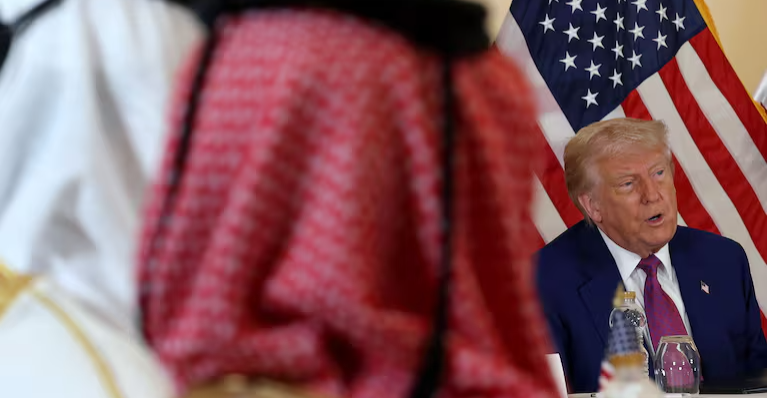 Shafaq News/ On his first Middle East tour since leaving the White House, US President Donald Trump landed in the heart of the Gulf. However, while his meetings were divided between Riyadh, Doha, and Abu Dhabi, Iraq’s absence from his agenda was a clear sign of a reshaping of the balance of influence, and perhaps Baghdad’s marginalization from the new regional equation.
The visit focused on achieving a set of economic and geopolitical goals pursued by Washington. On the economic front, Trump was keen to strengthen investment and trade partnerships with his Gulf allies, with his agenda including major trade agreements and mutual investments in technology, energy, and infrastructure. Through this tour, Washington sought to consolidate its regional influence and ensure that no vacuum is left open to exploitation by competing powers.
This included discussing the future US role in regional security, emphasizing the importance of ensuring stability and containing conflicts by supporting regional allies and mediating hot issues such as the Palestinian-Israeli conflict. The tour also represented an opportunity to push more countries in the region toward the Abraham Accords for peace with Israel, as Trump discussed expanding the normalization framework with the participation of Saudi Arabia, which has not yet formally joined the agreements.
In general, the analyses of American experts who spoke to Shafaq News Agency expressed that Washington seeks, through this visit, to establish a new Middle East centered on Riyadh and to limit the influence of its adversaries, through a close economic-security alliance with the Arab Gulf states.
One of the most striking observations of Trump’s Middle East tour is the exclusion of Iraq from its itinerary. Analysts have attributed this marginalization to strategic considerations related to Iraq’s current political position. Unlike the Gulf states allied with Washington, Iraq is in a situation that makes it a lower priority on Trump’s agenda; its influence “is under clear Iranian hegemony,” placing it at odds with the new American orientations.
At the heart of the scene: interests first
The tour was not merely a protocol appearance by a president seeking to regain the limelight. Rather, analysts see Trump as drawing a new map for the region, one based on a clear pragmatic logic: the economy first, and strong allies before faltering ones.
“It was a balanced plan, but it focused on Saudi Arabia and Qatar as key players in shaping the dynamics of the region,” says Frank Musmar, chairman of the University of Maryland’s advisory board.
He added to Shafaq News Agency: “Iraq has become a symbol of an old chapter of American interventions that no longer fit Trump’s rhetoric, neither politically nor populistically.”
The US president, who has long expressed his frustration with “endless wars,” seemed committed to his traditional approach: reducing military engagement and expanding influence through economic and energy partnerships. In this context, Mismar explains that ignoring Baghdad was not merely a diplomatic coincidence, but a calculated decision aimed at avoiding the complexities of the confusing Iraqi situation and sending a message to the political class there: the time has come to make sovereign decisions.
Mismar believes that the US administration deliberately ignored Baghdad during this round, citing dissatisfaction with Iraqi decision-making being dependent on the Tehran axis, as well as the country’s internal instability. Instead of Baghdad, Trump preferred to focus on the Gulf axis, which is more aligned with his policies, holding summits with Riyadh, Abu Dhabi, and Doha to maximize shared security and economic gains.
This American disregard has raised questions within Iraq, but observers believe it is a veiled message to the Baghdad government that it must reduce its dependence on the Iranian project if it wants to play a role in the new regional arrangements.
From marginalization to structural absence
Iraq’s absence from the tour’s agenda was not merely a diplomatic coincidence. From an Iraqi perspective, Baghdad is no longer viewed as an effective strategic ally in the new Middle East arrangements.
Dr. Ihsan Al-Shammari, a professor of political thought at the University of Baghdad and head of the Iraqi Center for Political Thought, told Shafaq News Agency that linking Iraq to Iran in US policy documents was one of the reasons for its absence. He pointed out that the national security memorandum signed by Trump to increase pressure on Tehran did not separate Iran from Iraq, which weakens the chances of dealing with Iraq as an independent issue.
He added, “It seems that Washington does not view Iraq as an entity separate from the Iranian influence network, but rather considers it part of the US-Iranian negotiating spectrum, whether regarding the future of sanctions or the US military presence.” He pointed out that, in light of this perception, Iraq has become part of a potential confrontation arena between Washington and Tehran, or even between Tel Aviv and Tehran.
But Al-Shammari doesn’t hold Washington solely responsible. He also points to Iraq’s weak foreign policy performance, saying, “The Sudanese government has failed to restore the principle of balance, and its foreign policy has moved closer to Tehran at the expense of Arab and international relations, which has contributed to widening the gap with Washington’s allies.”
He added, “There is also a flaw in the Iraqi government’s handling of the major developments in the Syrian file, and a clear absence of new regional understandings that often take place behind closed doors.”
Al-Shammari concludes that there is a growing international conviction that Iraq is no longer an active player in the new Middle East. Indeed, “some Iraqi political forces are deliberately excluding Iraq from these arrangements, in line with foreign agendas that do not want it to be open or active.”
Iraq OUT.. Syria IN
But if Iraq was absent, the surprise came from Damascus. In a scene observers described as “historic,” Trump shook hands with the new Syrian president, Ahmed al-Sharaa, in Riyadh, announcing the gradual lifting of US sanctions on Syria.
“No president other than Trump could have taken this step,” Radwan Ziadeh, a Syrian researcher in Washington, told Shafaq News Agency. He noted that the “unprecedented” move opened the door to reintegrating Damascus into the regional and international order.
Tom Harb, director of the American Middle East Alliance for Democracy, went further, arguing that Trump had “transferred Syria from the Turkish embrace to the Saudi embrace,” and that any future security breaches there would be Riyadh’s responsibility.
However, this proposal does not enjoy consensus. Ziadeh himself considers talk of Syria transitioning from one camp to another a “misleading simplification,” and points to joint coordination between Ankara, Doha, and Riyadh to push for this shift.
Riyadh… From Shadow to Light
It wasn’t just Sharaa’s handshake that caught the eye, but also Trump’s repeated references to Saudi Arabia’s growing role, not only in Syria but across the Middle East as a whole. According to Paulo Van Schirac, president of the Washington-based Institute for Global Studies, Trump’s visit “came within the framework of a plan to redistribute roles,” with Saudi Arabia now viewed as the new champion of regional stability.
However, Chirac warned, in an interview with Shafaq News Agency, against “being carried away by optimism,” noting that the reality on the ground in Syria remains fragile. From prisons run by the Syrian Democratic Forces to the refugee issue, there are still major questions outstanding, and no one has easy answers.
On the other hand, Sharaa faces the challenge of internal reconciliation with the Kurdish component in the northeast of the country. It remains unclear whether the new Damascus is prepared to make concessions on this sensitive issue.
Added to this is the enormous economic challenge of reconstruction and improving the lives of Syrians after the lifting of sanctions. These obstacles make the process of Syria’s regional and international reintegration difficult and protracted. Chirac believes that Washington and its allies will remain cautious about lifting all forms of isolation from Damascus before ensuring its genuine commitment to a comprehensive settlement.
Indeed, the limited US military presence in Syria will continue as a stabilizing and pressure factor, and will not be completely withdrawn unless actual stability and a comprehensive restructuring of the Syrian situation are achieved, something that “does not seem within reach,” according to Chirac.
Accordingly, it can be said that the post-Riyadh summit arrangements hold promising opportunities for Syria and the region, but they are also a challenge. The success of these new arrangements depends on the ability of the concerned parties to fulfill their security and political commitments on the ground, and to ensure that the ongoing regional transformations serve as a gateway to a sustainable solution, rather than merely a temporary deal on the Middle East chessboard.
pivotal moment
Whether the visit was an attempt to reposition itself politically or merely a symbolic move to improve Trump’s image abroad, what happened in the Gulf reflects real shifts in the mood of American power and in the mechanisms of alliance formation.
Trump did not announce detailed plans, but he changed the rules of the game. His failure to visit or make any actual reference to Iraq, his sudden embrace of Damascus, and his indication of a growing Saudi role are all indicators of a reshaping of regional alliances away from traditional entities.
While Tehran and Baghdad are waiting to see whether these shifts are merely symbolic gestures or more permanent changes, the American message is clear: those who do not move in line with new American interests may find themselves marginalized, analysts say.
shafaq.com
