The US State Department warns Baghdad: The Popular Mobilization Law changes the nature of our bilateral security partnership with Iraq.
The US State Department warns Baghdad: The Popular Mobilization Law changes the nature of our bilateral security partnership with Iraq.
2025-08-06
 Shafaq News – Washington
The US State Department confirmed Tuesday evening that Washington opposes the Iraqi parliament’s efforts to enact the Popular Mobilization Forces (PMF) law, noting that its passage would alter the nature of the bilateral security partnership with Baghdad.
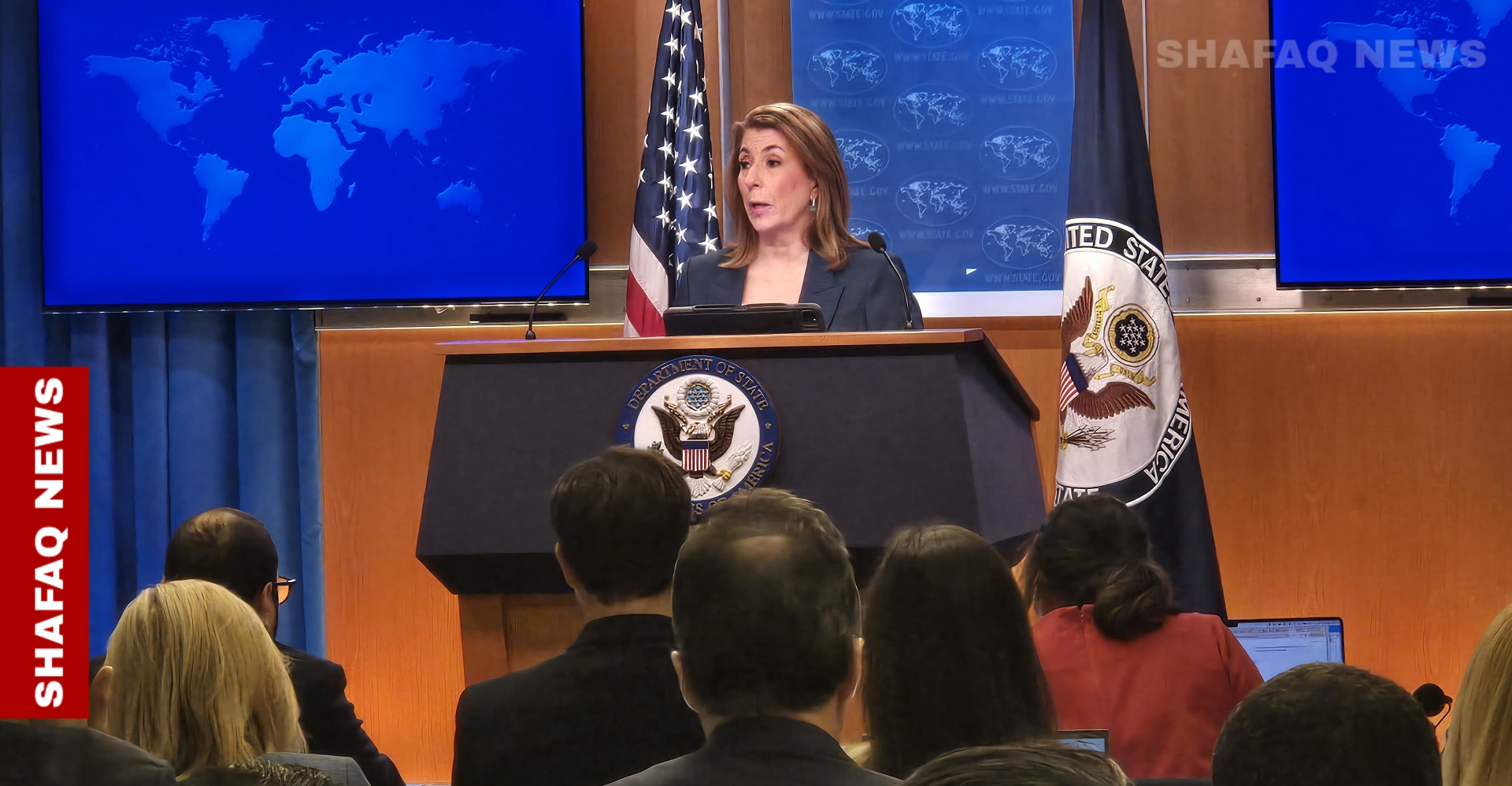
“We strongly oppose the legislation of the Popular Mobilization Forces (PMF) law, which empowers armed groups linked to Iran and terrorist organizations,” State Department spokeswoman Tammy Bruce said during a press conference in Washington, DC, attended by a Shafaq News Agency correspondent.
American researchers warned in a report published by the Washington Institute for Near East Policy that passing the Popular Mobilization Forces law would undermine Iraqi security reforms and provide legal cover for factions operating outside state authority, including groups designated by the United States as “terrorist organizations.”
The report, translated by Shafaq News Agency, called on the US administration to respond through multiple pressure tools, including imposing sanctions on PMF leaders close to Tehran, freezing some aspects of security cooperation with Baghdad, and linking military aid to the level of commitment to security reforms and the principle of state monopoly over arms.
The United States, through its embassy in Baghdad, also reiterated its concern over the passage of the Popular Mobilization Forces Law.
An informed political source previously revealed to Shafaq News Agency that the Popular Mobilization Forces (PMF) law, which was scheduled to be voted on during the current parliamentary session, will be postponed due to ongoing disagreements among political forces, particularly within the Shiite component, regarding the PMF’s structure and future role.
The source explained that “the current version of the law aims to integrate the Popular Mobilization Forces (PMF) as an integral part of the official military establishment, with a military leadership that is hierarchically aligned, a position rejected by some influential parties within the PMF.” He added that “political consensus has not yet been achieved, and the principle of mutual benefit and gains may be used to advance the law later.”
This postponement reinforces the statement made by Parliament Speaker Mahmoud al-Mashhadani, who confirmed the US’s explicit rejection of the law’s enactment in its current form.
Political sources also told Shafaq News Agency that “the United States is exerting diplomatic pressure to prevent its passage, fearing it would establish the Popular Mobilization Forces’ independence from the Iraqi army and grant legal legitimacy to factions that Washington considers terrorist groups.”
This proposal is consistent with what was recently revealed in a statement by the US State Department following a call between Secretary Marco Rubio and Iraqi Prime Minister Mohammed Shia al-Sudani, who conveyed the United States’ “deep concern” regarding the Popular Mobilization Forces (PMF) bill currently before the House of Representatives. Rubio emphasized that any such legislation would entrench Iranian influence and armed terrorist groups, undermining Iraq’s sovereignty.
This controversy comes nearly nine years after the Iraqi parliament first passed the Popular Mobilization Forces (PMF) law in November 2016, in response to ISIS’s invasion of Mosul and large swaths of Iraq. However, the previous law lacked organizational details, prompting some parties to push for a comprehensive amendment that would clearly define the PMF’s position within the security apparatus.
It’s worth noting that the Popular Mobilization Forces (PMF) were established by government decree in mid-2014 in response to the “sufficiency jihad” fatwa issued by Grand Ayatollah Ali al-Sistani following the fall of Mosul. Thousands of fighters from Shiite armed factions, some of whom had already been present before the fatwa, poured in.
shafaq.com
