Iraq: A “nation of industry” lost between oil and imports
Iraq: A “nation of industry” lost between oil and imports
2026-07-18
 Shafaq News – Baghdad
The Iraqi economy faces a crucial challenge in its ability to transition from an import-based model and near-total dependence on oil revenues to a productive economy with an industrial base capable of meeting part of the domestic demand, reducing the drain on foreign currency, and creating new job opportunities .
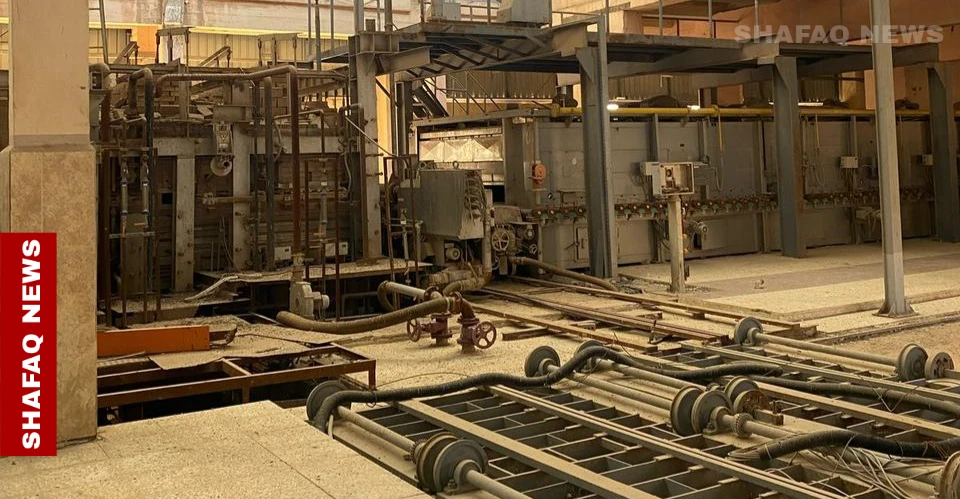
Despite Iraq possessing huge natural resources, a large consumer market, and a geographical location that qualifies it to be a link between the Gulf, Turkey, and Europe, the industrial sector still suffers from the effects of decades of wars, sanctions, neglect, and weak investment, after thousands of factories and plants went out of service and the contribution of industry to the gross domestic product declined to limited levels .
Experts believe that restarting the closed factories is not just an economic issue, but a project to reformulate the development model in the country, especially with the continued fragility of the economy in the face of fluctuations in oil prices, as the general budget depends on oil by nearly 90 %.
Between rising and stumbling
In this context, the Vice President of the Iraqi Federation of Industries, Aqeel Al-Saigh, says that the industrial sector has begun to witness a gradual return of some activity, stressing that thousands of factories have returned to work during the past period, in addition to the opening of new factories .
Al-Saigh adds to Shafaq News Agency that protecting local products was one of the essential tools to support industry, explaining that Iraq imposed customs procedures on a number of imported products that have a local alternative .
He continues: “We have put in place protection on Iraqi products that have similar imports, and we have imposed fees on cardboard at a rate of 100%, and on carpet at 65%. The support also included juices, cakes, cheeses, dairy products, single-use products, PVC ( the hard plastic used in pipes and windows), iron, and others .”
He points out that Iraq’s industrial exports have begun to include construction materials, iron, and metal cans used in the food and beverage industries, but he criticizes the continuation of some policies that he believes have weakened the local product .
He says: “We have always stayed away from the language of numbers because they are variable, but I can say that we have brought thousands of factories back to work, and the number of operating factories has reached about 37,000, while we still have about 35,000 factories that are shut down .”
He affirms that a large part of these factories has the ability to return to production, but it needs real government support and not just media measures .
He adds: “We had hoped that there would be a serious move to support the Iraqi economy and restore these qualified factories, but the management of governments and ministries was not serious enough, and it was often just media rhetoric .”
Missed opportunity
Al-Saigh believes that Iraq possesses great industrial potential that has not been properly invested in, especially in the petrochemical sector, which can provide raw materials for dozens of industries .
He says that burning associated gas represents a significant economic loss, because this gas could be turned into a source for large industries .
He explains that “this gas that is burned today can produce real gold, through petrochemicals and plastic granules, and from oil materials that are used in the industries of detergents, cosmetics and others can be produced .”
He adds that the absence of these industries has made Iraqi factories dependent on importing raw materials from abroad, which has raised production costs and weakened competitiveness .
He continues: “If these materials were available inside Iraq, many goods would be produced locally, and could even be exported to other countries .”
Importing serves production
For his part, Professor of International Economics, Nawar Al-Saadi, believes that Iraq’s transition from an import-dependent economy to a productive economy has become a strategic necessity and not merely an economic option .
Al-Saadi tells Shafaq News Agency that building a strong economy cannot be achieved while the country continues to rely on importing most consumer and industrial needs, and while local production capacities remain limited .
He emphasizes that the solution is not to close the door to imports, but to reorganize it to serve the national industry .
He adds that “imports should be directed towards providing the raw materials, technology and equipment needed by Iraqi industry, and not flooding the markets with products that can be manufactured locally .”
Al-Saadi identifies five main paths for economic transformation, the first of which is adopting a national industrial policy that identifies priority sectors such as food, pharmaceutical, petrochemical and building materials industries .
Secondly, protecting the national product in a well-thought-out manner by applying standard specifications and combating commercial dumping without harming the consumer .
The third path involves reforming the business environment by providing stable electricity, speeding up procedures, and developing the banking sector .
It points to the importance of linking education and vocational training to the needs of industry, as well as redirecting public spending towards productive investment instead of the dominance of operational spending .
Al-Saadi affirms that Iraq possesses the elements of success, but it needs a long-term vision that places production, exports, and the private sector at the center of the development process .
Industrial repair
For his part, economist Ahmed Adnan believes that industrial transformation cannot be achieved with a single decision, but rather requires a comprehensive package of reforms that begins with restructuring the stalled government factories .
Adnan tells Shafaq News Agency that one of the options being considered is to involve the private sector in managing these factories and transform them from a burden on the budget into productive investments .
He adds that Iraq needs to establish specialized industrial cities equipped with infrastructure and energy, in addition to developing petrochemical industries .
He points out that the Iraqi environment represents a great investment opportunity due to the country’s reliance on imports to cover about 80% of its needs .
He says: “If Iraq can produce these needs internally, it will not only reduce imports, but could also become a source for neighboring countries .”
He emphasizes that reforming the energy sector and developing agriculture are essential parts of the economic transformation, along with providing a safe environment for investors through clear laws, protecting capital, and involving large insurance companies .
He adds that the recent international openness to investment in Iraq, including official visits and contacts with global companies, may represent an opportunity to reintroduce the Iraqi economy to international markets .
Wealth waiting to be invested
Economic expert Mustafa Al-Faraj believes that the shift from a rentier economy to a productive economy is possible, but it requires a clear political will and smart investment in natural resources .
Al-Faraj, speaking to Shafaq News Agency, points out that Iraq possesses untapped mineral wealth, including silica sand, which can be the basis for multiple industries .
He says that building a strong industrial base requires supporting local industry through well-considered customs protection for products that have a local alternative, providing tax incentives and soft loans to factories, establishing specialized industrial zones equipped with energy and services, and developing transport, port and logistics networks to reduce production and export costs .
Al-Faraj concludes by emphasizing that the exploitation of natural resources should not be limited to their extraction, but should also include transforming them into value-added industries that provide jobs and support exports .
shafaq.com
