“A new Middle East is taking shape”: Washington is betting on the Kurds between Iraq and Syria to reduce Iran’s influence.
“A new Middle East is taking shape”: Washington is betting on the Kurds between Iraq and Syria to reduce Iran’s influence.
2026-07-11
 Shafaq News – Special Translation
A new Middle East is taking shape based on trade and interdependence rather than reliance on military power alone, according to an American vision, as explained in an analysis published by The National Context . The analysis indicated that this vision includes linking Iraq, Syria, and Turkey, which contributes to weakening Iranian influence, while the Kurds have become a guarantor of this new regional order.
The Erbil-based website said in a report issued in English and translated by Shafaq News Agency that the new regional system is based on the idea of the state, noting that the Kurdistan Region agreed, for the first time, to adopt a unified customs system under the supervision of the federal authority, so that its oil exports pass through the state-owned SOMO company.
He added that, within this framework, the Kurdistan Democratic Party and the Patriotic Union of Kurdistan are viewed as separate local partners and actors within the new structural system, and not as two halves within a single regional government.
The report addressed what it described as the “pivot doctrine,” which refers to a US-led economic security structure between Iraq and Syria, or Mesopotamia and the Levant, reflecting the regional application of the National Security Strategy issued by the US administration in December, which affirms that energy and the economy are the tools of US power in the Middle East, and views the region as a destination for investment, not a military burden.
According to the report, the appointment of Tom Barrack himself reflects this vision, as he assumes the position of ambassador to Turkey, in addition to being a special envoy to Iraq and Syria, making him responsible for the three files, indicating that the agreements that followed with Chevron and HKN in Iraq, and ConocoPhillips in Syria, reflect a practical application of this strategy.
He added that Turkey, within this system, is not just one of the three equal countries, but also represents the market, the transit center, and the gatekeeper of security. The peace process it is leading with the Kurdistan Workers’ Party is supposed to determine whether the Kurdish networks will act as a link or remain a source of threat. He considered that the goal is to shift the center of gravity towards the infrastructure, and to move from the principle of holding territory to controlling the systems that make that territory effective. This crystallized during the war with Iran and the closure of the Strait of Hormuz, which showed the extent to which regional energy depends on a single chokepoint.
The report explained that the corridors currently being established through Syria and through Turkey aim to eliminate this dependency, noting that the fall of the Assad regime made the Syrian corridor possible, after it was replaced by a government allied with Turkey. This process allowed Washington to direct Iraq’s connectivity through Syrian and Turkish territory away from Iranian influence, thus reducing Tehran’s influence in Iraq through a route not linked to the Iraqi government itself.
He pointed out that a new American approach is taking shape across these three countries, relying less on direct military force and more on interconnection, energy corridors, economic integration, and sharing regional burdens. He added that these issues are no longer being managed as separate tracks, but rather simultaneously to achieve a common goal of limiting Iranian influence, creating alternative routes for trade and energy, and more closely linking Iraq and Syria with Turkey and regional networks allied with the United States.
The report also addressed how Turkey frames the peace process with the Kurdistan Workers’ Party (PKK), presenting it not as a local settlement, but as a necessary process for achieving regional stability. It noted that the report of the parliamentary committee responsible for this process invokes the figures of King Saladin and Sultan Alp Arslan, to frame the Kurds and Turks as historical partners, and views the Kurdish populations in neighboring countries as part of the same issue, so that the Kurds throughout the region become a source of Turkish influence, rather than being viewed as a security responsibility.
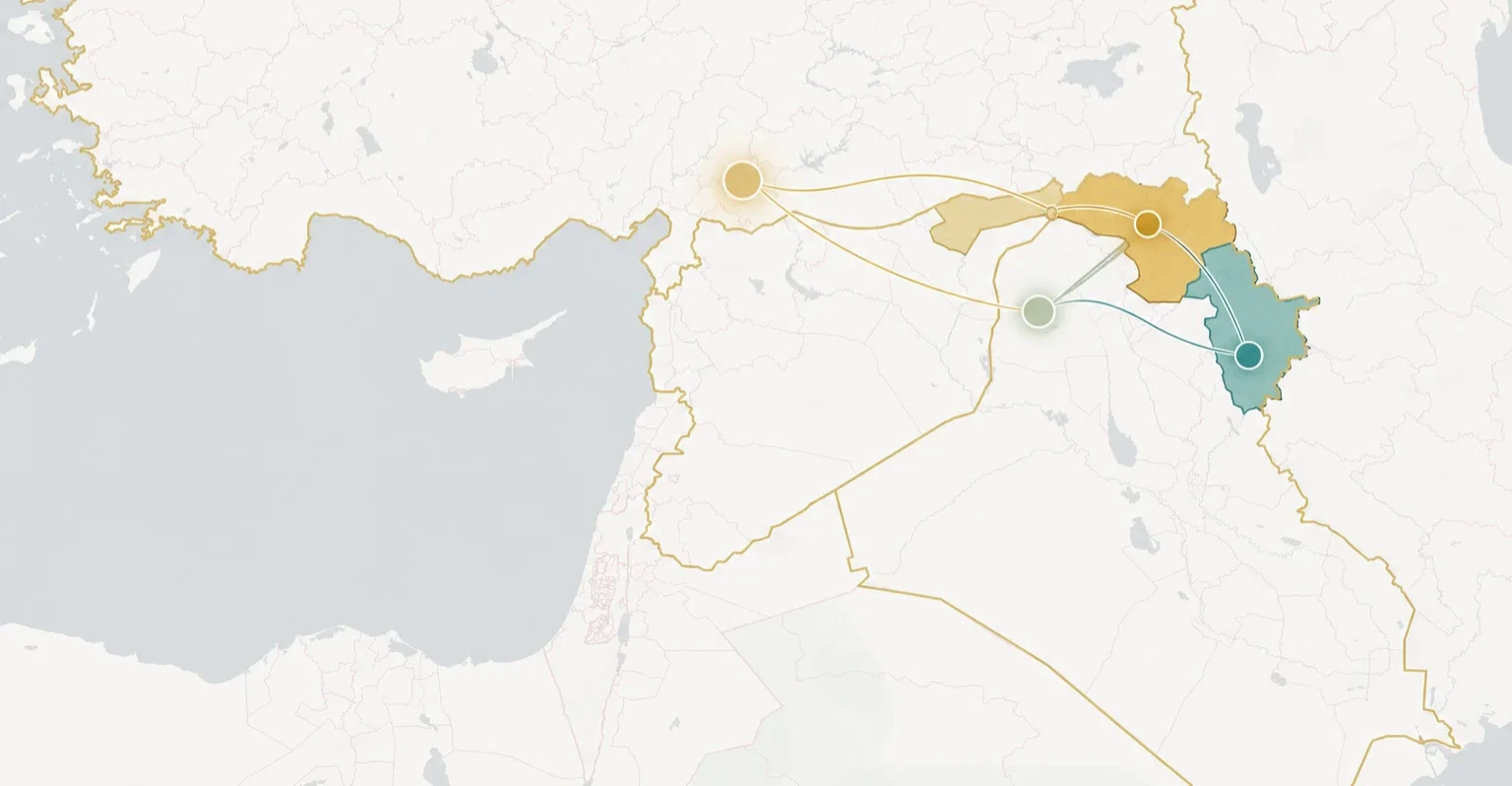
According to the report, the American and Turkish approaches intersect in this framework, describing them as “not identical, but compatible,” noting that the Kurdish actors have become, within this emerging framework, important nodes, but the Kurds are not dealt with as a unified bloc, but rather as separate actors, each with a specific role, indicating that this idea appears more clearly in Iraq, especially in the roles of the Kurdistan Democratic Party and the Patriotic Union of Kurdistan.
He pointed out that oil is mainly concentrated in the areas of influence of the Kurdistan Democratic Party, along with the Ibrahim Khalil crossing and the pipeline linking it to the Turkish port of Ceyhan, while gas, which has become more important, is almost entirely concentrated in the areas of influence of the Patriotic Union of Kurdistan. He stressed that this reality gives both parties special importance, but at the same time it strengthens the position of the Patriotic Union of Kurdistan, because gas has become at the heart of the next stage of regional energy plans.
In this context, he noted the expansion of the production capacity of the Khor Mor field, the completion of the pipeline linking it to the Sulaimaniyah power plant, as well as the increase in gas sales from the Chemchemal field, stressing that this gas reinforces the trend aimed at reducing dependence on Iran on two levels; the first within Iraq, as it can replace Iranian gas that still feeds nearly a third of the electricity production in the areas under the control of the federal government, and the second through export to Turkey, coinciding with the end of Ankara’s contract to import Iranian gas, amounting to about 9.6 billion cubic meters annually, during this month.
According to the report, the Patriotic Union of Kurdistan (PUK) has also gained additional importance in the context of the peace process. It noted that its close relationship with the Kurdistan Workers’ Party (PKK) was previously a cause of strained relations with Turkey, but the current stage, which requires political management and regional integration, has made this relationship a useful factor, as it can help manage the relationship between the PKK, the Syrian Democratic Forces (SDF), and Turkey.
He considered that this does not mean that the Patriotic Union of Kurdistan replaces the Kurdistan Democratic Party, but rather that each of them plays a different role, explaining that the Kurdistan Democratic Party still constitutes a axis for the oil sector, for border interdependence, and for the Kurdish-Turkish network existing in Iraq, although this role has become narrower, while the Patriotic Union of Kurdistan has become more central in gas files, political channels through Sulaymaniyah, and managing files related to the Kurdistan Workers’ Party.
The report emphasized that within this broader framework, Kurdish actors have become regional linkages, positioned between Iraq, Syria, and Turkey, providing communication channels that states cannot use directly, or prefer not to use publicly. It explained that this explains why key Kurdish issues pass through Erbil and Sulaymaniyah, and not just through state capitals.
He noted that when the commander of the Syrian Democratic Forces, Mazloum Abdi, needs to discuss the future of the Syrian Kurds with Washington, the meetings are held in the Kurdistan Region. He added that Kurdish leader Masoud Barzani received Abdi and Tom Barrack at his residence in Pirmam during January, while Bafel Talabani received them near Sulaymaniyah in February, and Kurdistan Region President Nechirvan Barzani received them in June.
The report stated that the PKK disarmament ceremony was held near Sulaymaniyah, while also mentioning the existence of a permanent (American-Syrian-Turkish) “working group” in which Tom Barrack, who led the negotiations aimed at pushing the Syrian Democratic Forces towards integration into the Syrian army, is involved.
According to the report, Barak stressed the need for a single nation-state with which the United States would deal, and he also expressed his admiration for the Turkish peace process.
According to the report, all of this also explains why the two-year deadlock in the Kurdistan Regional Government’s cabinet has generated only limited external pressure, as oil continues to be transported from the Kurdistan Democratic Party’s fields regardless of who is running the cabinet, while gas is transported from the Patriotic Union of Kurdistan’s fields on the same basis.
He noted that this American vision carries one contradiction, which emerged during this week, namely that weakening Iran leads, in return, to strengthening Turkey’s power, indicating that US President Donald Trump described Turkey, during the recent NATO summit, as an “extraordinary ally,” and indicated that he would lift the ban on selling it F-35 fighter jets, while Israeli Prime Minister Benjamin Netanyahu said, on the same day, that this deal would destroy the regional balance of power.
The report added that the question raised after the Strait of Hormuz crisis is no longer whether Iranian influence will decline, but rather who will fill the void left by Iran, noting that Israel does not want Turkey to be the party to assume this role.
He concluded that the Kurds had become one of the pillars upon which the new regional order rested, and that the main strategy was based on strengthening connectivity through roads, pipelines, trade corridors, gas networks, ports, and political corridors.
The report concluded by saying that Kurdish actors have become one of the links that make this system possible, explaining that the Kurds “are not the architects of this system, but they have become part of the structure that brings Iraq, Syria and Turkey together within it.”
shafaq.com
