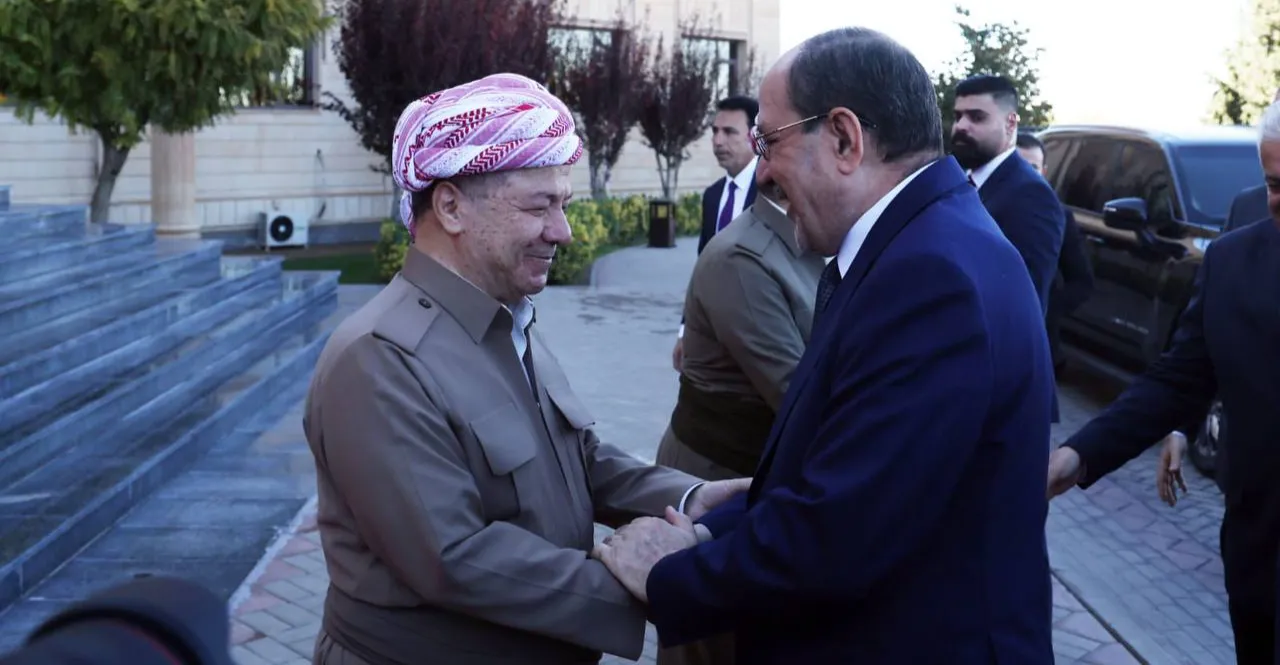
Maliki arrives in Erbil carrying with him the agenda for forming the new Iraqi government.
Maliki arrives in Erbil carrying with him the agenda for forming the new Iraqi government.
2025-11-22 00:15
 Shafaq News – Erbil
The head of the State of Law Coalition, Nouri al-Maliki, arrived in Erbil, the capital of the Kurdistan Region, on Saturday morning.
According to information available to Shafaq News Agency, Maliki will meet with Kurdish leader Masoud Barzani, Kurdistan Region President Nechirvan Barzani, and Regional Government Prime Minister Masrour Barzani to discuss the formation of the next Iraqi federal government.
Information indicates that Maliki, who is heading a delegation from the Coordination Framework, will also present to the leaders in Kurdistan, during this visit, the names of candidates to assume the positions of the next Prime Minister, President of the Republic, and Speaker of Parliament.
Deputy Prime Minister and Minister of Foreign Affairs in the caretaker government, Fuad Hussein al-Maliki, was received at Erbil International Airport.
Meanwhile, Hisham al-Rikabi, the media office director for al-Maliki, confirmed in a post on the “X-Twitter” platform (formerly), that the latter had arrived in Erbil in response to an invitation from the President of the Kurdistan Democratic Party, Masoud Barzani, to discuss many files related to the formation of the three presidencies, in addition to other issues.
Later, al-Maliki’s media office stated that he had met with the leader of the Kurdistan Democratic Party, Kurdish leader Masoud Barzani.
The office added in a statement today that the political situation and the results of the ongoing dialogues between the national forces were discussed.
The head of the State of Law Coalition pointed to the importance of continuing joint efforts to expedite the formation of the government to meet the aspirations of the Iraqi people, enhance stability, and protect the democratic process.
On the ninth and eleventh of November, Iraq held special and general voting in the parliamentary elections for the sixth parliamentary session, as part of a democratic practice in the political process that emerged after 2003 through the overthrow of the former Baath regime by the forces of the United States of America and its allies.
The Coordination Framework announced on November 17 the formation of the “largest parliamentary bloc” after the Independent High Electoral Commission announced the final results of the special and general voting.
On the same day, the Supreme Federal Court (the highest judicial authority in Iraq) decided to end the work of the House of Representatives and transform the government into a “caretaker government”.
It appears that the coordinating framework, which includes the ruling Shiite political forces in the country that secured the highest number of votes in the recent parliamentary elections, is seeking to finalize the formation of the next Iraqi government as quickly as possible and before the constitutional deadlines in this regard expire.
However, there are some obstacles that may prevent progress in these efforts, most notably the issue of appointing a new Prime Minister, or proceeding with renewing the second term of the current Prime Minister, Mohammed Shia Al-Sudani, who topped the lists of candidates in obtaining the highest number of votes.
shafaq.com
