An American institute warns against reproducing the “Maliki model” in Iraq.
An American institute warns against reproducing the “Maliki model” in Iraq.
2025-11-22 03:38
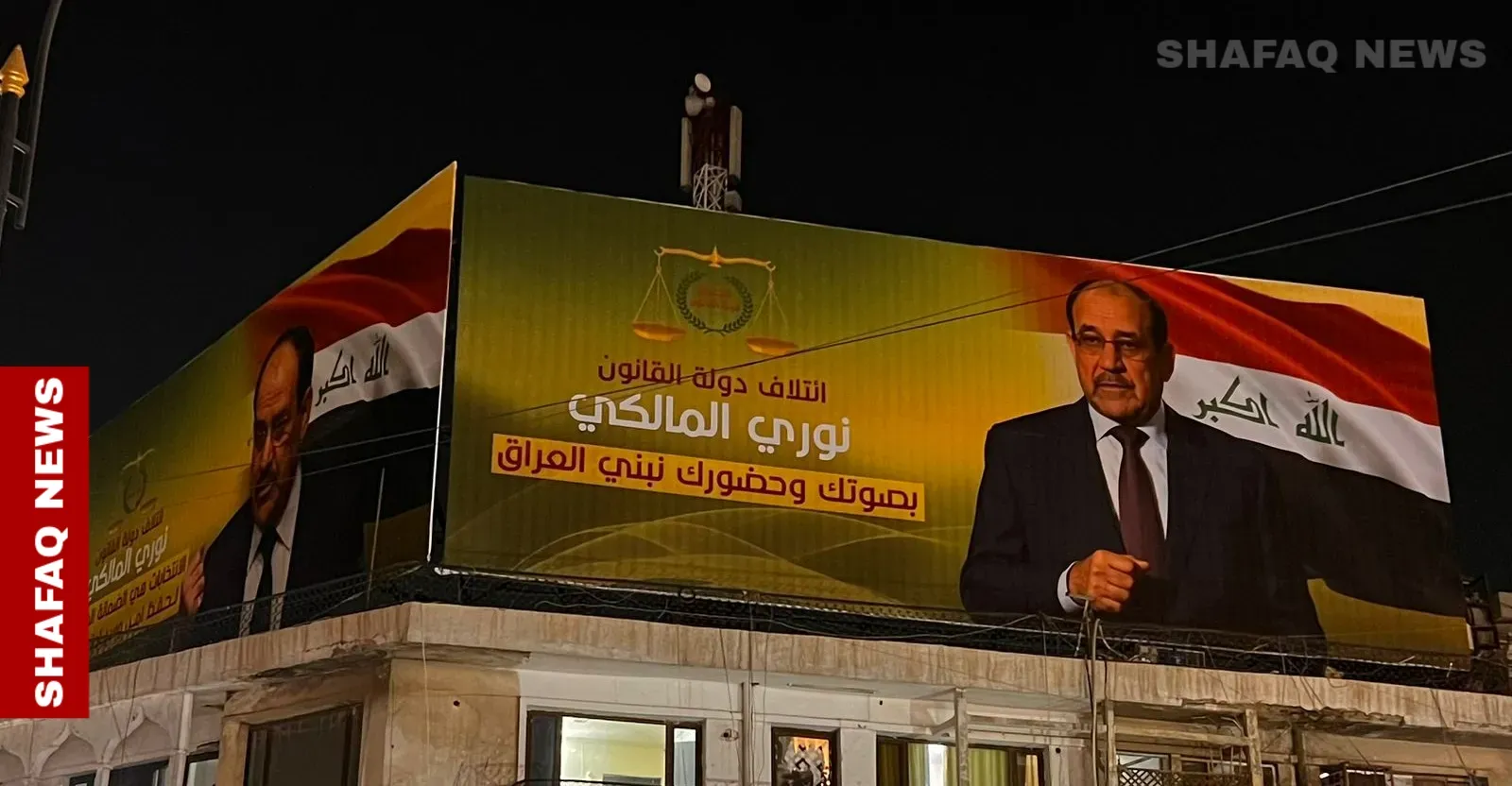 Shafaq News – Translation
The Arab Center in Washington raised the question of whether Mohammed Shia al-Sudani has a chance of assuming a second term as prime minister, while describing him as “fascinated by the trappings of power” and having a tendency to “violate civil rights,” raising concerns about a repeat of the Nouri al-Maliki experience. Therefore, the formation of a broad coalition like the one that brought the current Iraqi government to power is not ruled out, adding that the Iraqi political system is not ideal, but Iraqis are betting on continued stability in light of regional turmoil.
On November 11, 2025, Iraqis voted in their seventh parliamentary election since the fall of Saddam Hussein’s regime in 2003. According to the Iraqi High Electoral Commission, the election saw a turnout of 56%, a much higher percentage than previous elections. Although the judiciary has not yet confirmed the results, no party achieved a decisive victory.
The American Institute stated in a report, translated by Shafaq News Agency, that the most likely outcome of the November 11 elections is the formation of a broad coalition government, whereby a select group of Shiite parties will determine who will assume the position of Prime Minister. It added that the Iraqi political system after 2003 is not ideal, but Iraqis who lived through decades of dictatorship and violence paid a heavy price for the establishment of this system.
The US report noted that Iraq has recently achieved a degree of relative stability, explaining that it narrowly avoided being drawn into the war between Israel and Iran. Therefore, the report concluded that in order for the government to implement necessary internal reforms, Iraqis are counting on continued stability amidst regional turmoil.
The report argued that, no less important for Iraqis from diverse ethnic and sectarian backgrounds who suffered decades of one-party rule under the Baath regime, is avoiding the consolidation of power in the hands of one individual or party.
According to the report, in practice, Iraq has developed over the past two decades an informal consensus system based on ethnosectarian identity, similar to the Lebanese model in which the presidency is for a Maronite, the prime ministership for a Sunni, and the speakership of parliament for a Shiite.
After noting that no party has ever won a majority of seats in Iraqi elections since 2003, and that the closest any party came was in 2014 when a coalition led by Nouri al-Maliki won 92 seats, the report explained that even if one party wins 51% of the seats, parliamentary democracy in Iraq has strong safeguards that prevent a single party from monopolizing power. The election of the president requires a two-thirds majority in parliament, and then the president is tasked with choosing a prime minister-designate from the largest bloc in parliament. The report indicated that this was included in the constitution to protect the post-Baath state from the dominance of the majority and to impose a broad system of power-sharing.
While the report mentioned the formation of the Coordination Framework Coalition after the 2021 elections, which nominated al-Sudani to head the government, it said that despite the usual challenges facing the prime minister, including balancing the pressures of competition from Washington and Tehran, as well as governing a coalition of potential rivals, al-Sudani’s term will be largely remembered for his success in preventing Iraq from being drawn into regional wars after Israel’s war in Gaza after October 7, 2023.
Therefore, the report concluded that the question now is whether the Sudanese will be able to convince his political allies to grant him a second term, given that a second term would allow him to move forward with reconstruction and development projects.
But the report noted that al-Sudani is personally attracted to all the trappings of power and is prone to “violating civil rights,” and if he succeeds in winning a second term, a rare occurrence in Iraqi politics, it would raise concerns that he might exploit the opportunity to consolidate his power, as Nouri al-Maliki did before him, which would hinder the fragile democratic transition in Iraq.
The report went on to say that if al-Sudani fails, the next prime minister will likely be a consensus candidate acceptable to all political parties, who will also need to maintain Iraq’s security.
According to the report, Al-Sudani believes that his popularity will convince the coordinating framework to support him for a second term, noting that he is clearly counting on the infrastructure projects he has implemented and on the aspirations of the Iraqi people for basic services. However, the report indicated that winning electoral votes is only part of the equation for political success.
After noting that Maliki was the only prime minister to have served two terms in office since 2003, the report pointed out that Maliki’s story serves as a warning of the dangers that a second term in office could represent, including complacency, corruption, and overreach of power.
The report went on to say that this risk is becoming more acute in the presence of an emerging democracy like Iraq, adding that despite the effects of a turbulent, undemocratic neighborhood, Iraq has managed to hold several competitive elections with multiple transfers of power.
The report added that it could be argued that Iraq was more successful than Tunisia, which was once the best example of democratic transition after the “Arab Spring” but has returned to authoritarianism under President Kais Saied.
While the report stated that a one-term prime ministership is an important safeguard against the erosion of democracy in Iraq, it noted that al-Sudani is the first prime minister after 2003 who was not living in exile during the Baath regime.
According to the report, Al-Sudani’s entire life in Iraq was seen as a turning point in the democratic transition process, adding that, like millions of ordinary Iraqis, Al-Sudani suffered from international sanctions and the brutality of the Baath Party, and did not possess a second passport that would allow him to leave Iraq.
Therefore, the report stated that the Sudanese were accustomed to the social welfare policies that had been in place in Iraq for many years, noting that expanding these oil-funded policies, especially public sector employment, was no longer viable in light of the growing population.
The report discussed how, during his first 100 days in office, Al-Sudani showed no sign of continuing the reforms outlined in the White Paper prepared by Mustafa Al-Kadhimi’s government, which formed a roadmap to reduce Iraq’s dependence on oil, transform its economy, and protect it from the collapse of oil prices. Al-Sudani continued the path of mass employment in the public sector, relying on high oil prices throughout his premiership.
The report now says that because of his slim margin of victory, Sudani will have to shift his focus from convincing voters to vote for him to convincing the political elite to give him the opportunity to form a new government.
He went on to say that while al-Sudani may have ruled during Iraq’s most stable period in decades, he did not fail to create enemies. He was accused of illegal acts such as wiretapping his political opponents and developing a patronage network by appointing his brothers and cousins to positions in the Prime Minister’s office, which his opponents might exploit against him if they felt his bid for the premiership was too bold or that he was not allocating them enough positions in the new government.
According to the report, foreign influence has declined during government formation in Iraq in recent years, with a decrease in direct intervention from both the United States and Iran. It noted that the decline in American intervention is due to the United States being exhausted from Iraq, adding that Iran’s weakness is a result of direct Israeli attacks on its territory, the military defeat of the Lebanese Hezbollah, and the fall of the Assad regime in Syria.
He went on to say that a weak Iran could be in Sudan’s interest, as it has strengthened its ties with the West and demonstrated its ability to work with Western countries despite its political alliances with parties close to Iran.
He added that it remains to be seen whether the United States will seek to influence the formation of the new government, and whether a newcomer to the Iraqi political scene such as Special Envoy Mark Savaya will bear fruit.
The report went on to say that Iraq’s democratic transition has demonstrated its resilience, producing numerous leaders who have guided the country through a series of domestic and regional crises. It continued, stating that the role of the prime minister, from navigating broad coalition governments to managing relations between the bitter rivals of Tehran and Washington, is not easy.
The report noted that al-Sudani completed his term, but did not achieve enough to distinguish himself from other Iraqi politicians, adding that despite his strong performance in the elections, his record was not excellent enough to entice voters and give his party a majority.
He concluded by saying that whether Sudani returns now as prime minister or a new face takes over, the next prime minister will remain dependent on the coordination framework and the larger coalition that includes Sunni and Kurdish parties, a dependence that raises doubts about whether the new government will be completely different from its predecessor.
shafaq.com
