Minister of Industry: Anbar Desert has the largest phosphate reserves, estimated at 10 billion tons.
Minister of Industry: Anbar Desert has the largest phosphate reserves, estimated at 10 billion tons.
2025-05-22 04:54
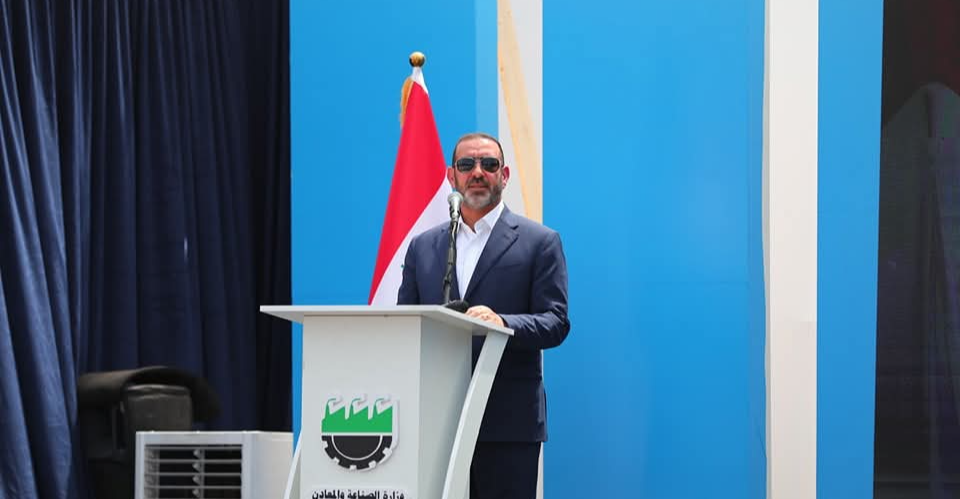 Shafaq News/ Minister of Industry and Minerals Khaled Battal Al-Najm laid the foundation stone on Thursday for the project to “construct and operate new integrated plants for the production of phosphate fertilizers” in Al-Qaim District, Anbar Governorate, western Iraq.
This vital project is being implemented in partnership between the State Phosphate Company, Asas Engineering Company, and East China Engineering Science and Technology Company, with a production capacity of 500,000 tons per year of triple superphosphate (TSP) fertilizer and one million tons per year of DAP fertilizer.
In a speech delivered on the sidelines of the foundation stone laying ceremony, the minister said, “This project is not merely an industrial one, but rather a beacon of hope and a cornerstone for launching major investment projects to exploit minerals in the western Anbar desert, which God has blessed with the largest phosphate reserves, amounting to 10 billion tons.” He indicated that the value of the “phosphate fertilizer plant construction project amounts to two billion dollars.”
“We have reached this important stage to begin actual work on the phosphate fertilizer project,” he added, adding that “other silica and phosphate projects will be announced soon.”
The Minister of Industry continued, “The silica projects will be announced at the Baghdad Investment Conference, which will be held from June 14-15. This will be an important platform for launching and announcing projects with complete transparency and competition based on the principles and standards of technical and financial capabilities, expertise, and similar work.”
Commenting on the project, economic expert Taha Al-Janabi told Shafaq News Agency, “The importance of the plant is not limited to employment or import substitution, but rather lies in redefining the relationship with Iraq’s natural resources.”
He explained that “phosphate is a resource that Iraq has been exporting as a raw material for decades, despite its high added value when manufactured locally. The new plant, if it adheres to modern industrial standards, could form the nucleus of a true transformation industry that relies on local resources.”
Al-Janabi warned that “the project’s success depends not only on its construction, but also on its ability to achieve actual, sustainable production and avoid what happened with previous projects that were halted after the establishment stages for administrative or financial reasons.”
It’s worth noting that Anbar Province, rich in natural resources, has not received major industrial investment for decades, despite its strategic geographic location, which makes it a hub of economic activity in western Iraq.
This project is expected to test Anbar’s ability to transform into an attractive industrial environment, particularly in light of the declared government interest and the clear presence of local and Arab capital.
shafaq.com
