The American gamble backfires in Iraq… Al-Zaidi weakens Trump’s campaign against the factions with a “new card”
The American gamble backfires in Iraq… Al-Zaidi weakens Trump’s campaign against the factions with a “new card”
2026-10-20
 Shafaq News – Special Translation
The American bet on Iraqi Prime Minister Ali al-Zaidi collapsed after he agreed to empower pro-Iranian factions within the government apparatus, according to an analysis by the Middle East Forum , which indicated that what is happening is the opposite of Washington’s expectations of al-Zaidi.
The American Institute explained in a report entitled “Washington’s Iraqi Gamble Failed,” translated by Shafaq News Agency, that the expectations of the administration of US President Donald Trump regarding al-Zaidi were correct, namely disarming the militias allied with Iran, restoring the state’s monopoly on force, creating favorable conditions for American commercial interests, and limiting Tehran’s exploitation of Iraqi sovereignty.
According to the report, the opposite is happening after only 4 months, as Washington’s bet on al-Zaidi, who continues to benefit from American financial and political concessions, has collapsed. The report adds that by embracing al-Zaidi’s government, Washington risks undermining its own strategy to dismantle Iranian regional networks.
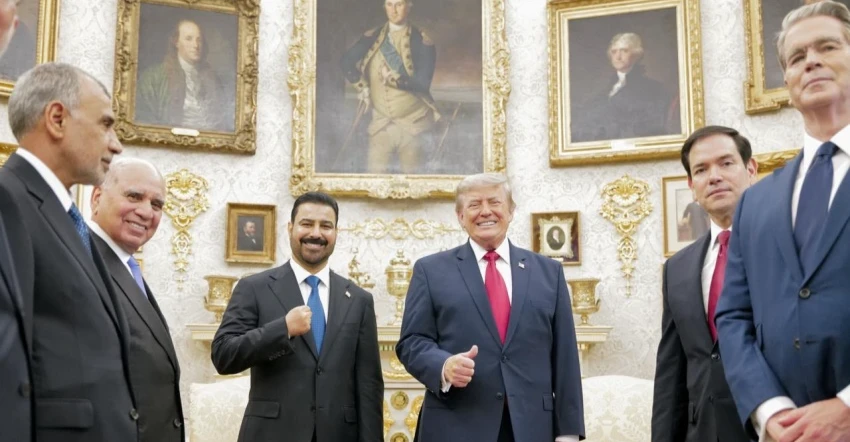
He noted that al-Zaidi pledged during his visit to the White House to disarm the factions by September 30, but this deadline passed without any action being taken, while his government failed to prevent militia attacks against neighboring countries and the Kurdistan Region, and also failed to stop cross-border “terrorist activity” involving Iranian and pro-Assad foreign agents using Iraqi territory.
The report criticized al-Zaydi for failing to exercise sovereign authority, as happened when the Popular Mobilization Forces mocked sovereignty by desecrating the American flag and raising the Iranian flag, while threats against American civilians continued and security forces had to escort American bloggers to the Kurdistan Region for their protection, while they asked a Wall Street Journal correspondent to leave the country to save his life.
He argued that a prime minister who cannot protect Americans cannot make credible promises of a safe environment for American investment.
The Middle East Forum addressed political arrangements that maintain the influence of the factions, explaining that al-Zaydi retained employees and advisors linked to the militias who had been appointed by former Prime Minister Mohammed al-Sudani, such as Hussein Allawi and the Prime Minister’s Chief of Staff, Ihsan al-Awadi, who promote the Prime Minister through the media.
According to the report, al-Zaydi appointed election losers from various political blocs to advisory positions and government leadership roles, such as advisor Ala Talabani and the acting head of the Iraqi Atomic Energy Commission, Thanaa al-Zajrawi, compensating the parties through a system of political and sectarian quotas.
The report also addressed the Al-Zaidi government’s tolerance of Tehran’s exploitation of Iraq’s economy and financial system to evade sanctions, noting that the system of patronage and selective enforcement of anti-corruption measures, and financial leniency, contribute to protecting political allies and factional control, and provide Tehran with channels through which it can maintain its influence.
The report spoke of a “political deal” that took place, relating to the timing of the announcement of the record budget, the end of ministerial divisions, and the appointment of Laith al-Khazali, affiliated with Asaib Ahl al-Haq, as deputy prime minister.
He pointed out that ministries such as artificial intelligence and tourism would serve as sites for armed factions to access state resources, while the artificial intelligence cooperation agreement between Iraq and Iran, signed during the era of Al-Sudani, would ensure that these ministries act as channels to assist Iran.
After mentioning the Coordination Framework’s announcement of the “State Leadership Council,” the report considered that al-Zaydi is moving from the hoped-for American role of confronting pro-Iranian factions and creating American-Iraqi opportunities, to working as Hezbollah calls him “treasurer,” where his interest now lies in securing American concessions that allow the factions to survive and move between American pressure.
Therefore, the report concluded that “voices in Washington calling for leniency and continued overlooking of this failure will weaken the broader American campaign against armed groups and political parties allied with Iran.”
According to this view, the factions are undermining American objectives, as it is unreasonable for Washington to “demand the dismantling of militias while simultaneously facilitating the financial channels and institutional arrangements that support them.”
The American report concluded by noting that this approach is losing American influence at precisely the right moment for Washington to apply it, adding that Washington must treat the new ministries and deputy prime minister positions as “terrorist entities and agents and refuse to engage with them.”
The Middle East Forum report concluded by emphasizing that Iraq must face a choice: “maintain the alliance with Iran and accept the consequences of financial isolation, or abandon the militias.”
shafaq.com
