Hinting at its “rejection”… Sudanese coalition: Al-Zidi’s agreements with Washington will be presented to the “framework” and parliament
Hinting at its “rejection”… Sudanese coalition: Al-Zidi’s agreements with Washington will be presented to the “framework” and parliament
2026-07-17
 Shafaq News – Baghdad
The Reconstruction and Development Coalition, headed by former Iraqi Prime Minister Mohammed Shia al-Sudani, confirmed on Friday that all agreements that Prime Minister Ali al-Zaidi will conclude with the US administration will be presented to the Coordination Framework, the State Administration Coalition, and the House of Representatives for approval or rejection.
Coalition member Ali Hussein Obeid Al-Fatlawi told Shafaq News Agency that “Iraqi political forces stipulated to Prime Minister Ali Al-Zaidi that in the event of concluding any joint agreements or understandings concerning a specific file or project, they must be presented to the House of Representatives to obtain legal approval, and therefore any plans or agreements outside the framework of the law cannot be passed.”
Al-Fatlawi indicated that “Al-Zidi’s return will be followed by a discussion of all the frameworks and understandings that were agreed upon during his visit to Washington, in a meeting with the Coordination Framework and the State Administration Coalition, to review the details related to those understandings, especially since some memoranda of understanding do not require the approval of the House of Representatives, while some agreements need to be re-examined and reviewed.”
Al-Fatlawi explained that “among the files that need to be reviewed is the file of American oil companies, as some of these companies are demanding $30 for every barrel of oil they extract according to contracts for the service and development of oil fields.”
He added: “While the cost per barrel in other contracts within the licensing rounds ranges between $6 and $9, this means that American oil companies will share the revenues obtained with Iraq if we assume that the price per barrel is $60.”
According to Al-Fatlawi, “This matter may lead to a state of oil monopoly or dominance, therefore these agreements must be presented to the House of Representatives and studied.”
He added: “In other words, everything Al-Zaydi has up his sleeve will be put on the table of the Coordination Framework, the House of Representatives, and the State Administration Coalition.”
Al-Fatlawi stated that “during the era of former Prime Minister Adel Abdul Mahdi, and according to an agreement with the International Monetary Fund, an agreement was made with China to deposit 100,000 barrels per day in storage facilities outside Iraq for the benefit of China, with the revenues to be deposited in a fund for the benefit of Baghdad.”
He explained: “As for the agreement with the United States in the same arrangement but with a higher oil ceiling of up to 500,000 barrels per day, and depositing its revenues in favor of Iraq, this is an exaggeration and needs to be balanced.”
Al-Fatlawi concluded that “Iraq will play a strategic role in resolving the crises in West Asia, and may play the role of mediator in resolving the American-Iranian dispute and in the region in general. This means that Iraq will regain the lead in addressing the region’s crises and contributing to controlling its security.”
An informed source revealed to Shafaq News Agency last Tuesday that Iraq will sign more than 18 agreements with the United States in various fields, including politics, economy, industry, energy, oil, education, health, investment and armament.
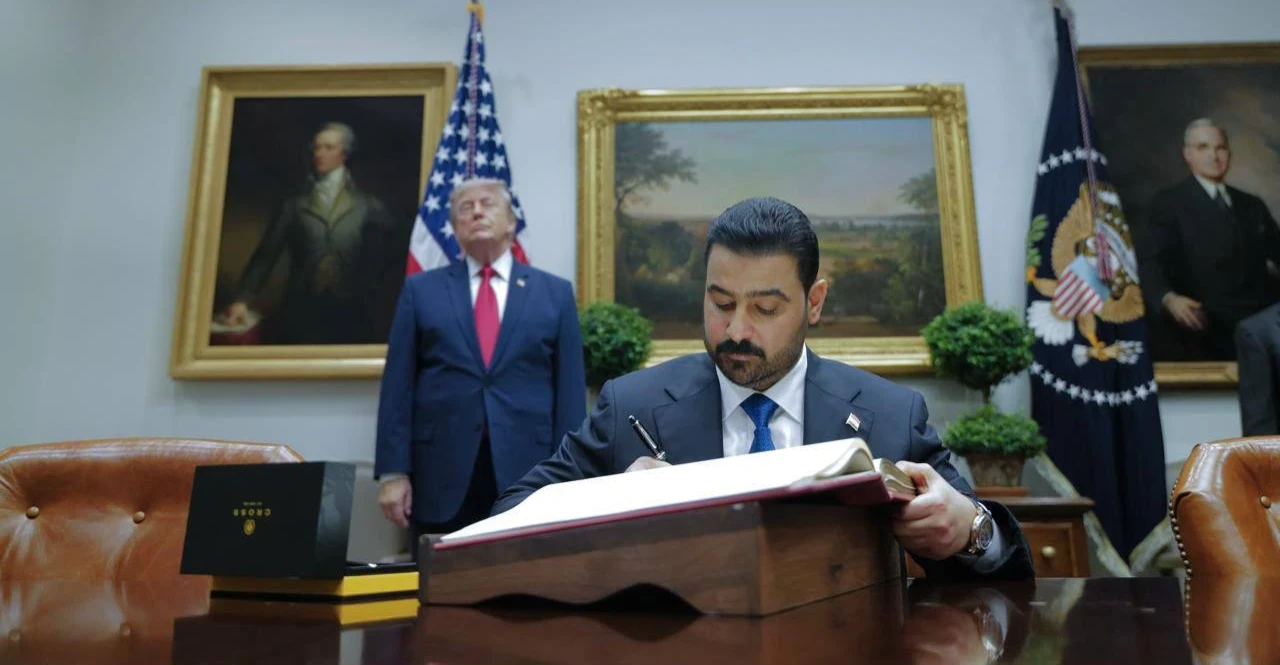
Iraqi Prime Minister Ali al-Zaidi is holding talks in the United States that began on July 13, 2026, in his first official foreign visit since taking office.
Al-Zaidi met with US President Donald Trump at the White House; the two sides discussed ending the US military presence in conjunction with the near conclusion of the international coalition’s mission, and affirmed Baghdad’s commitment to restricting weapons to the state by the end of next September.
Al-Zaidi and his accompanying delegation also held discussions in Washington to secure alternative routes for exporting Iraqi oil away from the Strait of Hormuz, in addition to signing several strategic memoranda of understanding aimed at strengthening the economic partnership, attracting major American companies to invest in the oil and gas sectors, and developing the energy infrastructure in Iraq.
shafaq.com
