“The collapse of the pretext” is behind the escalation by Iraqi factions… What awaits the resistance’s weapons after two months?
“The collapse of the pretext” is behind the escalation by Iraqi factions… What awaits the resistance’s weapons after two months?
2026-07-12
 Shafaq News – Baghdad/Washington
The rhetoric of escalation from a number of armed factions in Iraq has resurfaced in recent days, coinciding with rapid internal and regional developments, most notably the controversy surrounding the issue of restricting weapons to the state, and the anti-corruption campaign launched by the government.
In addition to the large funeral processions for former Iranian Supreme Leader Ali Khamenei in Najaf and Karbala, which political parties saw as an indication of the continued popular and political presence of forces close to Tehran.
The heightened rhetoric coincided with a critical phase in Baghdad, where Prime Minister Ali al-Zaidi’s government is attempting to pursue two parallel tracks: first, reorganizing the relationship between the state and armed factions and confining security and military decisions to official institutions; and second, pursuing corruption cases and recovering public funds, in steps that observers believe could redraw the balance of power within the Iraqi state.
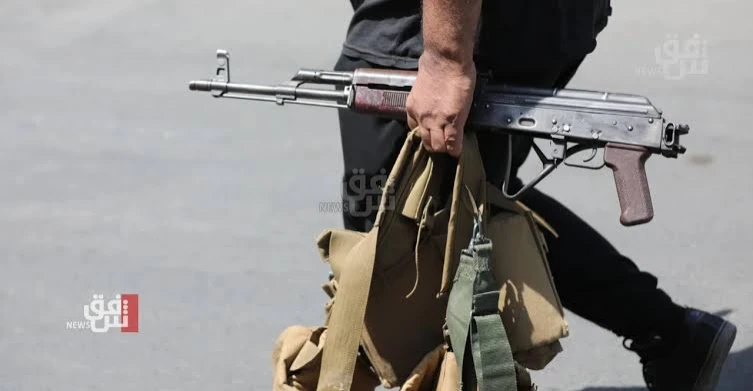
Observers believe that these developments have given the factions a new space to demonstrate their ability to mobilize the public, at a time when they are facing increasing pressure to redefine their role within the state, especially with the approaching deadline set by the government to complete the steps to restrict weapons, coinciding with the end of the international coalition’s mission in Iraq during next September. Thus, the “pretext” for clinging to weapons will have ended, with the end of the foreign presence in the country.
Escalatory speech
In this context, US Republican Party member Malik Aziz Francis says that the escalation of political and media rhetoric by some armed factions is a result of the overlap of internal and regional factors, noting that these forces realize that Iraq is going through a phase of rearranging political and security priorities.
Francis adds to Shafaq News Agency that the heightened tone of the rhetoric may be interpreted as an attempt to maintain presence and influence at a time of shifting power balances, as well as a message to demonstrate readiness and the ability to exert influence should the region witness a new escalation between the United States and Iran.
He points out that the state’s continued efforts to combat corruption, strengthen the rule of law, and monopolize the use of force impose a new reality on the armed forces, which may explain the rise in the level of political discourse of some of them during this stage.
But Francis rules out that escalating rhetoric necessarily means an imminent military confrontation, explaining that political and media messages are often used to manage crises and improve negotiating positions without necessarily turning into a direct clash.
The funeral procession is a message of presence
For his part, political affairs researcher Ramadan Al-Badran believes that the escalation of the factions’ rhetoric is “expected,” considering that increased pressure towards dissolving or restructuring these groups will be met with more hardline rhetoric and perhaps escalatory actions.
Al-Badran told Shafaq News Agency that “these factions do not have a program to dismantle themselves or dissolve their presence within the Iraqi reality,” noting that the current regional circumstances, especially the situation in Iran, make them need to maintain multiple pressure points.
He adds that any regional moves that use different arenas for pressure and negotiation may have repercussions on Iraq, considering that the uniqueness of the Iraqi situation lies in the fact that part of this challenge comes from within the Iraqi environment itself and not only from outside it.
Al-Badran believes that the recent funeral ceremonies constituted an important political demonstration, showing the existence of a social space within Iraq, especially in the Shiite environment, that interacts with the Iranian situation. He added that the challenge facing the government is how to address a long legacy of overlapping sovereignty and internal and external influence within a short period of time.
Weapons confiscation
These developments come amid government efforts to reopen the file on restricting weapons to the state, a file that has remained one of the most complex issues since 2003, and has become more prominent after 2014 following the war against ISIS and the establishment of a legal framework for the Popular Mobilization Forces.
Recent political studies indicate that the essence of the crisis is no longer related only to the presence of weapons outside the official institution, but to the nature of the chains of command and loyalties, as Baghdad believes that the state’s possession of weapons is not enough unless the decision to use them is subject exclusively to the General Command of the Armed Forces.
The government had announced its intention to adopt a gradual approach based on disengaging some factions from the Popular Mobilization Forces and reorganizing the relationship with security institutions. Factions such as Asaib Ahl al-Haq and Kataib al-Imam Ali announced their readiness to integrate within the framework of the state, while other factions, including Kataib Hezbollah, Harakat al-Nujaba and Kataib Sayyid al-Shuhada, refused to give up their weapons.
Local and regional motives
In this regard, political researcher Nawal Al-Mousawi believes that the return of the escalation rhetoric has local, regional and international causes.
Al-Moussawi told Shafaq News Agency that the local factor is related to an attempt to consolidate influence after the funeral ceremonies, which she described as a “large and remarkable public gathering,” noting that this may represent a message related to the next stage and the time limits set by the government regarding the restriction of weapons.
She adds that there is an attempt to maintain a balance in the face of the American role, especially after the issue of reorganizing the factions became directly linked to the relationship between Baghdad and Washington.
It also indicates that the regional variable, particularly the rising Turkish role and enhanced cooperation with NATO, may affect the calculations of the powers associated with Iran, while the international dimension is linked to tensions between Russia, Ukraine and the Middle East, making Iraq part of a wider network of rivalries.
Washington is watching
For his part, writer and Washington-based political science professor Nabil Mikhail says that the United States is closely monitoring Iraqi and regional developments and is seeking to see the negotiating track between Washington and Tehran continue.
In his interview with Shafaq News Agency, Mikhail ruled out the possibility of a large-scale military conflict between the United States and Iran at the present time, especially with the existence of mediation channels, noting that the priority lies in maintaining the ceasefire agreements and ensuring the security of navigation in the Strait of Hormuz.
On the other hand, political analysts believe that Iran views the issue of armed factions in Iraq as part of a regional influence system, and that any reduction in the role of these groups could affect one of its most important tools of influence in the region.
Scenarios for the next phase
While some observers believe that Iraq is entering a phase of redefining the relationship between the state and the factions, others believe that the most likely path is gradual containment rather than open confrontation.
In this regard, political analyst Khaled Walid says that there are no clear indications of an imminent escalation, considering that the factions’ messages represent manageable political positions, and that the general trend within the state is towards de-escalation and addressing issues through understandings.
Walid adds to Shafaq News Agency that the position of the political forces and the government regarding the restriction of weapons, the withdrawal of the international coalition and reform programs has become clear, and that the next stage will be towards containing the tensions.
For her part, Israa Najm, a member of the General Assembly of the Sadiqun Movement (the political wing of Asaib Ahl al-Haq led by Qais al-Khazali), affirms the movement’s support for Prime Minister Ali al-Zaidi in government work, noting that the anti-corruption file should include everyone whose guilt is proven by evidence and a judicial decision.
Najm concludes her remarks to Shafaq News Agency by saying that the movement’s position on the funeral ceremonies was clear, and that the participation reflected, in her opinion, broad unity within the Shiite community in receiving and mourning Khamenei.
shafaq.com
