As the heat intensifies, air conditioners disappear from Baghdad: Where did they go?
As the heat intensifies, air conditioners disappear from Baghdad: Where did they go?
2026-07-10
 Shafaq News – Baghdad
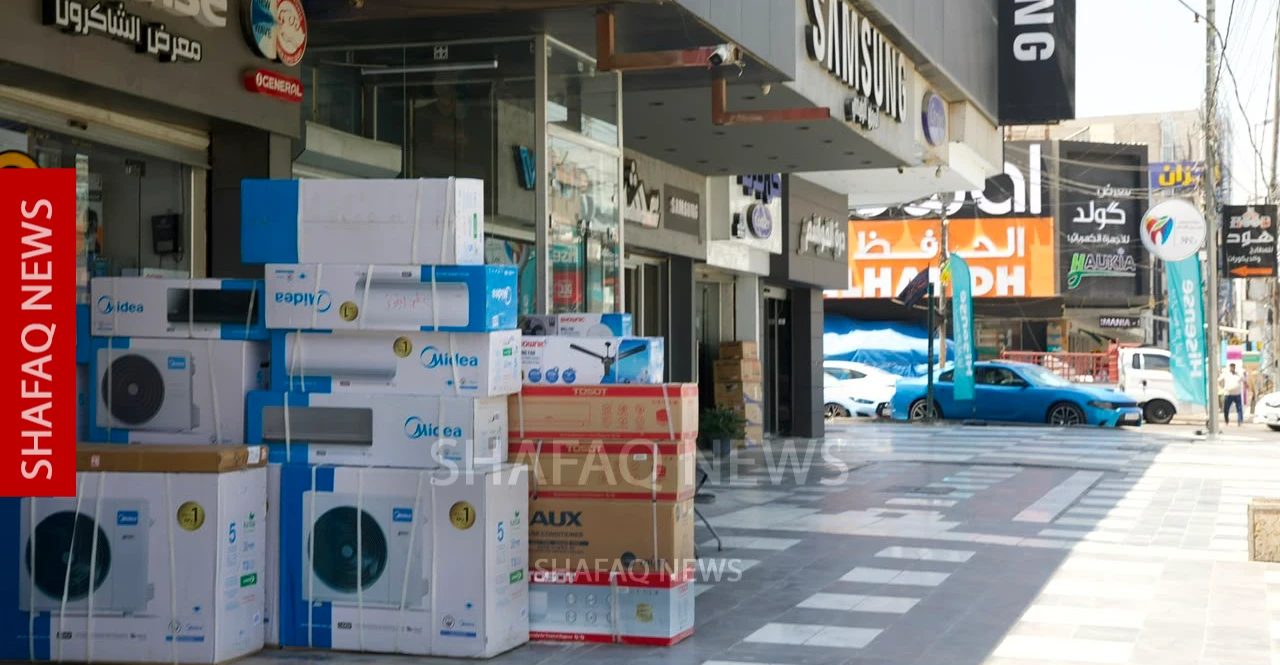
With the summer heat intensifying, the crisis for Iraqis is no longer limited to power outages, but has extended to the markets, which are now suffering from a clear shortage of electric cooling devices, especially “split” units of international brands, in addition to screens, freezers and other household appliances, amid an unprecedented rise in prices and the disappearance of many well-known brands.
Traders and citizens confirm that reliable devices have become scarce in the markets, while the prices of those that are available have sometimes doubled, at a time when importers attribute the crisis to the increase in shipping costs, the activation of customs tariffs, as well as the disruption of import activity after the recent developments in the Strait of Hormuz.
While shop owners talk about the decline in imports and traders’ fear of incurring large losses, the consumer finds himself facing two bitter choices: either buying low-quality devices that do not last long, or paying double the amount to get a device from a well-known brand, if it is available in the markets.
In this regard, Ahmed Muzaffar, the owner of an electrical appliance store in the Karrada area, told Shafaq News Agency, “The biggest problem facing traders right now is the cost of shipping, which is no longer stable, as it varies from one shipment to another.”
Muzaffar adds that shipping costs have increased significantly, which has been reflected in the prices of electrical appliances, with the increase sometimes being no less than 50%.
He explains that the device, which used to sell for less than one million dinars in the past, now costs one and a half million dinars.
According to Muzaffar, the problem is not limited to high prices, but also includes a shortage of goods, as importing electrical appliances has become very expensive, prompting some traders to avoid importing for fear of incurring losses.
He points out that the high prices make marketing devices more difficult, because the purchasing power of citizens has declined. Therefore, some traders prefer to postpone importing until the situation stabilizes. However, the first to be affected is the citizen who can no longer find reliable devices in the markets, and if he finds them, their prices have become very high.
Traders point to another problem: some containers remain at border crossings due to the fees and costs involved.
Trader Salman Dhiab told Shafaq News Agency that taxes and customs tariffs have prompted a number of company owners to “postpone the removal of their containers from ports or border crossings.”
For his part, trader Ali Abdul Aoun explains that reliable electrical appliances were previously available in most shops, but today only a limited number of companies provide them.
It shows that the prices of these devices have almost doubled as a result of the low supply and high demand. For example, the price of one type of split unit has increased from about 750,000 dinars to one and a half million dinars.
Conversely, citizens complain about the lack of devices from well-known companies, compared to the widespread availability of low-quality devices that break down quickly.
Citizen Wasan Ali (35 years old) from the Al-Jadriya area says that she searched for a long time for high-efficiency air conditioners produced by well-known international companies, but she did not find them in the markets.
Ali adds that the devices currently available are cheaper, of lower quality, and prone to breakdowns quickly, forcing many citizens to buy them due to the lack of better alternatives.
For his part, citizen Hussein Al-Abadi (48 years old) says that “most of the electrical appliances currently available in the markets are of low quality,” indicating that he bought several appliances during the past months that broke down after a short period of use.
Experts believe that the crisis is linked to several factors, including high import costs, customs tariffs, shipping fluctuations, as well as challenges related to trade.
In contrast, a source at the Umm Qasr port offers a different account, asserting that “the port is currently free of any accumulation of containers destined for the Iraqi market, and that ships unload their cargo immediately after docking to avoid fines.”
The source told Shafaq News Agency that “the containers currently present are transit containers destined for Turkey, and are not intended for the Iraqi market,” noting that “a number of ships are waiting outside the port to obtain permission to enter, in light of the developments related to the Strait of Hormuz crisis.”
In contrast, the Palm Center for Rights and Freedoms believes that the import complications are also related to Cabinet Decision No. (957) of 2025, issued on October 28, which activated the Customs Tariff Law that had been suspended since 2010, and imposed fees ranging between 5% and 30% depending on the type of goods, after fees were previously collected at a fixed amount ranging between three and four million dinars per container, regardless of the type of goods or their value.
shafaq.com
