With the Strait of Hormuz under threat, the Kurdistan-Ceyhan pipeline is a lifeline for Europe.
With the Strait of Hormuz under threat, the Kurdistan-Ceyhan pipeline is a lifeline for Europe.
2026-04-03 07:38
 Shafaq News – Special Translation
The strategic importance of Iraqi oil pipelines from the Kurdistan Region to Turkey is increasing, given the disruption or interruption of traditional pipelines, especially from the Strait of Hormuz, as geopolitical tensions escalate, revealing structural weaknesses affecting regional economies, according to the energy-focused website Discovery Alert.
Discovery Alert explained in a report, translated by Shafaq News Agency, that concentrating oil exports through limited routes creates structural weaknesses that affect regional economies far beyond the immediate production areas. However, Iraqi oil exports to Europe represent a crucial element of European energy security, demonstrating how alternative routing strategies can mitigate supply risks during periods of uncertainty.
According to the report, modern oil export systems focus on transporting huge quantities through limited routes, which creates inherent weaknesses that become clearly apparent during times of crisis. It notes that the volume of global oil trade reaches about 100 million barrels per day, with large quantities of it flowing through a limited number of strategic routes, a concentration that multiplies the impact of any disruption to any of these routes.
The report went on to say that calculations related to routes reveal that producers have invested heavily in diversification strategies, explaining that a 20% reduction in primary export capacity usually necessitates the use of secondary routes at a rate of between 200% and 300% to maintain similar volumes, assuming that these alternatives have sufficient capacity. Therefore, countries that rely heavily on oil revenues face existential financial challenges when primary export routes become unavailable.
He added that historical analysis shows that oil exporters who rely on oil for more than 80% of their revenues face severe economic disruptions during supply interruptions lasting more than 30 to 45 days.
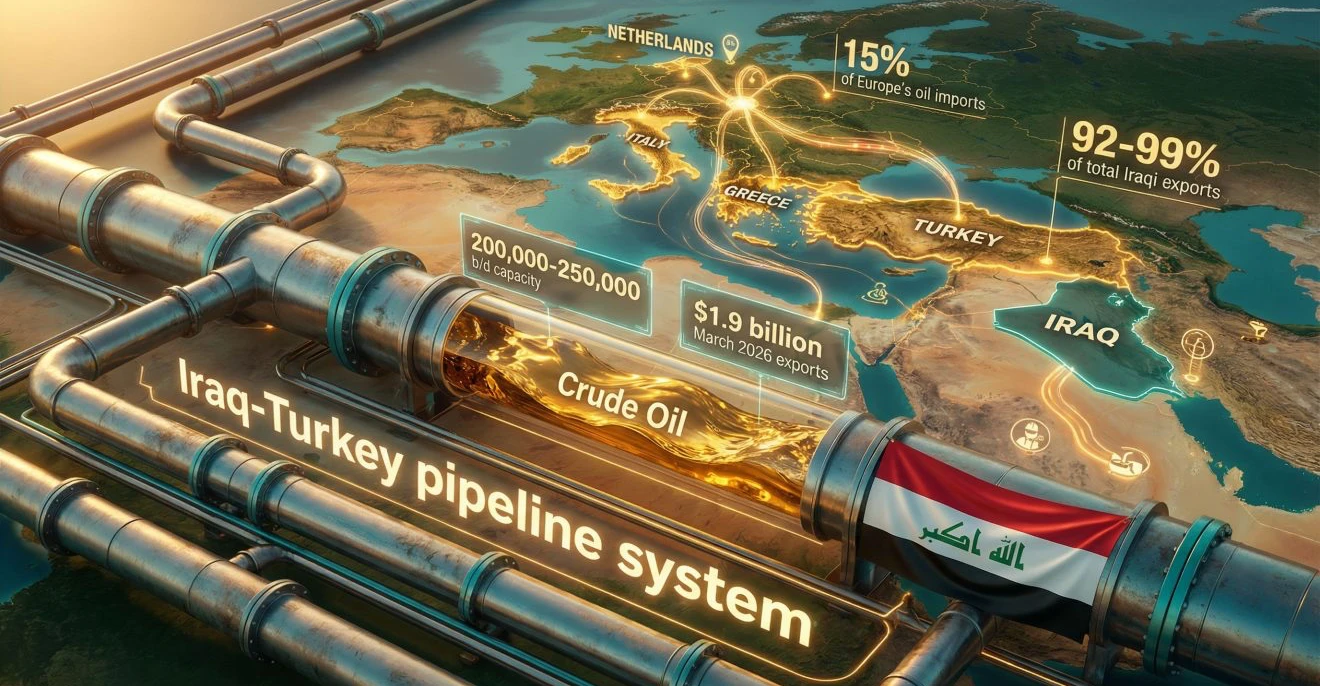
After highlighting the strategic investments in infrastructure along alternative routes, regardless of their higher costs per barrel, the report stated that the oil pipeline system between Iraq and Turkey exemplifies how secondary infrastructure can become of critical strategic importance during disruptions to main transport lines.
The report explained that this system, which has a capacity of between 400,000 and 550,000 barrels per day, has historically served as a supplementary export channel, but it demonstrates the importance of maintaining reserve infrastructure investments, especially in light of the expected rise in oil prices in 2025.
According to the report, the advantages of this line include direct access to the Mediterranean Sea and avoidance of maritime chokepoints, as well as enhancing European integration of distribution via Turkish terminals, along with operational flexibility that allows for rapid volume adjustments, in addition to quality assurance to prevent crude oil contamination during transport.
In general, the report stated that the technical specifications of pipeline systems provide clear advantages compared to alternative means of transport, explaining that the cost of transporting a barrel via pipelines usually ranges between $2 and $4, while the cost of transporting by truck ranges between $8 and $15 per barrel for similar distances.
However, the report considered that these cost differences become less important during times of crisis, when the availability of roads is more important than the economic feasibility of transportation.
The report stated that European oil import patterns reflect strategic diversification efforts aimed at reducing dependence on a single supplier or transport route, noting that the European continent imports about 12-15 million barrels per day, while oil sources from the Middle East constitute between 30 and 40% of the total quantities via different routes.
The report added that Iraqi oil exports continue to play a vital role in maintaining European energy security.
Regarding the diversity of Europe’s energy imports, the report stated that this includes Russian crude oil: 25-30% (before the 2022 sanctions), sources from the Middle East amounting to 30-35% via multiple routes, African sources at 20-25% from Atlantic basin sources, in addition to imports from North America.
The report stated that the Netherlands, Italy, and Greece are key European entry points for crude oil from the Middle East, with their refineries featuring specialized configurations designed to process specific types of oil. It added that Mediterranean refineries place particular importance on supply reliability due to their strategic location serving both European and regional markets.
The report noted that European energy security calculations are increasingly focused on diversifying supply routes rather than simply improving costs. It considered road transport by trucking to be the most flexible, but also the most expensive, alternative to pipeline systems for transporting oil, as transporting 50,000 barrels per day requires approximately 1,250 to 1,500 truck movements daily, highlighting the logistical complexity of expanding road oil transport.
According to the report, transporting oil by truck involves significant additional costs, but it provides operational advantages during times of crisis, as transportation costs typically range between $15 and $25 per barrel for distances exceeding 500 kilometers. It added that, for comparison, this represents a significant increase compared to the cost of transportation via pipelines, which ranges between $3 and $6 per barrel.
He pointed out that the regional cooperation framework allows for the use of shared infrastructure to the benefit of multiple countries, which provides an important strategic surplus during supply emergencies, which is crucial given the impact of the oil trade war on global supply chains.
The report addressed the categories of risks affecting export infrastructure, including military conflicts targeting energy infrastructure, political instability that disrupts cross-border agreements, technical malfunctions requiring long maintenance periods, and weather events affecting maritime and land transport.
The report explained that the 2019 attacks on Saudi Aramco facilities demonstrate how strikes can temporarily reduce global oil supplies by 5 to 6 million barrels per day, adding that they highlighted the vulnerability of concentrated production infrastructure and its impact on global markets.
He pointed out that modern conflict patterns show an increasing targeting of energy infrastructure as strategic objectives, and the attacks that occurred in 2022-2023 on energy infrastructure in Ukraine, as well as various pipeline incidents in the Middle East, demonstrate how energy systems become military targets during conflicts.
Strategic effects
The report stated that Iraqi oil exports to Europe are constantly evolving as geopolitical pressures reshape traditional supply chains, adding that regional stability factors are increasingly affecting Iraqi oil exports to Europe, as buyers prioritize supply chain reliability over cost reduction.
He concluded that these market dynamics provide opportunities for producers who can demonstrate their ability to deliver consistently through a diversified export infrastructure.
The report concluded by noting that Iraqi oil exports to Europe represent a highly important case study on how energy exporters adapt to geopolitical changes while maintaining their primary sources of income.
shafaq.com
