The Federal Supreme Court affirms the constitutionality of the Prime Minister’s actions.
The Federal Supreme Court affirms the constitutionality of the Prime Minister’s actions.
2026-11-25
 Shafaq News – Baghdad
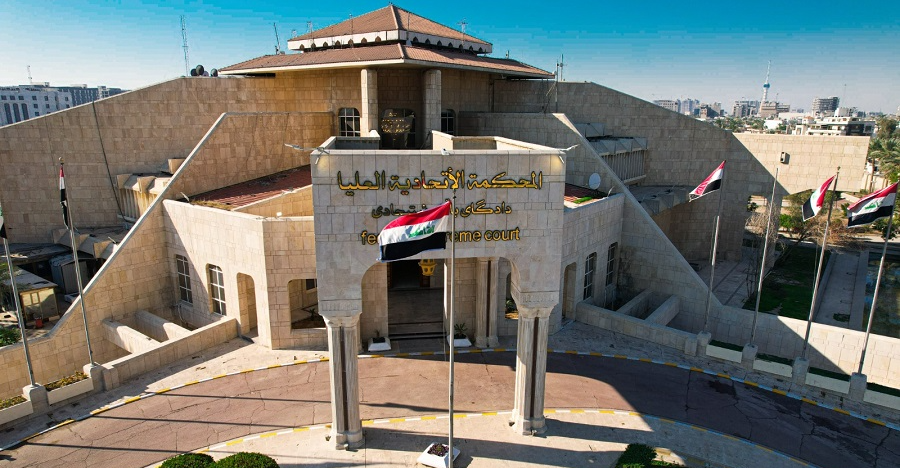
On Wednesday, the Federal Supreme Court, the highest judicial authority in Iraq, issued a ruling declaring the actions taken by Prime Minister Ali al-Zaidi towards the Kurdistan Region constitutional.
A court decision, reported to Shafaq News Agency, stated that its interpretative decision No. (268/Federal/2026) issued today was based on the Prime Minister’s request to the Federal Court to interpret some articles of the Constitution. The court finds that interpreting the constitutional texts requires confirming that the distribution of powers between the federal authorities and the regional authorities does not affect the unity and sovereignty of the state, nor does it lead to the fragmentation of the exclusive powers established by the Constitution, nor does it permit the suspension of shared powers or the violation of the coordination requirements mandated by the Constitution.
The court stated that, based on the provisions of Article (93/Second) of the Constitution of the Republic of Iraq of 2005, and Article (4/Second) of the Federal Supreme Court Law No. (30) of 2005 as amended, the Federal Supreme Court decided to interpret the constitutional texts subject to the request as follows:
First: Protecting, securing and defending the international borders of the Republic of Iraq is the exclusive responsibility of the federal authorities under Articles (109) and (110/Second) of the Constitution. The federal government has the authority to deploy and manage the federal armed forces and take the necessary measures to secure all of Iraq’s borders with neighboring countries, including the borders located within the territories administered by the Kurdistan Region.
Second: The federal authorities have the right to exercise their powers in supervising, monitoring and controlling the performance of the departments operating in all border crossings in the Republic of Iraq, including the crossings located within the Kurdistan Region, in accordance with the provisions of the Border Crossings Authority Law No. (30) of 2016 and related laws, taking into account the provisions of Article (114/First) of the Constitution regarding the administration of customs in coordination with the governments of the regions and governorates not organized into a region.
Third: Establishing a unified national system for automating border crossings and customs and linking them electronically to the relevant federal ministries and bodies throughout Iraq, including the crossings located in the Kurdistan Region, and setting the necessary technical, financial and customs standards and controls for their operation, falls within the jurisdiction of the federal authorities in formulating financial and customs policy and regulating trade policy across the borders of regions and governorates, according to Article (110/Third) of the Constitution, taking into account the coordination stipulated in Article (114/First) thereof.
Fourth: The management of extracted oil and gas is carried out in accordance with the provisions of Article (112/First) of the Constitution, and is undertaken by the federal government with the governments of the producing regions and governorates. The ownership of oil and gas belongs to all the people of Iraq according to Article (111) of the Constitution. The Federal Ministry of Oil and the competent federal regulatory bodies shall exercise their constitutional and legal powers in supervising, monitoring and auditing the fields, operations and contracts related to the production, extraction and marketing and export of oil and gas, in accordance with the constitutional provisions and applicable laws and the decision of the Supreme Federal Court No. (59/Federal/2012) and its unified (110/Federal/2019) issued on 2/15/2022. Contracts related to this shall be made by the competent authorities and in accordance with the law.
Fifth: The federal authorities, based on Article (110/Third) of the Constitution, have the right to formulate financial and customs policy, determine the controls and unified customs tariff, supervise the public revenues realized from fees, taxes and non-oil revenues throughout Iraq, including the Kurdistan Region, and audit, settle and deposit them into the public treasury in accordance with the applicable laws, and in a manner that does not conflict with the provisions of Article (114/First) of the Constitution regarding the administration of customs in coordination with the governments of the regions and governorates not organized into a region, and the decision of the Supreme Federal Court No. (224/Federal/2023) and its unification (269/Federal/2023) issued on 2/21/2024.
Sixth: The spatial scope of the exercise of the Kurdistan Region authorities is determined in accordance with the provisions of Article (53/A) of the Iraqi State Administration Law for the Transitional Period, which Article (143) of the Constitution of the Republic of Iraq of 2005 kept in effect. It includes the lands that were administered by the Regional Government on 3/19/2003 and located in the governorates of Dohuk, Erbil, Sulaymaniyah, Kirkuk, Diyala and Nineveh. The jurisdiction of the Regional authorities may not extend to the lands located outside that scope, taking into account the constitutional provisions related to the disputed areas contained in Article (58) of the aforementioned law and Article (140) of the Constitution.
Seventh: The management of lands located outside the defined spatial scope of the Kurdistan Regional Government’s jurisdiction and the exercise of constitutional, administrative and executive powers over them are the responsibility of the federal authorities, each according to its constitutional and legal jurisdiction. The actual administrative practice of the regional authorities outside that scope does not create a constitutional jurisdiction for them.
The decision was issued by majority vote and with two members dissenting, as a final and binding ruling for all authorities, based on the provisions of Articles (93/Second and 94) of the Constitution of the Republic of Iraq of 2005 and (4/Second and 5) of the Federal Supreme Court Law No. (30) of 2005 amended by Law No. (25) of 2021 and was publicly announced on 11/25/2026.
shafaq.com
