Security details for officials in Iraq: Billions of public funds and suspicious privileges
Security details for officials in Iraq: Billions of public funds and suspicious privileges
2026-11-25
 Shafaq News – Baghdad
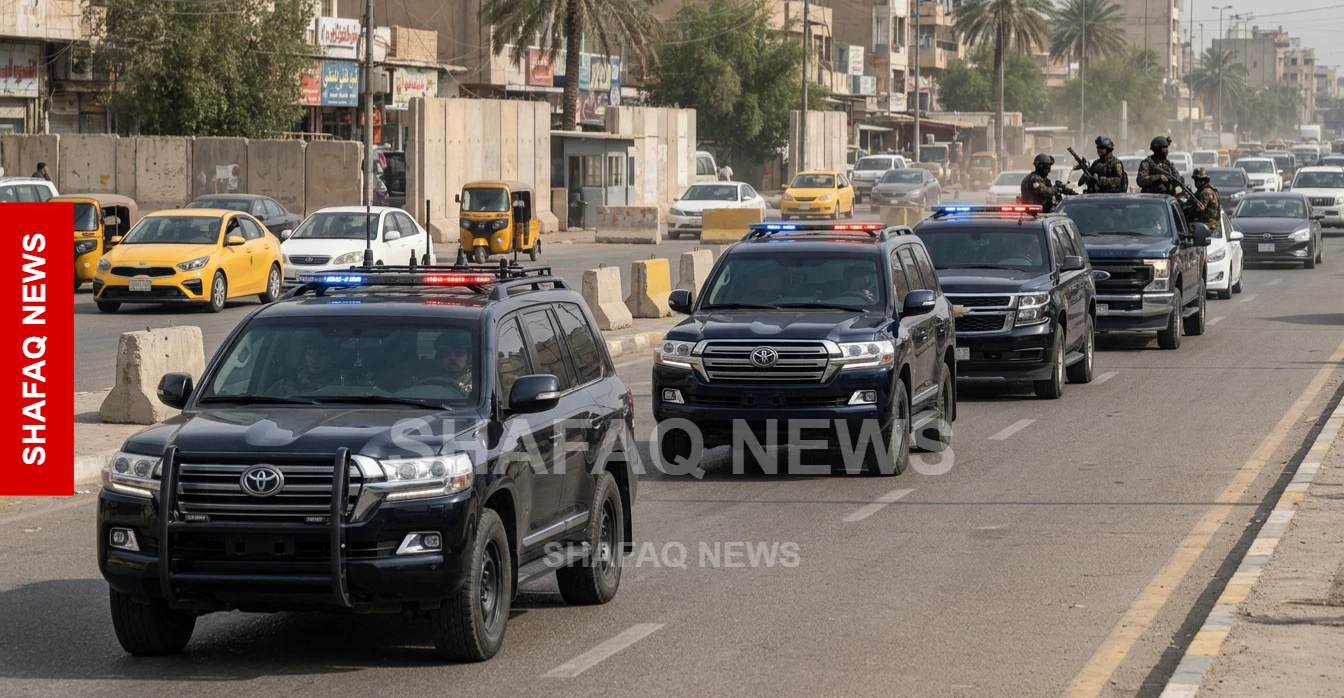
The convoys protecting officials in Iraq are raising renewed controversy regarding their cost to public funds, in light of the continued allocation of large numbers of personnel and vehicles to the three presidencies, deputies and senior officials, despite previous government decisions and legislation aimed at reducing and controlling these privileges, amid accusations of their exploitation and turning some of them into a gateway for financial waste and suspicions of corruption.
While security needs justify some of these allocations, especially during years of security turmoil, observers believe that continuing them at the same level is no longer appropriate for the country’s reality, demanding that the number of security details, their allocations, and the expenses of officials’ convoys be audited, and that unified controls be put in place to end the disparity and prevent the exploitation of security institutions’ resources.
Decisions without resolution
The controversy surrounding this issue dates back years, as the House of Representatives voted on October 28, 2019, to abolish the privileges and financial allocations for the three presidencies (the Presidency of the Republic, the Council of Ministers, and the House of Representatives), as well as for members of parliament, ministers, senior officials, and governors, during a session dedicated to discussing the demands of the demonstrators and the government’s reform packages.
Law No. (28) of 2019 was also issued to abolish the financial privileges of officials in the state, including controls related to privileges and allocations.
In 2023, the issue resurfaced when former Prime Minister Mohammed Shia al-Sudani directed, in September of that year, that the number of security details be reduced and negative aspects of official convoys be prevented, after the Ministry of Interior had determined, in June 2023, the number of security details allocated to its senior officers and officials according to their ranks and positions.
On December 15, 2025, Al-Sudani directed an urgent review of the salaries and allowances of the three presidencies, and to work on unifying the salaries of the employees of the Presidency of the Republic and the Presidency of the House of Representatives with their counterparts in the Presidency of the Council of Ministers, as part of government measures to reduce spending and maximize revenues, while those decisions did not directly address reducing the number of security details.
Numbers and allocations
In an attempt to understand the mechanism for distributing these protections, a former minister, who asked not to be named, revealed that the number of protection personnel for the minister during his tenure is 20, and it decreases to 8 after the end of his mission, and then to 4 after four years, while the ambassador is allocated 8 personnel inside the ministry headquarters, which are withdrawn when he travels, and the number is reduced to two personnel after he is referred to retirement.
The minister added to Shafaq News Agency that the three presidencies include protection regiments whose total number of members reaches about 700, indicating that reducing these numbers or continuing them is subject to the decisions of the Prime Minister according to the security conditions, and that some protection may continue for a specific period even after the official leaves his position.
The former minister pointed out that Law No. (28) of 2019, concerning the abolition of financial privileges for officials, is supposed to regulate aspects of this issue, but he describes its application as merely formal, considering that legal texts do not necessarily reflect actual practice.
According to the law published in the Iraqi Gazette on December 9, 2019, the number of cars allocated to the President of the Republic, the Speaker of Parliament, and the Prime Minister was set at five cars, and four for their deputies. Article 8 stipulated the withdrawal of protection regiments from the presidencies, former ministers, and political figures since 2003, leaving the determination of the number of their protection personnel to the Commander-in-Chief of the Armed Forces.
Suspicions and waste
For his part, the head of the Al-Nahrain Foundation for Supporting Transparency and Integrity, Muhammad Al-Rubaie, said that spending on protecting officials, in light of the financial distress and deficit facing the country, represents one of the avenues of waste and suspicions of corruption that require extensive scrutiny.
Al-Rubaie explained to Shafaq News Agency that the continuation of the protection system from 2003 until 2026 necessitates reviewing the integrity of the elements associated with officials, due to the possibility that some of them are using it as a cover to hide illicit gains or register real estate and financial assets in their names, stressing the need to subject these cases to auditing instead of making general accusations without investigation.
He called for reducing the number of security personnel and adhering to actual working hours, considering that allocating 16 personnel to one deputy is a large number, especially if some of them do not actually perform the security duties.
It also calls for preventing officials from relying on their family members, and assigning this task to the Directorate of Personal Protection in the Ministry of Interior.
According to Al-Rubaie, the cost is not limited to salaries, but also includes cars, fuel and other operating expenses, warning that the lack of oversight of this sector may open the door to the exploitation of public resources and increase the risks of financial corruption and money laundering.
Between security and spectacle
Political researcher Zaidoun Al-Salmani links the continuation of large numbers of security personnel to a previous security phase in which terrorist threats targeted officials and party leaders, but he believes that the justifications for maintaining the same allocations have declined with the improvement in security during recent years.
Al-Salmani told Shafaq News Agency that the largely stable security situation requires the government to reconsider protection expenses, stressing that the review should not be limited to the number of personnel, but should also include office expenses, fuel quantities allocated to vehicle convoys, and related expenses.
He called for setting clear limits for each position, from the Director General to the highest officials, and holding violators accountable, considering that some figures have turned public positions from service responsibilities into displays of pride and show of influence in front of the public, instead of dealing with them as an assignment to serve citizens.
In the same context, independent politician Abu Mithaq Al-Masari considered that the continued spending of billions of dinars monthly on the three presidencies, under the headings of salaries, allowances and related expenses, is no longer logical in light of the financial circumstances the country is going through.
In an interview with Shafaq News Agency, Al-Masari pointed out that the decline in resources and economic pressures, along with the repercussions of the regional war and the disruption of export outlets, require higher institutions to review the amount of money they receive and reduce the high levels of spending, in order to alleviate the burdens on the state treasury.
The demands to reconsider the privileges of officials are not limited to protections, as former MP Firas Al-Muslawi revealed to Shafaq News Agency on April 11, 2025, that he had collected more than 60 parliamentary signatures to amend the law on the salary scale of employees, so that the reduction would include the salaries of the three presidencies, MPs and those with special grades, within the framework of what he described as achieving social justice.
Previously circulated figures reveal a discrepancy in estimates of the number of security personnel. Reports and statements spoke of allocating 16 personnel to each deputy, while others indicated 30 personnel. Old estimates also circulated that the total number of security personnel for the Speaker of Parliament, its members and officials reached 5,446 personnel, at a monthly cost exceeding 8.1 billion dinars, and about 98 billion dinars annually.
shafaq.com
