Sudanese: Trump asked for our support for the Nobel Prize, and there are no resolutions against Hezbollah and the Houthis.
Sudanese: Trump asked for our support for the Nobel Prize, and there are no resolutions against Hezbollah and the Houthis.
2025-12-08
 Shafaq News – Baghdad
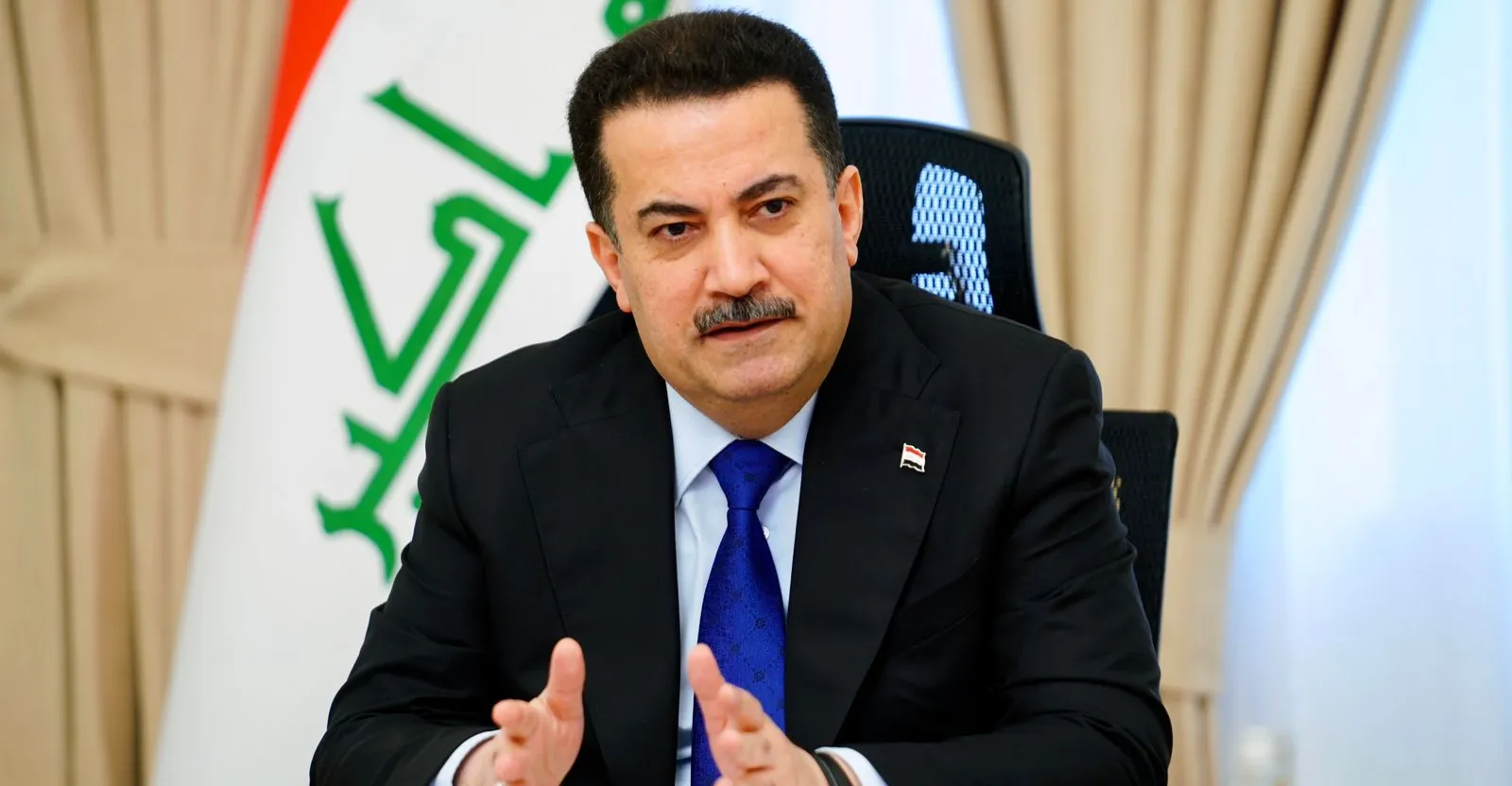
Outgoing Prime Minister Mohammed Shia al-Sudani revealed on Sunday evening that US President Donald Trump had requested, during a phone call, Iraq’s support for his nomination for the Nobel Peace Prize, while denying that a political decision had been issued to include the Lebanese Hezbollah and the Yemeni Ansar Allah group on the terrorism lists.
Al-Sudani said in a televised interview monitored by Shafaq News Agency that he received a phone call from US President Donald Trump in which he asked Iraq to support his nomination for the Nobel Peace Prize.
On the political front, Al-Sudani stated that “turning the position of Prime Minister into a job is unacceptable, because it leads to a weak government, and a weak government cannot last long, and that respecting the will of the voters is a necessity.”
He pointed to “the importance of giving the Coordination Framework space to choose the Prime Minister and not ignoring the results of the vote,” explaining that “the elections showed that the Framework won a majority of the Shiite component’s seats, with 170 seats, and that the Framework’s forces currently represent the Shiite component.”
Al-Sudani added that he “never rebelled” against the framework, and that he is the only prime minister committed to communicating with the state administration coalition, stressing that all economic and foreign decisions are taken with the knowledge and approval of the coalition, and that he did not make decisions unilaterally, while the details remain within the powers of the prime minister.
He explained that Iraq had no interest in involving itself in the Syrian conflict, stressing that maintaining relations with Syria was a natural way to protect Iraq’s security.
Al-Sudani continued, saying that his government’s approach is based on building friendships, not enmities, with the aim of ensuring the country’s stability, and that “the government has maintained balanced relations with all parties without compromising principles,” noting that “his government has been subjected to significant distortion because of the successes it has achieved.”
According to his statement, the Sharm El-Sheikh conference had nothing to do with normalization with Israel, and Iraq’s participation in it was necessary to end the Gaza war. He pointed out that the conference witnessed the declaration of a ceasefire in Gaza, which was an Iraqi demand. “There was an intention for Israeli Prime Minister Benjamin Netanyahu to visit the conference, but Iraq refused and maintained its position.”
According to Al-Sudani, the leaders of the framework did not attack him regarding the Sharm El-Sheikh conference; there were only questions, while some parties are working to target the government and mislead public opinion.
Al-Sudani also denied that any government decision had been issued against the Lebanese Hezbollah or the Yemeni Ansar Allah “Houthis”, stressing that some are trying to mislead, and that Iraq does not have any political stance against these parties, nor do they have any financial accounts in Iraq to impose sanctions on them.
On the economic front, Al-Sudani explained that everyone agrees that the economic path was wrong, and that real economic reform was achieved during the era of this government, especially in the energy, oil and industry sectors, indicating that he inherited debts worth 70 trillion and 505 billion dinars.
“Those who talk about the state’s debt are the same ones who voted for the budget law,” according to Al-Sudani, who confirmed that “the government spent only 12 trillion dinars on projects for 2024 throughout Iraq.”
Al-Sudani stressed that what is being rumored about spending exorbitant amounts of money on projects is untrue, adding that the total cost of projects in Iraq during three years amounted to only 31 trillion dinars, and that the distribution of projects was done according to professional standards and scientific studies.
He stated that he inherited 1,380 stalled projects worth 131 trillion dinars, while the financial deficit in the three-year budget amounted to 180 trillion dinars, stressing that the government did not restrict anyone with regard to freedoms, despite some exceeding the limits of the profession, and that the Cabinet’s decisions are taken by consensus.
Al-Sudani stressed that limiting weapons to the state is not an innovation but a constitutional principle, and that he did not accept targeting diplomatic missions before agreeing to be tasked with forming the government. He explained that ending the mission of the international coalition in Iraq does not mean severing ties with the outside world, and that disarming the factions is not done by a government decision but through a responsible political agreement.
He pointed out that Nouri al-Maliki has the right to run for Prime Minister, and that he also has the right to run “as he is the owner of a project,” stressing that he welcomed al-Maliki’s nomination for a third term, and that the coalition is open to everyone inside and outside the framework.
shafaq.com
