The Mecca-Tehran Alliance: Motives and Strategic Messages
The Mecca-Tehran Alliance: Motives and Strategic Messages
10-27-2026
 Iyad Al-Anaz
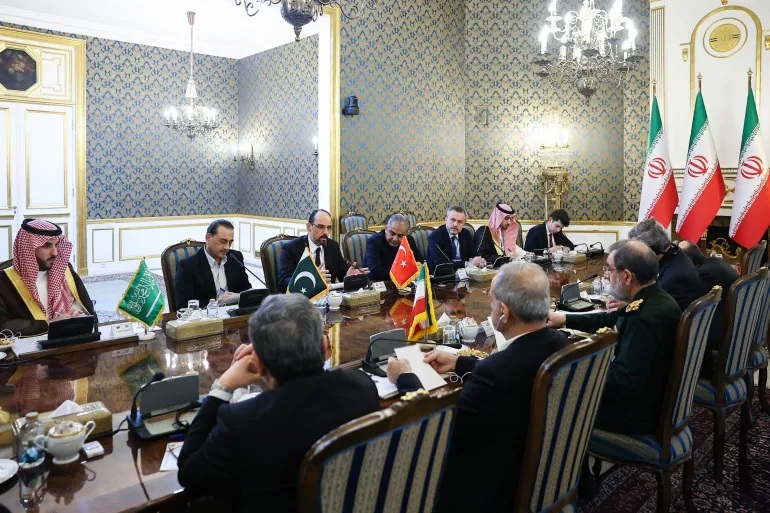
International, regional, and Arab attention was focused on the significant development represented by the visit of the tripartite delegation from the countries of the Mecca Agreement to Iran on October 26, 2026. The delegation included Saudi Defense Minister Prince Khalid bin Salman, Pakistani Army Chief Asim Munir, and Turkish Intelligence Chief Ibrahim Kalin. This joint visit and diplomatic move was of paramount importance at a time when the Arabian Gulf region is undergoing a major turning point, marked by political and economic transformations with repercussions for the overall international situation and for interests related to international energy supplies and global trade.
The idea for the tripartite meeting with Iranian officials arose during the Pakistani Army Chief’s previous visit and his meeting with Mohsen Rezaei, Secretary of Iran’s Supreme National Security Council, on October 21, 2026. During that meeting, Riyadh, Ankara, and Islamabad expressed their desire to visit Tehran and hold joint talks to discuss the situation in the region, establish fundamental principles for reshaping the landscape, de-escalate tensions, encourage political dialogue and diplomatic negotiations, and support the mediation efforts undertaken by Qatar and Pakistan to achieve collective security and a shared vision that serves all parties.
The significance of the meeting between the countries of the Mecca Agreement and Iran lies in its numerous implications and the precise political messages it carries. These messages pertain to the pursuit of de-escalation with Iran, opening avenues for dialogue, reaffirming collective deterrence to protect Saudi Arabia, expanding the regional role in managing the US-Iranian confrontation, attempting to dissuade Iran from its regional behavior and political orientations, halting its support for armed factions, and curbing its influence and expansion. The visit also underscores the importance of adopting understanding as a crucial tool, recognizing that military action alone cannot guarantee stability without fruitful dialogue and successful meetings grounded in defensive capabilities and leading diplomatic efforts.
This visit represents a political and security development because it not only opens a channel for dialogue with Iran but also tests the ability of regional states to combine building collective deterrence with preventing the escalation of the confrontation. The most important question here is whether a serious understanding will be reached that limits Iranian threats, or whether it merely signals to Iranian officials that the security of Saudi Arabia is no longer a secondary matter but is now linked to broader defense coordination. It is worth noting that the Mecca Alliance is a trilateral defense framework stipulating that an armed attack on one of its members is considered an attack on all three. Furthermore, the establishment of the alliance does not necessarily imply that it is intended to launch a military confrontation with Iran.
We believe that the main objectives of the tripartite delegation’s visit are to stop and contain the threats of the Houthi group and to halt its expansion, which is the most prominent security and military objective for Riyadh. The continuation of military operations, Houthi attacks, and missile strikes targeting civilian airports, oil facilities, and infrastructure leaves Riyadh with no option but to move towards an open and continuous confrontation. Herein lies the importance of Iran’s understanding of Riyadh’s dialogue with it, not because of its responsibility for what is happening, but because its relationship with the Houthis gives it a role and position in any attempt to exert pressure towards de-escalation and stopping the escalation operations. This is an attempt to demonstrate Iranian good intentions, which had previously signed a joint agreement with Saudi Arabia under Chinese auspices in March 2023, and a test of the extent of Iran’s willingness to contribute to reducing Houthi threats and to use its influence to limit the scope of its expansion and reach.
There is a shared view from Ankara and Islamabad that Saudi security is now linked to a joint deterrent and a unified will. This is the fundamental objective that Iran must understand, representing the strategic dimension of regional equilibrium. The defense agreement between Saudi Arabia, Turkey, and Pakistan elevates cooperation from the level of political consultation to the development of a joint defense capability. Two messages can be discerned here for Iranian officials: first, that the door to dialogue remains open and that the countries of the Mecca Alliance do not seek to transform Iran into a permanent adversary; and second, that continued threats to Saudi Arabia may be met with a joint deterrent that transcends Saudi national will.
The Saudi call to reduce Houthi threats is not related to the Saudi-Iranian relationship, but rather to protecting Riyadh’s ability to manage its economy and oil exports, and to preventing the expansion of the war. Protecting Saudi Arabia’s strategic depth contributes to safeguarding the security of the Arabian Gulf and freedom of navigation in the Straits of Hormuz and Bab el-Mandeb, and to preventing Saudi territory from becoming an additional arena for the US-Iranian confrontation. Any escalation of this confrontation could make oil facilities, civilian airports, ports, and energy networks targets for reciprocal pressure.
Furthermore, listening to Iran’s opinion on the Mecca Agreement and how it views it, and whether it fears that the agreement will turn into a military tool that limits its regional scope of action, will be one of the main reasons for the tripartite visit, which the delegation seeks to find out how Iran will deal with the alliance, whether it will consider it a threat that must be confronted, or consider it a regional reality that can be coexisted with within understandings that guarantee sovereignty, non-aggression, non-interference in internal affairs, targeting of security and stability, and the movement of its tools, allies, and proxies in the region. Here, three files may overlap in the dialogue between Iran and the countries of the Mecca Agreement (Saudi security, confronting Houthi attacks, and the security of navigation in the Bab al-Mandab and Hormuz straits, and the conditions for resuming US-Iranian negotiations), and these are important files that surround a single circle that helps to reach preliminary understandings that may lead to a comprehensive agreement that satisfies all parties.
We can move to a key point regarding the position of US President Donald Trump’s administration on the trilateral visit and its potential outcomes and new insights regarding the US-Iranian confrontation. Some developments in the Iranian position may occur, but this does not necessarily mean a change in the US position on the conditions that Washington has previously adopted towards Iran. However, the visit could provide field diplomacy and political prospects that include an exit for US approaches if the contacts result in an Iranian commitment to stop the Houthi attacks on Saudi territory and targeting its security and stability, and an understanding regarding freedom of navigation, international energy supplies, and global trade. Washington will then have a wider scope to test Iran’s political path before making any decision on the military level, while the United States maintains its demands regarding the nuclear file, maritime security, and the naval blockade.
If the regional pressure on Iran is achieved and it is made aware of the activation of defense cooperation between Riyadh, Islamabad and Ankara, it may find itself facing a difficult equation. Any continuation of Houthi and Iranian attacks will lead to a broader security rapprochement between the countries of the Mecca alliance, which differed in their assessment of Iranian threats. This will give Washington the opportunity to benefit from regional security coordination without having to bear the burden of deterrence against Iran alone.
There is a clear political implication that the three countries (Saudi Arabia, Pakistan, and Turkey) are not necessarily acting in accordance with American calculations. Rather, they have their own direct interests in halting the military confrontation between Washington and Tehran, protecting energy and maritime shipping lanes, and preventing threats from spilling over into their territories. Establishing a regional channel with Iran may reflect a desire to expand regional decision-making in light of the ongoing security partnership with the United States.
However, regardless of the serious initial results of the visit, a future question remains: it will not compel Washington to ease pressure on Iran. Instead, it may provide a viable avenue for exploring alternative diplomatic options and assessing whether military escalation will achieve its objectives or increase the risks to US allies in the Arabian Gulf region. Here, it is crucial to define the practical significance of the fact that the Gulf Cooperation Council (GCC) states are not merely affected by the consequences of the US-Iranian confrontation, but are actively seeking to participate in shaping arrangements to contain it.
The results of the visit can be viewed through the Iranian behavior and its position on the Houthi attacks, and whether it will issue a clear commitment to de-escalation, and whether there is a decrease in the number of Houthi attacks on civilian airports, oil facilities and Saudi cities, and whether there are changes in dealing with freedom of navigation in the Arabian Gulf and support for oil supplies and global trade, and whether the American administration will welcome the regional political track and take the opportunity to verify it or will continue with military pressure and increase the pace of economic sanctions.
rawabetcenter.com
