Nizar Amidi to the Presidential Palace… Presidential settlement precedes government battle
Nizar Amidi to the Presidential Palace… Presidential settlement precedes government battle
2026-04-11
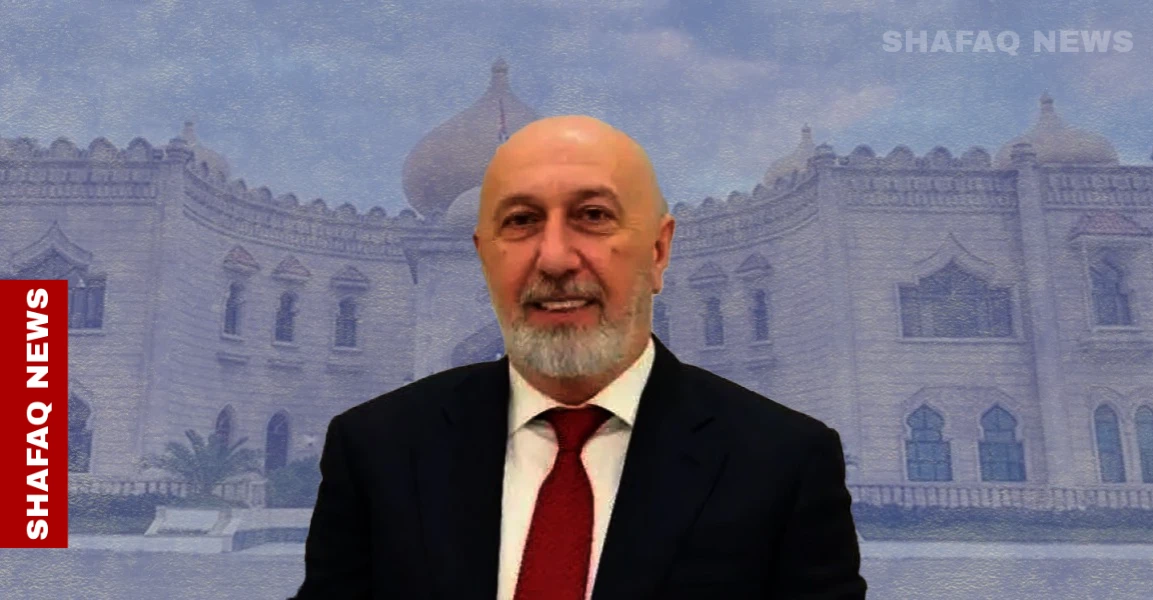 Shafaq News – Baghdad
Nizar Amidi’s arrival at the Peace Palace was not the result of a clear political moment or a complete consensus, but rather came after a series of meetings and deliberations that took place away from the public eye, at a time when Iraq was trying to get out of a long deadlock without really being sure what awaited it next, especially in the midst of a militarily turbulent region.
The election of the president appeared, on the surface, to be a step to break the deadlock and pave the way for the formation of the new government, but in reality, it may have shifted the dispute from the presidential station to a more complex station, namely the premiership and the form of the coalition that will manage the next phase.
In this sense, Amidi emerged not as the most prominent candidate in political discourse or the most controversial figure in the public sphere, but rather as a figure intimately familiar with state institutions, one who operates more within the realm of compromise than confrontation. At a time when Iraq was burdened by regional tensions and internal divisions, this type of figure seemed acceptable to various parties seeking a practical solution, even if not a definitive one.
Amidi, born in Amadiya, Duhok Governorate in 1968, belongs to a generation of politicians who built their careers through quiet work within state institutions. He studied mechanical engineering at the University of Mosul, then spent many years close to the presidency, working alongside several presidents, before becoming Minister of the Environment and later head of the Patriotic Union of Kurdistan’s political bureau in Baghdad. This background portrays him as a man of administration and balance, rather than a man of rhetoric and slogans.
The presidency, despite its limited executive powers compared to the prime ministership, remains a pivotal position because it opens the constitutional path for tasking the candidate of the largest bloc with forming the cabinet. Therefore, the battle for the presidency was not merely symbolic, but a battle over the gateway through which the new government would enter.
The arrival of Amidi also reaffirmed a political convention established in Iraq after 2003, whereby the three top leadership positions were distributed according to established power-sharing arrangements: the premiership went to the Shiites, the speakership of parliament to the Sunnis, and the presidency to the Kurds. Within this arrangement, the presidency remained, politically, the prerogative of the Patriotic Union of Kurdistan (PUK), while the Kurdistan Democratic Party (KDP) retained other positions within the Kurdish and Iraqi power-sharing equation. Since 2005, the presidency has been held by a succession of Kurdish presidents, with the PUK being the most prominent party in this process.
But his election was not a peaceful continuation of this tradition. This election cycle clearly revealed that old understandings no longer functioned automatically, and that the Kurdish political establishment itself no longer treated the presidency as a settled matter. The Patriotic Union of Kurdistan (PUK) held fast to its candidate, while the Kurdistan Democratic Party (KDP) pursued a different course, transforming the presidency into a new testing ground within the Kurdish political landscape, and subsequently into a point of intersection with Shia and Sunni political calculations in Baghdad.
Therefore, Amidi’s rise cannot be understood in isolation from the arrangements that took place behind the scenes. He did not reach his position solely due to his track record within the presidential institution, but also as a result of political convergences that saw his election as a suitable solution at this stage.
In reading the scene, it appeared that several Shiite forces found in supporting him a step that would help break the deadlock, most notably the forces close to Mohammed Shia al-Sudani, who is seen as aspiring to a second term, along with the Sadiqun movement led by Qais al-Khazali, and the Hikma movement led by Ammar al-Hakim, as well as the Patriotic Union of Kurdistan itself, before Mohammed al-Halbousi joined this undeclared alliance through his “Progress” bloc.
However, these understandings may not pave the way so much as they move the conflict to a more sensitive stage. Amidi’s election came at a time when the coordination framework itself was experiencing a clear division between a camp that adhered to the nomination of Nouri al-Maliki, as the official candidate who had been announced earlier for the premiership, and another camp that seemed closer to the understanding that facilitated Amidi’s arrival at the Peace Palace, and is seen as paving the way either for a second term for Mohammed Shia al-Sudani or for going to an alternative name.
In this context, the State of Law coalition’s decision to boycott the presidential election session was not a mere detail, but rather an indication that the dispute was no longer confined to the presidency, but had effectively shifted to the question of who would lead the next government. This impasse is further complicated by the continued American reservations regarding al-Maliki’s return, which makes the presidential election appear, thus far, to be a partial settlement rather than an end to the crisis, and perhaps the beginning of an even more difficult round of negotiations to form a government and distribute power within it.
Here, Amidi may acquire particular significance, not because he will change the nature of the Iraqi political system, but because he enters the office well-versed in its limitations and how the delicate relationship between Baghdad and Erbil is managed. He has spent seventeen years learning how the presidency operates from within. Now begins a more difficult test: how to lead it himself.
shafaq.com
