Maliki sets conditions for withdrawing his candidacy for prime minister, while Asa’ib Ahl al-Haq pushes for renewing al-Sudani’s term.
Maliki sets conditions for withdrawing his candidacy for prime minister, while Asa’ib Ahl al-Haq pushes for renewing al-Sudani’s term.
2026-03-12 03:42
 Shafaq News – Baghdad
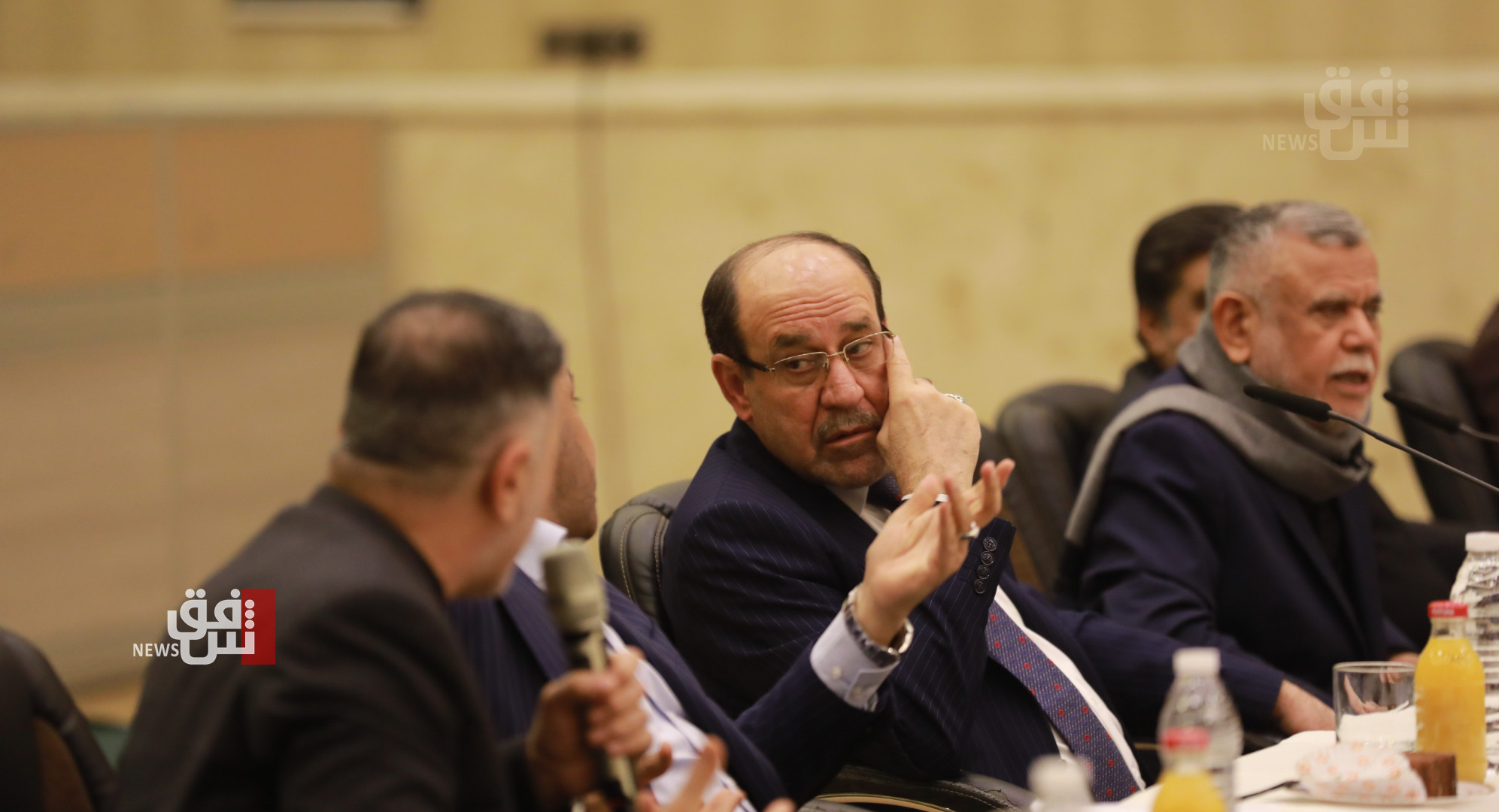
An informed source within the coordination framework revealed on Thursday that the leader of the State of Law Coalition, Nouri al-Maliki, set conditions for withdrawing his candidacy to head the new government, while the Asaib Ahl al-Haq movement believes that renewing confidence in the “outgoing” Prime Minister, Muhammad Shia al-Sudani, will protect Iraq from internal tensions and external sanctions.
The source told Shafaq News Agency that “Maliki’s messages, through the mediator who adopted the mediation to resolve the Shiite-Shiite dispute over the identity of the prime minister, reached all parties that rejected Maliki’s nomination.”
He explained that “among Maliki’s conditions is not renewing the mandate of caretaker Prime Minister Mohammed Shia al-Sudani, and not nominating the leader of the Victory Coalition, Haider al-Abadi, as a compromise candidate to fill the position. Rather, a figure who is acceptable to all parties, including Maliki’s approval, must be nominated.”
He noted that “the message has been received and discussions about the demands have begun among the framework’s forces through inter-communication and meetings, and the framework may reveal its position regarding those demands after the Eid al-Fitr holiday.”
The Coordination Framework had officially nominated Maliki on January 24, a move that opened the door to negotiations to form the new government, but the process faltered as disagreements continued over the election of the President of the Republic, the constitutional entitlement that precedes assigning the candidate of the largest bloc to form the government.
However, al-Maliki’s nomination was met with rejection from some Sunni forces, as well as parties within the Shiite bloc itself, in addition to strong rejection from the American administration, whose president, Donald Trump, threatened at the time that Washington would stop its aid to Iraq if al-Maliki assumed the premiership.
In contrast, the Asaib Ahl al-Haq movement, led by Qais al-Khazali, believes that the regional situation does not allow for additional tensions and that the issue of the premiership must be resolved as quickly as possible.
MP Mohammed Al-Baldawi, from the “Sadiqun” parliamentary bloc affiliated with Asaib Ahl al-Haq, told Shafaq News Agency that “the leadership of the coordination framework must have a clear vision for finding solutions, the first of which is forming a fully empowered government capable of leading the country during this period, and the status quo is not in the interest of the country or the Iraqi people.”
He stressed that “the situation requires us to give confidence to Prime Minister Mohammed Shia Al-Sudani to continue managing the phase, because this is in the interest of the people and the country cannot enter into new conflicts, and in order to spare the country from sanctions.”
He pointed out that “the economic situation in the country as a result of the closure of the Strait of Hormuz and the cessation of oil exports is not reassuring, and the government is seeking to find other outlets to finance employee salaries.”
Al-Baldawi added: “We will proceed with whatever the coordinating framework agrees upon. The leaders of the framework are the wise men of this country and possess the national mentality to bear responsibility,” noting that “the leaders of the coordinating framework will hold a meeting in the coming days to resolve the issue of forming the government, and there is near agreement and consensus on resolving this issue.”
The leaders of the Coordination Framework were scheduled to meet last Monday to resolve the disputes and agree on a candidate for the next government, but this did not happen due to a lack of convergence of views, according to a source within the Coordination Framework.
At the time, an informed source told Shafaq News Agency that “most of the forces within the framework had agreed to renew the mandate of caretaker Prime Minister Mohammed Shia al-Sudani, but the insistence of the framework’s candidate, Nouri al-Maliki, on his nomination, along with the rejection by some important parties in the Shiite bloc of renewing al-Sudani’s mandate, thwarted the meeting and no date was set for it to be held again.”
He added: “Official public meetings may be postponed until after the Eid al-Fitr holiday, meaning that internal meetings will continue to reach a final solution after clarifying the reasons for the rejection of the Sudanese renaming by the objecting parties.”
On Wednesday, a well-informed political source revealed that the head of the Badr Organization, Hadi al-Amiri, is making efforts to bring together the leaders of the Coordination Framework and bring them together at a dialogue table to resolve the crisis of the candidate for the upcoming government.
Al-Amiri’s attempts come after the escalation of the dispute between the parties within the framework regarding the leader of the State of Law Coalition, Nouri al-Maliki, the candidate for prime minister, around whom disagreements have revolved within the Shiite bloc itself, as well as from partners in the political process, in addition to external pressures, most notably the American ones, which reject al-Maliki assuming the premiership.
The source told Shafaq News Agency, “There are attempts by Al-Amiri to bring together the leaders of the Coordination Framework for an Iftar or Suhoor meal in the coming days to resolve the political dispute and solve the crisis of the prime minister candidate and the formation of the next government.”
He explained that “the coordination framework is currently divided into three wings, one of which includes Nouri al-Maliki, Mohsen al-Mandalawi and Hussein Mounis, another against al-Maliki which includes Ammar al-Hakim and Qais al-Khazali, and a third wing that is currently reserved which includes Hadi al-Amiri, Humam Hamoudi and Mohammed Shia al-Sudani.”
shafaq.com
