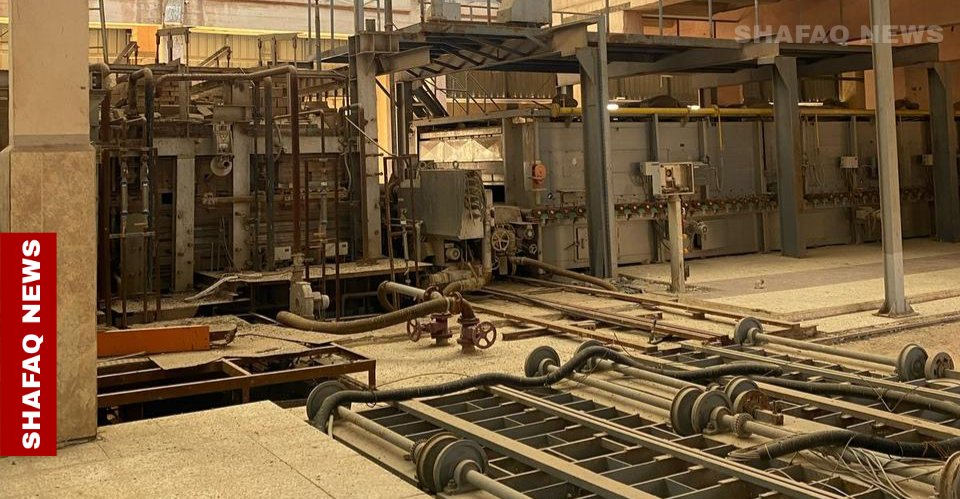
Iraqi factories: silent machines and machinery waiting to be brought back to life.
Iraqi factories: silent machines and machinery waiting to be brought back to life.
2025-09-07 01:35
 Shafaq News – Baghdad
For 22 years now, thousands of machines in Iraqi factories have been standing still, operating only in memory and not on the ground. Machines born to produce, feed the market, and provide job opportunities, have been transformed over time into rusty structures gathering dust.
Silent machines and postponed government decisions: these are the features of Iraqi industry, a prisoner of the past, waiting for the moment when the wheel of production can be put into motion again so it can return to life once more.
The reality of Iraqi factories and the long silence their walls have endured has prompted a Shafaq News Agency team to conduct a detailed inventory of the most prominent operating and closed factories in both the private and public sectors, revealing the secrets of industries that have stalled mid-stream, leaving behind closed doors waiting to see the light of day again.
Governmental dilemma
Iraq has approximately 83 government-owned factories that have been inactive since 2003. Over time, these facilities have become “unfit” for industrial use due to the obsolescence of their machinery and equipment and their failure to keep pace with rapid technological developments, according to sources who spoke to Shafaq News Agency.
Data from the Ministry of Industry and Minerals, released in 2022, estimated the total number of factories affiliated with public sector companies in Iraq at approximately 227, with only 140 workers.
In contrast, the number of government-owned factories currently operating ranges between 15 and 20, most of which specialize in the military industries sector, such as the production of bullets and materials for the army and police, in addition to the iron and cement industries. This contradicts the government’s narrative, but the source stated that most of them have been permanently closed.
Among the government-run factories currently operating in Iraq, there are four specialized in “textiles,” located in the capital, Baghdad, as well as in Najaf, Anbar, and Babylon. Government estimates indicate that their production ranges between 28,000 and 33,000 square meters.
The government-owned factory in Babylon includes five main small factories that produce plastic bags, medical products, various types of textiles, and synthetic fibers.
According to the agency’s information, these factories operate intermittently, shutting down and resuming operations based on the funding they receive from the government, which ranges between 3 and 5 billion dinars per installment.
The lack of human resources is one of the most significant challenges facing the government industrial sector. Thousands of engineers and workers have been unemployed for over 22 years, leaving them outside the scope of technological developments witnessed worldwide in the industrial sector. Consequently, Iraq now needs specialized and advanced personnel before reviving government-owned factories.
The private sector, on the other hand, faces a slightly different reality, with approximately 50,000 factories that have been idle since the Iran-Iraq War and the subsequent events after 2003, without receiving any support or rehabilitation programs from the state.
According to accurate information, there are approximately 30,000 private sector factories currently operating. However, they rely entirely on their own resources, without any government support, despite directives and decisions issued by the Council of Ministers.
Earlier, economist Nabil Al-Marsoumi posted on his personal Facebook page a post discussing the “industrial sector,” stating that “more than 50% of the country’s registered factories are out of operation.” He explained that “Iraq has approximately 67,000 factories registered with the Federation of Industries, but 35,000 of them have shut down for various reasons.”
ink on paper
The decisions issued by the Council of Ministers, headed by Mohammed Shia al-Sudani, which included loans and facilities related to gas distribution and electricity provision, have not been implemented on the ground, according to a senior source in the Iraqi Ministry of Industry. The source also confirmed that some of these decisions were implemented, while others were merely for media purposes.
The source pointed out, during his interview, the lack of genuine support and facilitation from the Iraqi government for the private sector and the revival of old factories. He explained that many of the factories established in recent years were built from the personal resources of their owners, without relying on government funding or any other support.
Last September, Iraqi Prime Minister Mohammed Shia al-Sudani stated that his government had no intention of privatizing state-owned companies. He indicated that the government’s focus was on the industrial sector, meeting the needs of the local market and exporting the surplus.
No partnerships
Abdul Hassan Al-Ziyadi, a member of the Iraqi Federation of Industries, says, “In recent years, the industrial sector in Iraq has witnessed serious attempts to advance the efforts of the private sector, as most factories were established with the personal resources of their owners, without any government support.”
However, Al-Ziyadi, speaking to Shafaq News Agency, said that Iraqi industry still faces significant obstacles, most notably the lack of meaningful government support and the absence of serious facilitations for the private sector, despite numerous Cabinet decisions on the matter.
Last April, the government discussed ways to support the industrial sector, during a meeting that reviewed the challenges facing factories, mechanisms for lending and ownership, the establishment of industrial cities, and the export of local products.
The meeting also discussed fees imposed on industrialists, rental allowances, and controls for auditors. At the time, the Iraqi Prime Minister pledged to launch the second package of decisions to support national industry to enhance income diversification and create job opportunities.
A few months ago, Iraq launched commercial production at its newest iron ore plant, after more than 10 years of work. Minister of Industry and Minerals Khaled Battal indicated that the plant will have a capacity of 600,000 tons per year.
shafaq.com
