From patronage to “strongman”… How do the winners top the results of the Iraqi elections?
From patronage to “strongman”… How do the winners top the results of the Iraqi elections?
2025-11-15 01:47
 Shafaq News – Baghdad
Twenty years ago, as soon as the first elections held in Iraq to choose the people’s representatives in the Iraqi parliament ended in 2005, the Iraqi voter’s vision settled in a “surprising” way, as all past elections up to the last one witnessed the lists of prime ministers topping the results, and they were always among the top three winners.
The Iraqi voter’s inclination towards the Prime Minister’s list, which happens to be present in every election cycle, has raised many questions. This has been attributed to several reasons, including a psychological one related to the “strongman,” as well as the absence of economic and social electoral programs from the parties, which pushes the voter to re-elect the “experienced” official, in addition to creating a “client public” base through appointments and municipal services.
The year 2005 witnessed the first parliamentary elections in Iraq, in which the election was conducted based on ideological and regional orientation, and the candidate lists promoted on this basis, and large religious institutions in the country intervened in the promotion process to attract voters, and the participation rate in it was the highest in the history of Iraqi elections at 76%.
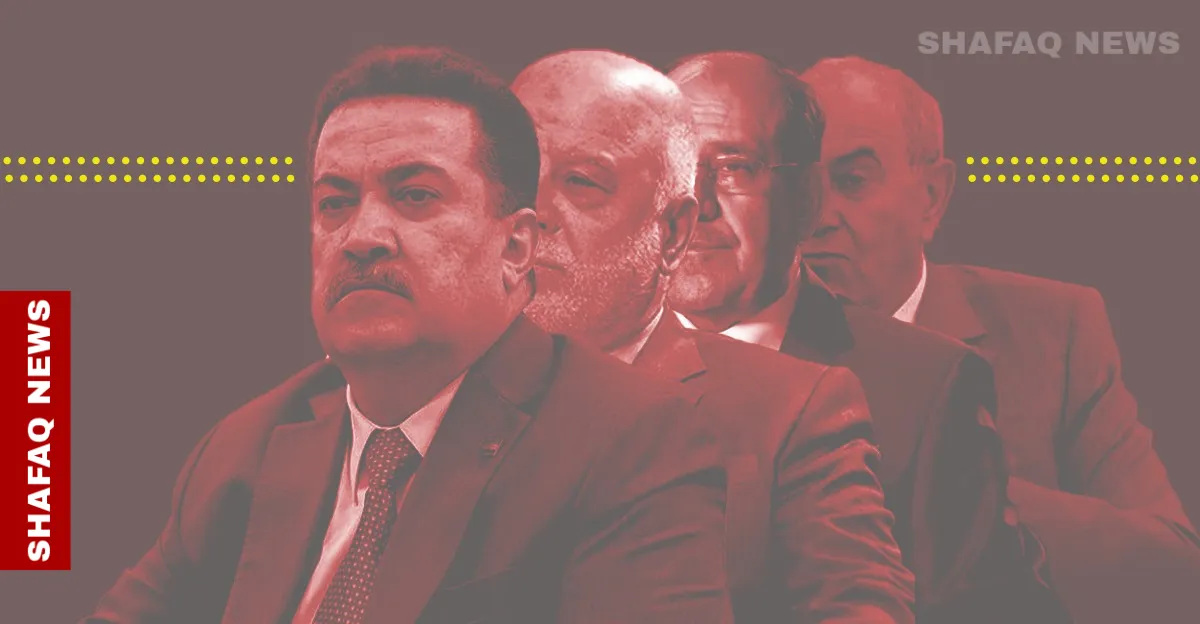
After those elections and the formation of the first Iraqi government through parliament, the electoral compass began to change. Below is a quick review of the most prominent lists of heads of government who won the elections, with the exception of Adel Abdul Mahdi and Mustafa Al-Kadhimi, as they did not run in any electoral race after becoming heads of government.
The 2010 elections saw the State of Law Coalition list, led by Nouri al-Maliki, who had been prime minister since the 2005 elections, come in second place with 89 seats, while the Iraqi List, led by Iyad Allawi, who also served as prime minister for a temporary period, topped the results.
In the 2014 elections, Maliki’s list again topped the elections with 92 seats, and he was also prime minister at the time, serving his second term which he won in the 2010 elections.
In the 2018 elections, the list of then-Prime Minister Haider al-Abadi, who had held office since 2014, came in third among the top three winners with 42 seats.
As for the 2021 elections, there was no participation of a prime minister, as Mustafa Al-Kadhimi was in office and did not run on any list. The results were topped by the Sadrist Movement lists with 73 seats, the Progress Party, which is linked to former Speaker of Parliament Mohammed Al-Halbousi, with 37 seats, and the State of Law Coalition with 33 seats.
In the 2025 elections, which took place a few days ago, the Reconstruction and Development Coalition, led by Mohammed Shia al-Sudani, who has been the Prime Minister since the 2021 elections, won the most seats with 46, according to preliminary results.
My customers’ audience
Regarding the Prime Minister’s leading position in every election, Washington-based political analyst Ramadan Al-Badran attributes this to a “paralysis” in the relationship between the citizen and the legislative authority, which has led to a lack of interaction between the two parties, unlike the executive authority represented by the Prime Minister.
The executive authority now has a direct role with the citizen, especially in the service aspect, as Al-Badran confirms during his interview with Shafaq News Agency.
But this direct contact has shifted the role of the executive authority to focus on municipal services, and this, from Al-Badran’s point of view, is “a distortion of the system,” because the Prime Minister’s job is not to provide municipal services, but his duties are farther and more comprehensive and include providing a safe environment, job opportunities for the private sector, attracting investments, and managing the state.
Al-Badran asserts that heads of government have focused on providing services and appointments, and this has established a clientelist public that depends on granting its trust based on the direct services it receives.
What is happening has led to the atrophy of the functions of authority and the disappearance of its role, whether legislative or executive. It has also pushed officials to head to densely populated areas and city centers to secure the largest number of votes, with great neglect of the countryside and villages, as Al-Badran concludes his speech.
psychological dimension
Regarding the voter’s inclination towards the head of government in each election, social and psychological researcher Wali al-Khafaji confirms that the Iraqi personality tends towards strong authority.
He elaborates: “The character of the Iraqi individual stems from the social environment and the surrounding circumstances. The general culture is always derived from the conditions that Iraq has gone through, which consist of political coups and oppression. Throughout the past decades, power has not been transferred peacefully, but rather through bloodshed. Therefore, this character has turned to the belief that the hero is the strong one, and he is the one who rules the country without participation. Even our culture in anthems and other things sings of the strong and glorifies him.”
Regarding the recent elections, they achieved the goal of the Iraqi character, as Al-Khafaji describes it, by the voter going with the “strong authority,” and he does not elect a person he has not tried. Therefore, Iraqis always say that they do not take risks, and proverbs have been made about this matter such as (the bad you know is better than the good you do not know), meaning that the bad you know is better than the good you do not know.
Regarding the above proverb, Al-Khafaji describes it as “dangerous,” meaning that Iraqis prefer the harsh one, and see him as better than an unknown person who might reach the position.
All of this is due to “the lack of trust between the public and the authorities,” explaining that “the people do not trust the government but they elect it, and based on the above, they try to take refuge in this power despite their lack of trust in it.”
Lack of programs
In light of all the above, political analyst Ghazi Faisal, a former Iraqi diplomat, adds that the absence of electoral programs contributed to the voter’s inclination towards a person from his environment, based on sect, creed, or ethnicity.
According to Faisal’s statement to Shafaq News Agency, the political parties that have not presented any real programs, such as addressing unemployment, climate, the economy and job opportunities, bear the responsibility for what is happening. All of these are missing during the pre-election campaigns.
In the absence of clear programs, voters tend to elect someone religiously or sectarily close to them. Furthermore, Iraqi voters seek tangible achievements. For example, al-Sudani was an obscure minister, virtually unknown, but after assuming the premiership and running for office again, he was elected because citizens saw he had delivered concrete results in terms of services and inaugurated projects. This stems from the first point: the lack of programs from political parties, which leads citizens to elect those they perceive as having accomplished something, according to Faisal.
He affirms that “the voter sees that this person is better than the other based on what he has presented, and he compares between them, and if there is no achievement, he will turn to voting on a regional, sectarian and ethnic basis.”
shafaq.com
