Following the Iraqi maritime coordinates… a political storm in the Gulf and calls for dialogue
Following the Iraqi maritime coordinates… a political storm in the Gulf and calls for dialogue
2026-02-23 01:05
 Shafaq News – Follow-up
Iraq’s deposit of nautical charts and official coordinates with the United Nations has sparked reactions in Gulf circles, amid calls to contain the repercussions of the move and address the issue through diplomatic frameworks and official channels.
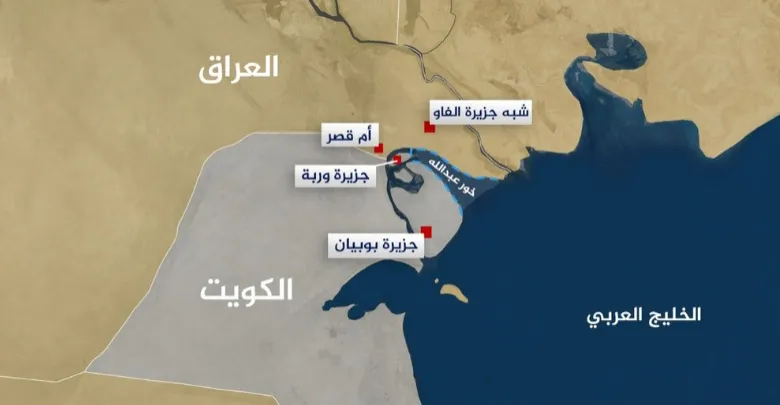
Diplomatic tensions between Iraq and Kuwait have been escalating for years over the issue of demarcating the maritime border beyond point (162), which is the maritime extension that has not been completed in its demarcation between the two countries since the issuance of Security Council Resolution No. (833) in 1993.
In this context, the Saudi Ministry of Foreign Affairs stated in a statement that it is monitoring with great interest and concern the lists of coordinates and the map deposited by Iraq with the United Nations, and what it included of parts of the submerged divided area adjacent to the Saudi-Kuwaiti divided area, in which the Kingdom shares with Kuwait ownership of the natural resources in accordance with the agreements concluded and in force between them, and based on the provisions of the United Nations Convention on the Law of the Sea of 1982.
She added that these coordinates represent a violation of the State of Kuwait’s sovereignty over its maritime areas and water heights such as “Fasht Al-Qaid” and “Fasht Al-Aij”.
In contrast, the UAE called for addressing the maritime coordinates dispute between Kuwait and Iraq through “constructive dialogue and diplomatic channels” with the aim of enhancing the security and stability of the region.
The UAE Ministry of Foreign Affairs affirmed in a statement its full and unwavering solidarity with Kuwait in all measures it takes to protect its legitimate rights and interests, reiterating its support for Kuwait in the face of any infringement on its sovereignty or national interests.
She expressed her concern and condemnation of the lists of coordinates and the map deposited by Iraq with the United Nations, and the potential infringement on Kuwait’s rights in its maritime areas and waters, including the Al-Qaid and Al-Aij areas in the Gulf.
Meanwhile, Qatar announced its full solidarity with Kuwait regarding the lists of coordinates and maps submitted by Iraq to the United Nations, which it considered to infringe upon Kuwaiti sovereignty over its maritime zones and its fixed and stable heights.
The Qatari Ministry of Foreign Affairs confirmed that it is following this issue with interest in light of what is related to the maritime areas between Kuwait and Iraq.
For its part, Bahrain confirmed that it is monitoring what was stated in the Iraqi coordinates, stressing Kuwait’s full sovereignty over its maritime zones and water heights, and rejecting any claims from other parties.
Manama called on Iraq to respect the historical relations between the two countries and to act in accordance with the rules of international law and the 1982 United Nations Convention on the Law of the Sea.
For its part, the Sultanate of Oman declared its solidarity with Kuwait and its sovereignty over its maritime zones and fixed and stable water heights, as stated in the lists of coordinates and the map deposited by Iraq.
In the same context, Egypt stressed the need to respect Kuwait’s sovereignty, unity and territorial integrity and to ensure that there is no interference with its maritime borders.
In contrast, the Iraqi Ministry of Foreign Affairs confirmed yesterday, Sunday, that the deposit of the maritime zones map with the United Nations was based on a number of Iraqi laws, resolutions and statements related to Iraq’s rights and jurisdictions.
The ministry pointed out that defining maritime zones in accordance with the provisions of the United Nations Convention on the Law of the Sea is a sovereign matter, and no country has the right to interfere in it.
According to the Ministry, the Iraqi government’s decision No. (266) of 2025 was based on a number of laws, decisions and statements related to Iraq’s rights in its maritime areas, based on the provisions of the United Nations Convention on the Law of the Sea of 1982 and the rules of international law.
Days ago, Iraq deposited a complete map of its maritime zones with precise coordinates with the United Nations, in a move aimed at strengthening its maritime rights and bolstering its negotiating position on issues related to maritime borders, according to what the Director General of the General Company for Iraqi Ports, Farhan Al-Fartousi, told Shafaq News Agency.
Al-Fartousi explained that this step supports Iraq legally and technically in any international discussions related to the demarcation of maritime borders, especially with regard to the Khor Abdullah file after pillar (162), which enhances Iraq’s ability to protect its maritime rights at the international level.
The 2012 Agreement on Navigation in Khor Abdullah between Iraq and Kuwait is a technical and administrative remedy for the effects of the former regime’s invasion of Kuwait in 1990 and the resulting demarcation of borders under Security Council Resolution No. (833) of 1993. Article Six of the Agreement affirmed that it “does not affect the borders between the two parties in Khor Abdullah as determined by Security Council Resolution No. (833) of 1993.”
The Iraqi Council of Ministers approved the draft ratification law at the end of 2012, and the House of Representatives approved it by a simple majority under Law No. (42) of 2013, and it was published in the Iraqi Gazette in issue (4299) dated 11/25/2013.
The Federal Court also issued its decision No. (21/Federal/2014) dated 12/18/2014, as it distinguished between the law regulating the process of ratifying treaties, which requires a two-thirds majority according to Article (61/Fourth) of the Constitution, and the law ratifying a specific agreement, which is approved by a simple majority based on Article (59/Second).
shafaq.com
