Following Al-Sadr’s decision, is the time approaching for the state to monopolize weapons in Iraq?
Following Al-Sadr’s decision, is the time approaching for the state to monopolize weapons in Iraq?
2026-05-28
 Shafaq News – Baghdad
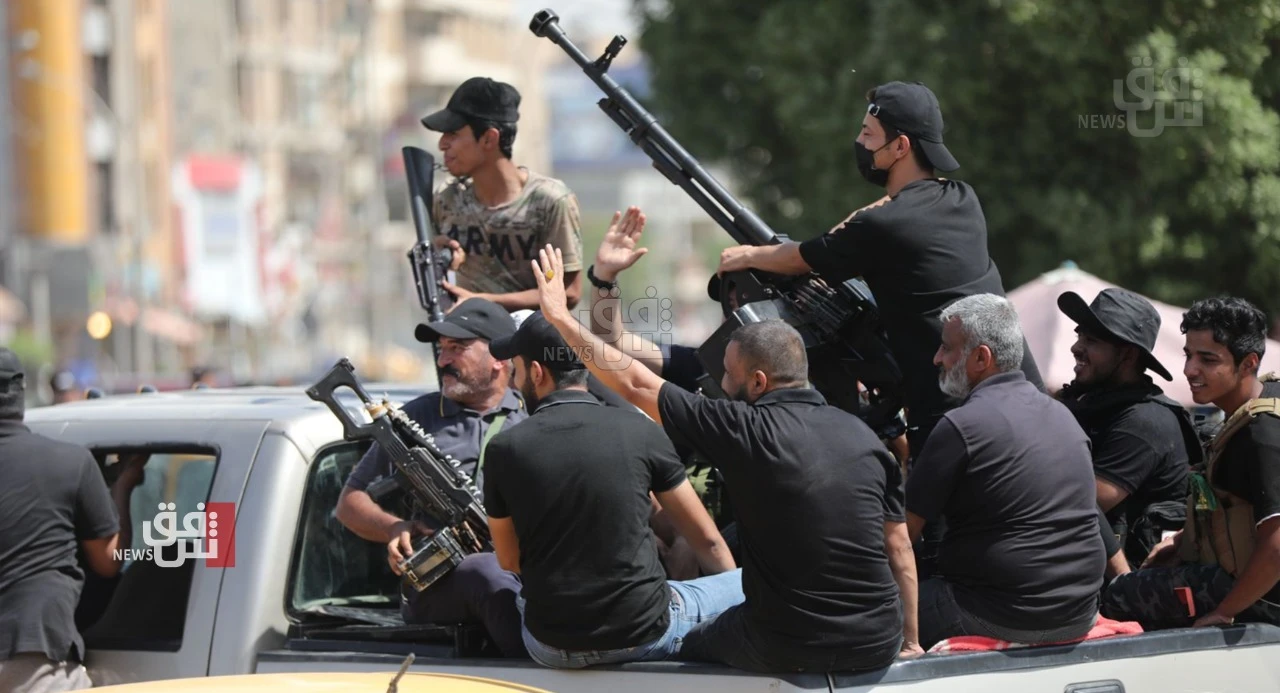
The issue of armed factions in Iraq has returned to the forefront of the scene, after the leader of the Shiite National Movement, Muqtada al-Sadr, announced yesterday, Wednesday, the disassociation from the Peace Brigades and their integration into the state, in a move that has reopened the debate about the future of uncontrolled weapons and their relationship with state institutions.
The move, which was welcomed by the newly formed Iraqi government headed by Ali Faleh al-Zaidi, came in a broader context of international pressure, especially from the United States, which links support for the Iraqi government with controlling armed factions and reducing their military and political influence within the country.
Origin of the factions
Most of the current armed factions trace their roots back to after 2003, when armed formations emerged in connection with the security vacuum that followed the American invasion of Iraq, and then expanded significantly after ISIS invaded large Iraqi cities in 2014.
At that stage, the Peace Brigades were formed as a military force in response to al-Sadr’s call to protect holy sites, in parallel with the integration of other factions into the Popular Mobilization Forces, which later became an official umbrella for a large number of armed formations.
But this merger did not end the multiplicity of power centers, but rather established a complex scene that combines the state, factions, and political and partisan authorities, which made the “weapons control” file one of the most problematic files in Iraq.
Chest and weapon
Al-Sadr is seen as one of the most prominent players in this matter, as he previously founded the “Mahdi Army” after 2003, before later dissolving it and reconstituting the “Peace Brigades” forces in 2014.
In a new statement, al-Sadr said that the disbanding of the Peace Brigades “comes from the public interest and to avoid the dangers threatening the nation,” calling for the transformation of all its affiliated civilian bodies into an unarmed civilian framework, and the complete handover of the military file to the state.
According to observers, this step represents a shift from rhetoric demanding the restriction of weapons to practical action within the movement’s own structure, which has placed the rest of the factions before a direct political test.
State priority
For his part, Iraqi Prime Minister Ali Faleh al-Zaidi welcomed the initiative, considering it “an important step to enhance stability and consolidate the principle of the state’s monopoly on weapons.”
Al-Zaydi called on all factions to join under the umbrella of the state, stressing that “the state is the only entity authorized to bear arms and enforce the law.”
In this context, researcher and academic Alaa Najah confirms that the government’s position is not new, telling Shafaq News Agency, “The Prime Minister has emphasized more than once the consolidation of the principle of restricting weapons to the state, which enhances the prestige of institutions, preserves internal stability, and reassures the Iraqi public.”
Najjar adds that “building a strong state begins with consolidating the monopoly of weapons in the hands of official institutions, as it is a fundamental step to protect sovereignty and enhance security and stability, away from escalation or division.”
Factional divisions
Despite the official welcome, the position within the armed factions remains divided. According to reports and statements circulating, some factions have expressed initial willingness to engage in the “weapons regulation” process, while other factions, most notably the Al-Nujaba Movement and Kataib Hezbollah, reject any path that leads to the surrender of weapons.
In this regard, writer and political researcher, Muhammad Al-Yasiri, says that “the issue is not about handing over weapons, but about restricting and controlling them,” adding to Shafaq News Agency that “some factions have expressed support for the restriction project, while others are looking for guarantees related to responding to any potential external threat.”
Al-Yassiri explains that there is a “difference between the Iraqi and American visions,” indicating that Washington focuses on stopping the use of drones and missiles, while Iraq talks about regulating heavy and medium weapons.
Multiple decision-making centers
On the other hand, analysts believe that the difficulty of the factions file is not only related to the Iraqi interior, as political analyst Ramadan Al-Badran says that Al-Sadr’s recent move “reflects a national orientation that supports the state,” but he points out that the other factions “differ in the nature of their affiliation, as some of them are influenced by external forces and do not have complete independence of decision.”
Al-Badran adds to Shafaq News Agency that the factions most closely linked to the Iranian Revolutionary Guard need “solutions that go beyond Iraq” and require broader regional coordination, considering that “the Iraqi political system itself is responsible for producing this structure during previous stages.”
American pressure
On the international front, the United States is intensifying its pressure on Baghdad, linking support for the Iraqi government to the removal of armed factions from state institutions.
Reports indicate that Washington is stipulating that armed factions cannot participate in the government unless they are disarmed, in addition to halting government funding for some formations, which further exacerbates the internal political situation.
Observers believe that Iraq today faces two options: either continuing the policy of “containment” adopted by previous governments, or moving towards a real restructuring of the relationship between the state and the factions.
But past experiences, especially during the tenure of former Iraqi Prime Minister Mustafa Al-Kadhimi, showed the limits of direct confrontation, after clashes between government forces and armed factions ended with the state backtracking on some of its steps, according to observers.
shafaq.com
