Factories shut down and contracts stalled: A research center lays out a roadmap to save Iraqi industry.
Factories shut down and contracts stalled: A research center lays out a roadmap to save Iraqi industry.
2026-08-29
 Shafaq News – Special Translation
Iraq needs genuine industrial reform to build a state, because success is not measured by the number of contracts, committees and employees, but rather, according to the Amman-based “ Center for Links for Research and Strategic Studies ” institute, by answering questions such as: How many factories have been revived? How many real job opportunities have we created? How much investment have we attracted? How much technology have we transferred? How much import have we replaced with real Iraqi production? How many dollars have we added to Iraq’s exports?
The “Links Center” said in a report from America, translated by Shafaq News Agency, that Iraq possesses great industrial assets that are rarely found together in one country, including vast oil, gas and mineral resources, a large local market, and a geographical location that connects the Gulf with Turkey, Iran and the Levant, in addition to a workforce that can be developed to become a base for manufacturing and export industries capable of diversifying the economy and reducing dependence on oil and imports.
However, the report considered that the Iraqi industrial sector is still far below its true potential, pointing to the existence of dozens of factories that have stopped working or are operating below their capacity, while imports strongly compete with local products, and investors face lengthy and multi-agency procedures, while many government companies rely on partnership and rehabilitation contracts with the private sector to restart their factories.
Therefore, the report concluded that the problem cannot be reduced to a single word such as “corruption,” explaining that what appears when studying the reality of the Ministry of Industry and Minerals is that it is an intertwined system of administrative inefficiency, weak governance, bureaucracy, inflated labor, the failure of public companies, weak transparency, and the abundance of partnership contracts, in addition to judicially proven corruption cases and other suspicions that warrant investigation.
He continued, saying that the real question is not: Is there corruption or not? Rather: Why are Iraq’s resources, factories and institutions not being transformed into production, exports, job opportunities and economic growth?
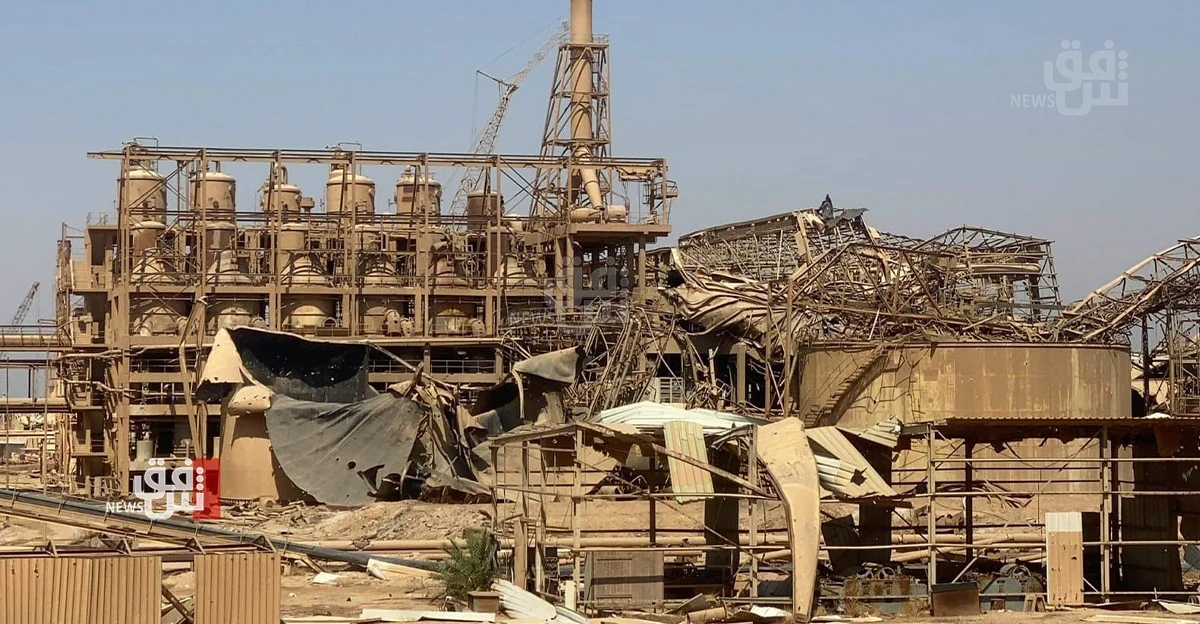
The report addressed 12 reasons for this, stating firstly that the Ministry of Industry oversees a large network of government companies and factories, and data published in 2026 indicates the existence of 31 public companies and 312 factories, of which 225 are operational and 87 are closed.
He pointed out that the existence of this number of closed factories raises fundamental economic and administrative questions: What are the reasons for the closure of each factory? Is the problem in the old technology, or the management, or the lack of funding, or the energy, or the external competition, or the availability of raw materials? And why do some facilities continue for many years without a clear decision to rehabilitate them, convert them, close them down, or involve the private sector in them?
Regarding the second reason, the report also discussed disguised unemployment and the bloated administrative apparatus, adding that one of the most serious questions related to public companies is the extent to which the number of workers is proportional to the actual size of production.
He explained that the presence of employees, technicians and engineers in the Ministry of Industry is normal and necessary, as industry needs engineering, research and development, quality control, marketing, investment, planning, maintenance, finance and legal affairs. However, the problem begins when a factory that is shut down or has weak production has a large number of workers without corresponding production or appropriate revenues.
He went on to say that in such a case, what is known economically as disguised unemployment appears, which he described as not necessarily criminal corruption, because it may be the result of a long economic legacy, or government appointments, or factory closures, wars, and failure to modernize production lines, but it turns into chronic administrative and financial waste when the situation continues for years without retraining or redistributing workers, developing the facility, or measuring their productivity.
He added that the solution is not to lay off employees en masse, but rather to put in place a program to rehabilitate the workforce and transfer skills to modern industries.
In the third reason, the report addressed the ministry’s announcement that it has 144 partnership contracts with the private sector under implementation, in addition to about 90 contracts being evaluated, bringing the total to 234 contracts. It added that the danger in this begins when the partnership contract turns from a means of developing industry into a permanent alternative to reforming government companies or establishing a national industrial policy.
He pointed out that the ministry’s success is not measured by the number of contracts it has signed, but rather by the actual investments, increased production, technology transfer, job creation, increased state share, development of local products, and increased exports that these contracts have achieved.
Fourth, the report stated that the biggest regulatory problem is not the existence of partnership contracts, but rather the extent to which information related to them is available and clear, as the name of the investor and the real owners of the company must be available, the value of the promised and implemented investment, the evaluation of the state’s assets included in the contract, the percentage of state profits, the investor’s percentage, the duration of the contract, the targeted production capacity, the number of new jobs, the percentage of local content, the volume of exports, environmental obligations, and performance indicators.
In point five, the report addressed the issue of corruption, stating that the Ministry of Industry and its companies have witnessed, over the years, cases, some of which ended in court rulings related to violations in contracts or job duties, adding that these cases mean that the risks of corruption in contracting are not entirely hypothetical.
The report called for a legal distinction to be made between three levels: corruption proven by a court ruling, suspected corruption under investigation, and a weak or non-economic administrative decision that does not necessarily constitute a crime, adding that mixing these levels weakens any real investigation.
The report identified another set of reasons: bureaucracy and the complexity of the investment decision; the multiplicity of committees and weak individual responsibility, since when a project succeeds, many parties share the achievement, and when it fails, it is difficult to identify the person or entity that caused the delay.
Another reason is the weak link between industry and scientific research, as universities and research centers should be part of the industrial system, as in Germany, Canada and South Korea.
Among the reasons he identified was also the weak focus on exporting, as it is not enough for a factory to produce for the local market, but it is evaluated according to its ability to compete and export.
The report stated that Iraq needs to shift from the slogan: “Supporting the national product” to “Manufacturing an Iraqi product that can compete globally.”
Another reason is that the report addressed the concept of “Made in Iraq,” explaining that protecting the national product is necessary, but it should not turn into protecting a product that does not contain real Iraqi value.
The report also addressed the problem of electricity, energy and infrastructure, as it is not possible to build a competitive industrial sector with intermittent electricity and high-cost energy because the investor calculates the cost of the unit produced, not just the value of the land or tax exemption, noting that new industrial cities must be pre-equipped with electricity, gas, water, roads, communications and logistics services.
Under reason 12, the report said that Iraqi industry faces great competition from imported products, but the solution is not to close markets randomly, adding that protection should be temporary and conditional on performance, so that, for example, an emerging industry can be protected for 5 years, provided that it raises its productivity annually, increases the percentage of local components, reduces costs, and starts exporting.
He went on to say that if the company continues to rely on government protection forever without development, then the Iraqi consumer will pay the price.
The report pointed out that the main goal of a modern Ministry of Industry is not to directly manage thousands of workers and government factories, but rather to create an environment that enables companies to grow, innovate and compete globally. It explained that for this purpose, ministries and industrial institutions in advanced economies work to attract foreign investment, finance innovation, research and development, support small and medium enterprises, develop strategic industries, provide skilled labor, link universities with factories, protect competition and open foreign markets to national products.
roadmap
The report presented what it called a “proposed reform roadmap for the Iraqi Ministry of Industry,” which includes conducting a comprehensive audit of all government companies and factories and classifying them into successful factories that can be expanded, factories that can be reformed, factories that need a strategic partner, and factories that have no economic viability in continuing in their current form.
He also proposed the creation of a unified transparency platform for partnership contracts that publishes details of all contracts, financial results, and productivity, and the imposition of an independent audit before signing any large partnership contract so that state assets are assessed, feasibility studies are conducted, and a fair economic ratio is determined for both parties, and the creation of a public register of the true beneficial owner of each company that enters into a government contract to prevent shell companies or companies secretly linked to influential people.
The report also suggested converting industrial investment into a single electronic window so that the investor submits one application and the state takes care of coordinating approvals between its institutions.
The report also suggested setting legal time limits for approvals, so that if the department does not respond within a specified period, the request should be automatically escalated to a higher level.
The report called for a review of the workforce and the launch of a broad retraining program in automation, renewable energy, modern maintenance, industrial artificial intelligence and quality control. It also suggested linking the salaries and bonuses of senior management in government companies to performance indicators rather than to the number of official letters and meetings.
The report also proposed the creation of a National Industrial Development Council comprising industry, trade, finance, energy, planning, higher education, the Investment Authority and the private sector to ensure that the state’s industrial policy does not operate within a single, isolated ministry.
The report called for selecting a limited number of sectors in which Iraq has a real advantage, such as petrochemicals, fertilizers, food industries, pharmaceuticals, building materials, minerals and energy-related industries, and focusing resources on them instead of scattering them.
He also proposed adopting a clear policy to increase Iraqi added value and the percentage of local content in products, calling for a gradual shift in industrial policy from production for the Iraqi market only to an export-oriented industrial policy targeting the Gulf, regional and global markets.
While the report suggested the creation of fast and specialized commercial courts or tracks for investor disputes so that the project would not remain for years waiting for the dispute to be resolved, it also called for the publication of an annual public report entitled “The State of Iraqi Industry” that includes each company’s production, profits, losses, exports, number of employees, contracts and investments.
The report concluded by saying that fundamental reform must change the question the Ministry of Industry asks itself. Instead of: How many companies and factories do we own? The question should become: How much economic value has industry added to Iraq? Instead of: How many partnership contracts have we signed? It should become: How much investment has turned into a productive factory? Instead of: How many employees do we have? It should become: What is the productivity of the employee and the facility? Instead of: How many products have we protected from imports? It should become: How many Iraqi products have become capable of being exported?
shafaq.com
