Exclusive: Consulate, Protection, and Investments: Kurdistan Region is Washington’s Strongest Partner in the Region
Exclusive: Consulate, Protection, and Investments: Kurdistan Region is Washington’s Strongest Partner in the Region
2025-12-05 08:41
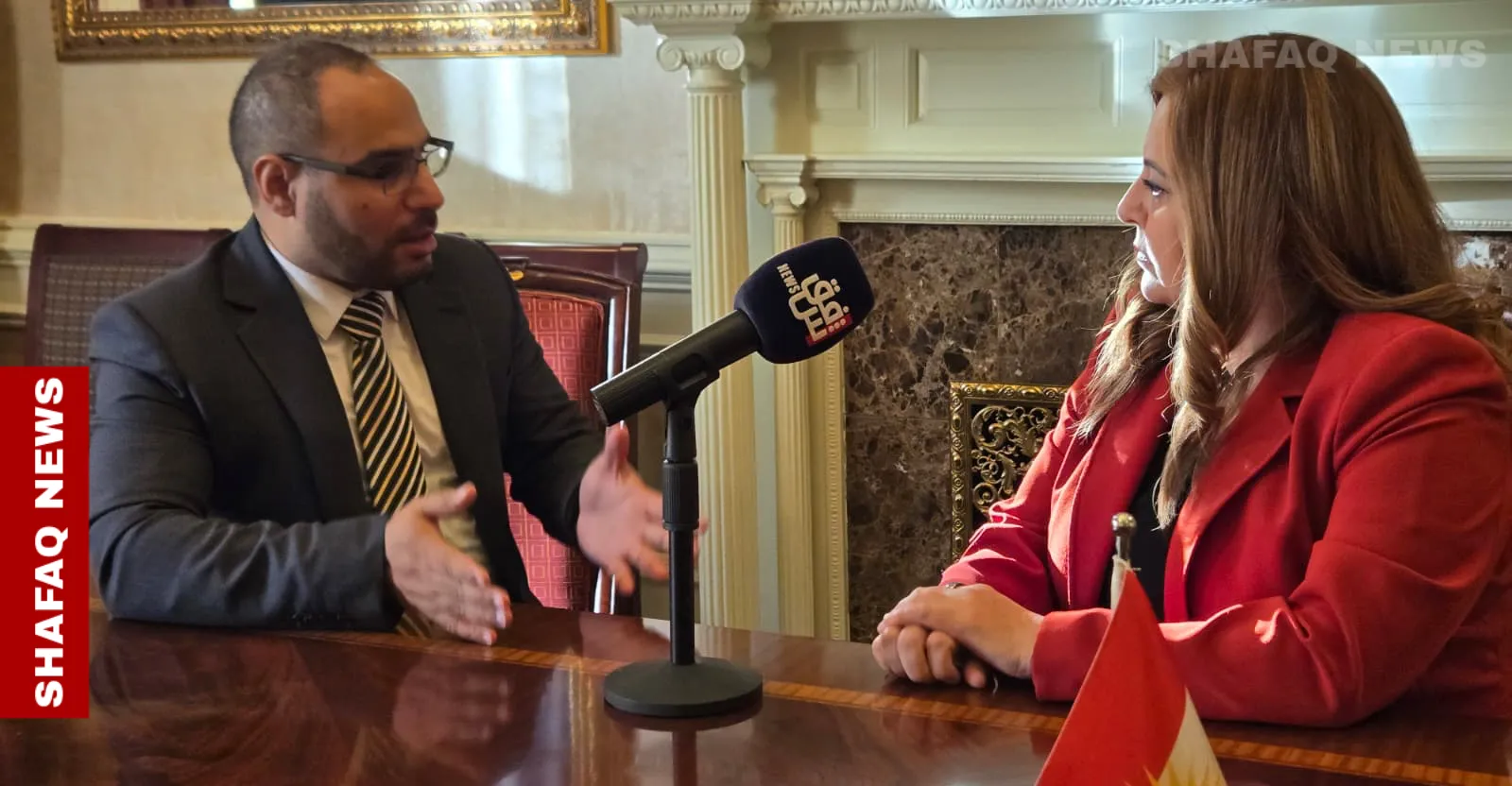 Shafaq News – Washington/ Mustafa Hashim
The Kurdistan Regional Government’s representative in Washington, Triva Aziz, affirmed on Friday that the region’s standing in the American capital “remains strong and exceptional,” and that the relationship between the two sides is “deeply rooted, strategic, and extends back decades.”
This comes at a complex regional moment, with increasing security tensions, and Washington seeking to redefine its role in the Middle East.
In an exclusive interview with Shafaq News Agency, Aziz stressed that the priorities of President Donald Trump’s administration in the Middle East—especially security, energy, and stability—are completely aligned with the vision of the regional government.
She added: “Our partnership with the United States is decades old, and it is a partnership built on trust. Washington sees the Kurdistan Region as a reliable and long-term partner at a moment when energy and security have become more important than ever.”
She noted that the opening of the world’s largest US consulate in Erbil reflects this clear American understanding, considering that the opening of the consulate is an explicit vote of confidence in the region’s future and stability.
The Kurdistan Regional Government’s representative in Washington continued: “This building is not just a diplomatic facility, but a strategic operations center for the United States in Iraq and the Middle East.”
Mark Savaya
Regarding the controversy sparked by the appointment of US Special Envoy to Iraq Mark Savaya, Aziz said that the regional government views the move very positively, welcoming any high level of US interest in Iraq and the region.
She pointed out that “Safaya’s appointment confirms that the US administration prioritizes the relationship with Baghdad and Erbil,” describing his statements about restricting weapons to the state and reforms as “in line with the interests of the region.”
According to Aziz, these points are consistent with the Kurdistan Region’s vision of “We want a stable Iraq and weapons under the authority of the state only,” and she expects Mark Savaya to have “an effective political and security role.”
She added: “We look forward to the new envoy helping us expedite the arrival of air defense systems, especially since the region urgently needs anti-drone systems.”
Khormor attacks
Aziz commented on the recent attack targeting the Khor Mor facility, one of the most important gas centers in Iraq, saying:
“The attack on Khor Mor was a direct blow to energy security, not only in Kurdistan, but for all of Iraq. This facility supplies millions of citizens with electricity.”
She added, warning: “We appreciate the American condemnation, but it is not enough. We need practical measures to protect vital infrastructure. The only beneficiaries of these attacks are those who want to destabilize Iraq and undermine American interests.”
The Kurdistan Regional Government’s representative in Washington did not hide her fear that these attacks would turn into a tool for political blackmail, adding: “Unfortunately, oil and gas fields have been targeted repeatedly. If these sites are not protected, they will be used to put pressure on Erbil, Washington, and American companies operating in the region.”
$110 billion partnership
In this regard, Aziz spoke about the contracts recently signed with giant American companies, worth between $100 billion and $110 billion, saying: “These contracts are a cornerstone of our economic partnership with the United States. They are a clear message that American companies see the region as a stable and promising market.”
She emphasized that the regional office in Washington does not merely manage meetings and visits, but works on a clear economic vision for the coming years, saying: “We have an economic roadmap for the next three years that focuses on quality investment, and we measure success by the quality of projects, not just their size—through long-term partnerships, technology transfer, and the development of vital sectors such as energy, agriculture, and digital transformation.”
Lobby conflict
Regarding the division within Washington between a faction calling for reduced involvement in the Middle East and another that sees the need to strengthen the American presence in Kurdistan, Aziz said: “Washington is indebted to competing viewpoints… but we have maintained strong bipartisan support for decades… our message is simple (the stability of Kurdistan serves both Iraq and American interests).”
Regarding the impact of the divisions between Erbil and Sulaymaniyah and the disruption of government formation in the region, she explained that “the United States understands that political disagreements are part of any democratic system… What matters to it is the stability of the region and its ability to provide security and a permanent alliance with Washington. These fundamentals have not changed.”
Kurdish identity
Aziz spoke about her role as the region’s representative in Washington and her Kurdish-American identity, adding: “My experience spans twenty years in foreign and legislative policy. I understand the language of Washington very well and how decisions are made there. At the same time, I remain close to the pulse of the Kurdish street and able to convey its concerns honestly and credibly.”
When asked to summarize the region’s message to American policymakers in one sentence, she said firmly: “The Kurdistan Region, as the United States’ most reliable ally, needs consistent political and security support to protect its people, stabilize its economy, and remain an effective partner in an increasingly dangerous environment.”
Despite the internal and regional challenges, Aziz expressed a positive vision for the future, stating her optimism: “We are optimistic about continuing the partnership with the United States, developing defense capabilities, and expanding investments, as the region can enter a phase of stability and growth. Although the challenges are real, the opportunities are greater.”
shafaq.com
