Draft 2027 budget: Dollar at 1500, broad taxes, and salary cuts
Draft 2027 budget: Dollar at 1500, broad taxes, and salary cuts
2026-11-26
 Shafaq News – Baghdad
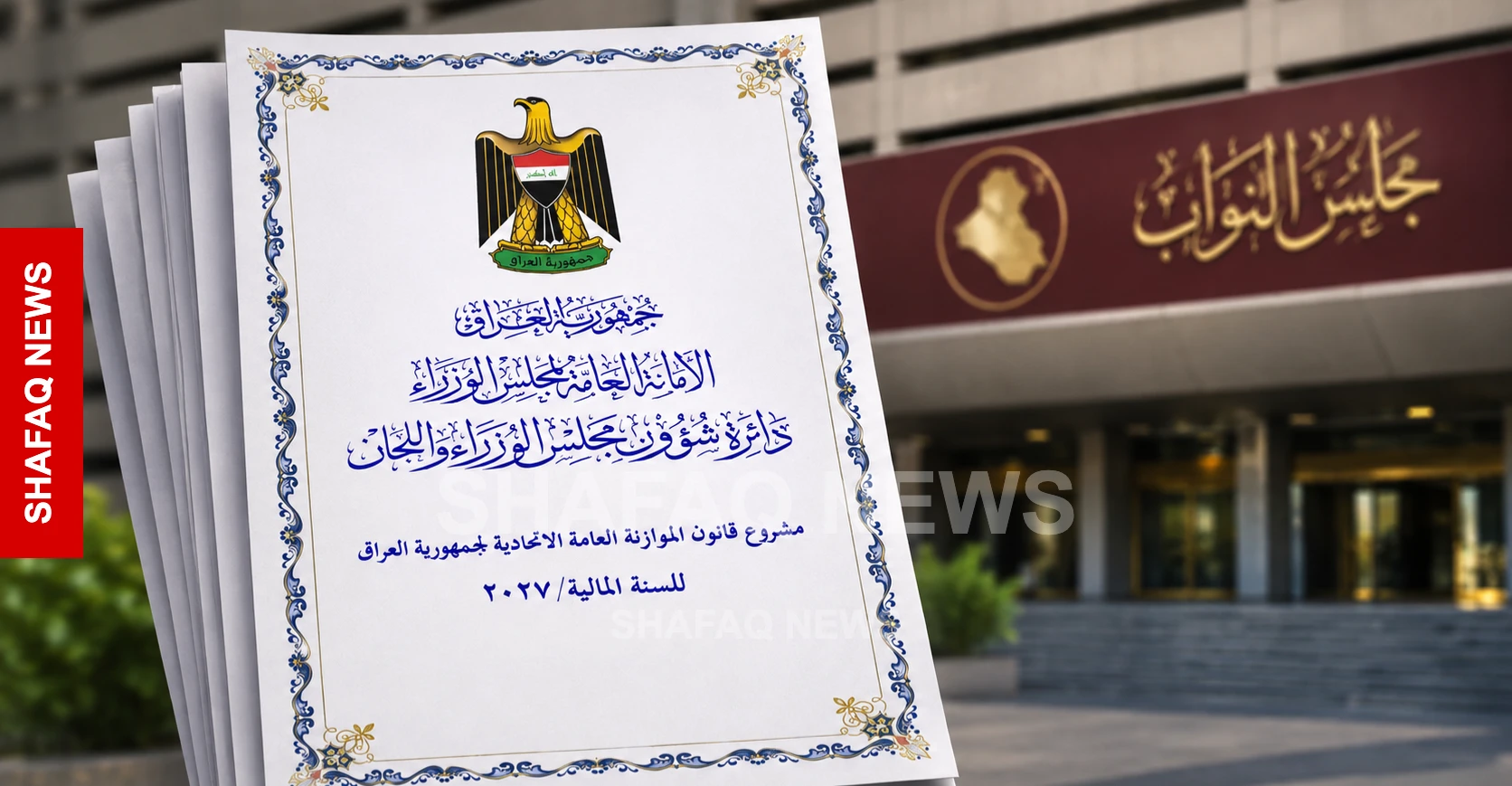
Shafaq News Agency obtained the latest version of the draft federal general budget law for Iraq for the fiscal year 2027, which includes expenditures exceeding 217 trillion dinars, a planned deficit exceeding 42 trillion dinars, as well as the creation of a ministry, an authority, two sovereign and armament funds, contracting with 120,000 people, and imposing fees and deductions to finance the new funds.
The draft, along with its financial tables, attachments, and government correspondence, is 144 pages long. The bill consists of 29 articles distributed across three chapters, addressing revenues, expenditures, deficit, program and performance budgeting, and general and concluding provisions.
Revenues, expenditures, and deficit
According to the draft, Iraq’s public revenues in 2027 were estimated at 175.086 trillion dinars, of which 146.573 trillion dinars were oil revenues, and 28.513 trillion dinars were non-oil revenues.
The revenues were calculated based on a price of $58 per barrel of exported crude oil, a total export rate of four million barrels per day, and an exchange rate of 1,500 dinars per dollar.
Oil revenues constitute about 83.7% of total estimated revenues, while public expenditures amount to about 217.248 trillion dinars, with a planned deficit of 42.161 trillion dinars.
The draft includes covering the deficit through a range of internal and external financing sources, including issuing treasury bills, bonds and national bonds, and borrowing from government banks and international financial institutions.
It also proposes allocating 30% of the additional revenues generated as a result of oil prices rising above the price approved in the budget to pay off the arrears of the governorates, and directing the remaining 70% to cover the deficit.
Kurdistan Region’s share
The draft allocated Article 10 to regulating the financial and oil relationship between the federal government and the Kurdistan Regional Government. This is one of the articles that will be subject to amendments in light of the results of the ongoing talks between Baghdad and Erbil, and the anticipated agreements to address the disputes between the two sides.
The draft, in its current form, sets the Kurdistan Region’s share at 12.67% of the total actual spending, including governing, current and investment project expenditures, after excluding sovereign expenditures.
It also included settling the financial dues between the federal government and the regional government for the years from 2004 to 2026, amounting to nine trillion and 329 billion dinars, based on the rights and obligations stipulated in the federal budget laws for each fiscal year, to be settled within seven years.
In the oil file, the draft stipulates that the Kurdistan Regional Government is committed to marketing no less than 445,000 barrels per day of oil, in coordination with the Federal Ministry of Oil, through the Iraqi Oil Marketing Company “SOMO” via the Turkish port of Ceyhan. In the event that exporting is not possible, the quantities will be delivered to the Federal Ministry of Oil for local use as needed.
The draft also includes the transfer of non-oil revenues to the state treasury, in accordance with the Federal Financial Management Law, and subjecting the data related to those revenues to monthly auditing by the Federal and Regional Financial Control Offices.
It also proposes settling the balances owed by the Kurdistan Regional Government to the Trade Bank of Iraq (TBI) at government and private banks, amounting to three trillion and 446 billion dinars, through scheduling monthly installments to be deducted from the region’s share starting from 2027 for a period of seven years.
The article also included the delivery of gas produced in excess of the region’s needs to the federal government, and deducting its value from the region’s entitlements in case of non-delivery, as well as restricting contracts with local and foreign companies in the oil and gas sectors to the federal Ministry of Oil.
In return, the draft obliges the Federal Ministry of Finance to fund the region’s entitlements on a monthly basis, in accordance with the obligations specified in the article, and to conduct accounting settlements regarding the oil and non-oil rights and obligations of both parties on a quarterly basis, after they have been audited by the Financial Control Bureau.
Sovereign Generations Fund
Among the most prominent things included in the draft was the establishment of a “Sovereign Generations Fund” with a capital of 500 billion dinars, linked to the Federal Cabinet, and enjoying legal personality and financial and administrative independence.
The fund’s resources include financial allocations from the federal budget, grants, gifts and donations from within and outside the country, and funds recovered from corruption cases, whether in cash, real estate, gold, jewelry, vehicles or other assets.
Its resources also include lands allocated by the Ministry of Finance, state properties and surplus assets abroad, and what is transferred to it from the transfer of ownership of public companies, lands and real estate pursuant to Cabinet decisions.
The draft proposes collecting a percentage of the funds for the benefit of a wide range of activities and revenues, including taxpayers, customs transactions, registered companies, revenues of universities, schools, hospitals, clinics, private beauty centers, and telecommunications and internet companies.
The proposed deductions extend to crude oil sales both domestically and internationally, state investment and operating contracts, vehicle registration and renewal, electricity, water and telecommunications collection fees, entry and residency visa fees, fuel sales and partnership contracts with the private sector.
The draft also proposes collecting 1% of the revenues of federations, unions, associations, clubs, and chambers of commerce and industry for the benefit of the fund.
Under the project, the Iraq Development Fund established under Budget Law No. 13 of 2023 will be abolished, and all its resources, assets and obligations will be transferred to the Sovereign Generations Fund, while the Iraqi External Development Fund will be linked to the new fund.
Armament fund and deductions from security personnel salaries
Article 23 of the draft law stipulates the establishment of an “Arms Fund,” linked to the Commander-in-Chief of the Armed Forces, to be financed from allocations earmarked in the federal budget, 5% of the revenues of the Sovereign Generations Fund, as well as internal and external grants, gifts and donations.
The fund’s sources of funding include deducting 0.5% from the salaries and allowances received by members of the security forces.
It also includes the establishment of the “General Authority for the Development Road”, which is linked to the Federal Cabinet, and whose work is regulated by a system issued by the Council.
The Ministries of Finance and Planning shall add the necessary allocations to complete the Development Road project, with an amount not exceeding 1.5 trillion dinars, or its equivalent in crude oil.
The draft proposes allocating an amount not exceeding 500 billion dinars to complete the procedures for implementing the fourth ring road for the city of Baghdad, in addition to preparing the plans and requirements for the establishment of a second lane for the expressway dedicated to the movement of trucks and vehicles.
Appointments and contract confirmations
Regarding government employment, the draft stipulates the suspension of appointments to permanent positions, contracts, and daily wages, and the deletion of vacant job positions or those that will become vacant due to transfer, retirement, resignation, or death, while specifying a number of exceptions.
The exceptions include the regularization of contractors who are continuing in service, and the regularization of daily wage workers whose service exceeds three years, after conducting audits and cross-referencing by the Federal Board of Financial Control.
It also stipulates contracting with 120,000 people, with 50,000 contracts distributed between the Ministries of Interior and Defense and the Counter-Terrorism Service, and 70,000 civilian contracts distributed according to population ratios and in accordance with a plan set by the Cabinet.
The Federal Public Service Council is responsible for redistributing surplus employees and contractors from some entities to other entities, according to instructions issued by the Cabinet.
The draft proposes to stop the transfer or assignment of employees to the three presidencies and the ministries of oil, finance, defense, education, higher education and scientific research, foreign affairs, or any other entity to which transfer would result in an increase in salaries and allowances.
Taxes on home-based businesses, beauty services, and the internet
As part of efforts to boost non-oil revenues, the draft proposes continuing to impose a 10% sales tax on mobile phone and internet services, and expanding the scope of activities covered by taxes and fees.
It stipulates that homeowners who conduct business activities from within their homes and generate daily, monthly, or annual income shall be subject to the provisions of the Income Tax Law, according to the electronic collection system.
Sales tax provisions also include services provided in restaurants and hotels up to the second class, cosmetic surgery clinics, beauty centers, private hospitals, veterinary clinics, clubs, and sports and entertainment halls.
The draft grants the Cabinet, when necessary and based on a proposal from the Minister of Finance, the authority to amend the tax scale and postpone tax accounting for a period not exceeding six months, provided that the amendment does not include income taxes imposed on oil licensing companies and mobile phone and internet companies.
The draft includes imposing a fixed airport fee of 25,000 dinars per ticket for international travel and 10,000 dinars for domestic travel, with the fees to be collected at Iraqi airports and border crossings and recorded as final revenue for the state treasury.
The draft requires ministries, governorates and relevant authorities to collect electricity, telephone, water and sewage fees and other charges stipulated in applicable laws, and not to process transactions in government departments without the beneficiary submitting collection invoices.
It also stipulates the continued application of the electronic collection system and the automation of tax and fee collection procedures, whether through the public or private sector or in partnership between them.
Regulating advertising and social media
The draft includes measures to regulate the communications and media sector, including obligating social media companies and foreign and local digital broadcasting platforms to pay income tax, in coordination between the Media and Communications Commission and the relevant authorities.
The measures include imposing fees on the publication and promotion of advertisements via social media sites, including advertisements by celebrities and digital content owners, and registering local and foreign media agencies and websites operating in Iraq.
It also includes measures to regulate the import of communications devices and electronic equipment, and to limit the entry of counterfeit, stolen, and non-compliant devices that do not meet approved technical specifications.
The draft grants the Cabinet the authority to restructure loss-making public companies, change their affiliation and define their tasks, or abolish companies that cannot be reformed, based on proposals from the competent authorities.
It also allows ministries, governorates and entities not affiliated with a ministry to open the door to investment and partnership with the local and foreign private sector, in accordance with the regulations set by the Cabinet.
This includes the gradual shift from central funding to self-financing for some government institutions, including the Imam Al-Azam and Imam Al-Kadhim colleges, and the endowments offices, according to the mechanisms and timeframes specified in the project.
Social protection and salaries
The draft proposes allocating 3% of the Social Protection Fund’s revenues to the Ministry of Labor and Social Affairs, to achieve the objectives of the Social Protection Law.
The ministry is required to adopt population ratios and poverty rates, based on data from the Ministry of Planning, to include eligible individuals in the social protection network.
The Cabinet is also granted the authority to add financial allocations to cover the shortfall in compensation for employees and retirees, and the requirements of the Ministries of Electricity and Oil and the items of the ration card.
The draft includes the allocation of approximately 41.931 trillion dinars within the program and performance budget, distributed among six entities, with the Ministry of Electricity receiving approximately 90% of it, with allocations amounting to 37.734 trillion dinars.
Among the allocations of the Ministry of Electricity, approximately 24.6 trillion dinars were earmarked for the purchase and import of energy and fuel, and more than nine trillion dinars for the production of electrical energy, in addition to allocations for the rehabilitation and maintenance of transmission and distribution networks.
The draft also includes continued external borrowing and financing of new projects in cooperation with the World Bank, the Japan International Cooperation Agency, the German Development Bank, the Islamic Development Bank and international export financing and guarantee institutions, to implement projects in the electricity, water, health, education, agriculture, housing, transport and infrastructure sectors.
The final article of the draft law indicates that its provisions shall come into effect on January 1, 2027, after the completion of the procedures for its approval and publication in the Official Gazette.
shafaq.com
