Baghdad and Erbil move towards de-escalation: A broad meeting brings together the presidencies, leaders of the framework, and Kurdistan.
Baghdad and Erbil move towards de-escalation: A broad meeting brings together the presidencies, leaders of the framework, and Kurdistan.
2026-11-26
 Shafaq News – Baghdad
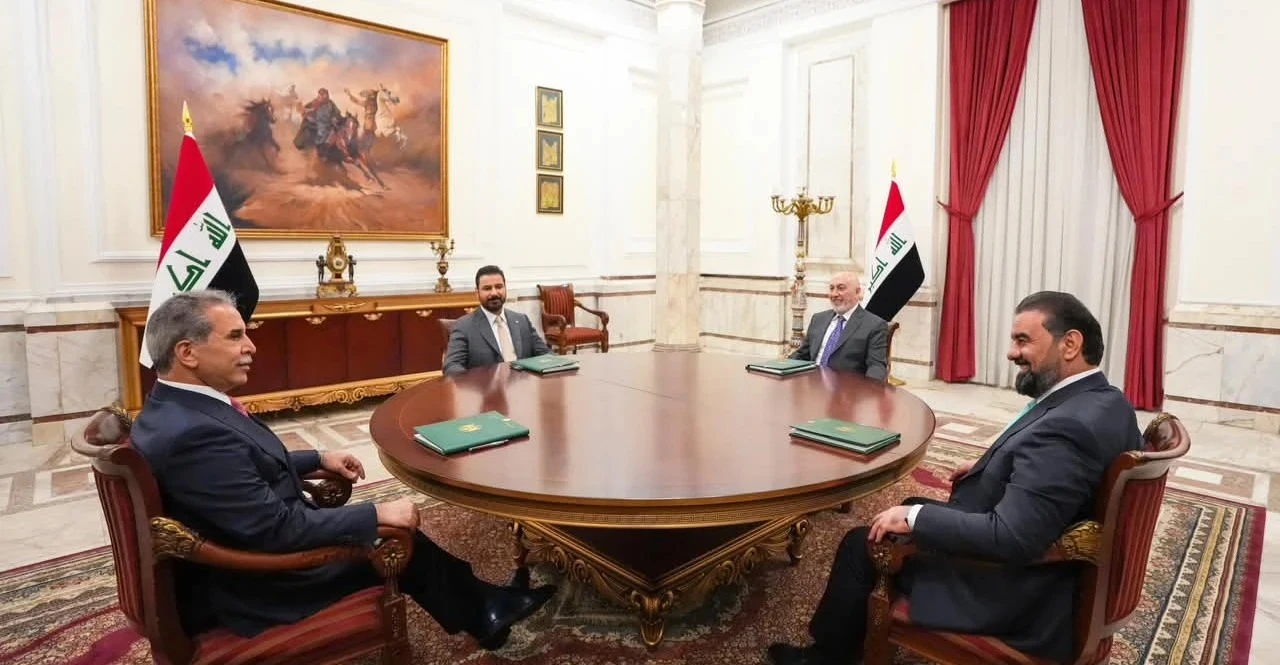
An informed political source revealed on Thursday that the most prominent leaders of the Coordination Framework and Kurdish leaders participated in the meeting called for by the President of the Supreme Judicial Council, Judge Faiq Zaidan, in the presence of the four presidencies, to discuss a constitutional way out of the crisis between the federal government and the Kurdistan Region, indicating a trend towards de-escalation and accelerating the approval of the oil and gas law.
The source told Shafaq News Agency that the meeting will include President Nizar Amidi, Prime Minister Ali al-Zaidi, Speaker of Parliament Hebat al-Halbousi, and Chief Justice Faiq Zaidan, along with a number of influential political leaders in the Iraqi scene.
He explained that among the participating leaders were the leader of the State of Law Coalition, Nouri al-Maliki, the leader of the Badr Organization, Hadi al-Amiri, the head of the National Wisdom Movement, Ammar al-Hakim, as well as the Prime Minister of the Kurdistan Region, Masrour Barzani, and the head of the Patriotic Union of Kurdistan, Bafel Talabani.
The source added that “there is more than one proposal to end the dispute between Baghdad and Erbil, most of which are based on constitutional texts,” indicating that among the proposals is reviewing maps of Iraq’s border strip with neighboring countries to the north, to discuss the issue of ownership of border crossings and the powers of their administration in light of the provisions of the constitution.
He pointed out that the political atmosphere is moving towards calming down and resolving disputes in a way that preserves the rights of Iraqis to their natural resources, noting that there is a trend towards approving the oil and gas law soon, which will regulate powers and prevent the renewal of disputes or differing interpretations in the future.
The four presidencies had agreed on Wednesday evening to hold a national dialogue at the beginning of next December, under the auspices of the head of the Supreme Judicial Council and with the participation of the concerned parties, to find constitutional solutions to the disputes between the federal government and the Kurdistan Regional Government.
The disputes between Baghdad and Erbil escalated last Tuesday, following Al-Zaidi’s issuance of a series of decisions that included the federal authorities taking over all border crossings in the region, limiting approvals for exporting oil and its derivatives to the federal Ministry of Oil, as well as the ministry taking over the management of the fields belonging to it and under the security control of the regional authorities in the governorates of Kirkuk, Nineveh, Salah al-Din and Diyala.
The decisions sparked rejection from Kurdish leaders, who stressed that they contradicted previous understandings between the two governments. Kurdistan Region President Nechirvan Barzani emphasized his rejection of addressing the region in military terms, calling for adherence to the constitution and respect for the region’s constitutional entity.
Amid the crisis, the Federal Supreme Court issued a decision on Wednesday confirming the constitutionality of the federal authorities exercising supervisory and control powers over border crossings throughout Iraq, including those located in the Kurdistan Region, taking into account the provisions of Article 114 of the Constitution related to customs administration in coordination with the regional and provincial governments.
The absence of a federal oil and gas law, which has been stalled since 2007, is one of the most prominent contentious issues between Baghdad and Erbil, given the differing interpretations of constitutional texts related to the management of oil wealth, contracting powers, production, export, and revenue distribution.
shafaq.com
