British report: Al-Shatri and Al-Sudani are the most likely candidates for prime minister as Washington and Tehran’s influence wanes
British report: Al-Shatri and Al-Sudani are the most likely candidates for prime minister as Washington and Tehran’s influence wanes
2025-11-27 05:55
 Shafaq News – Translation
A British report, published on Thursday, indicated that the forces of the Coordination Framework are moving faster than expected to agree on the leadership of the new government .
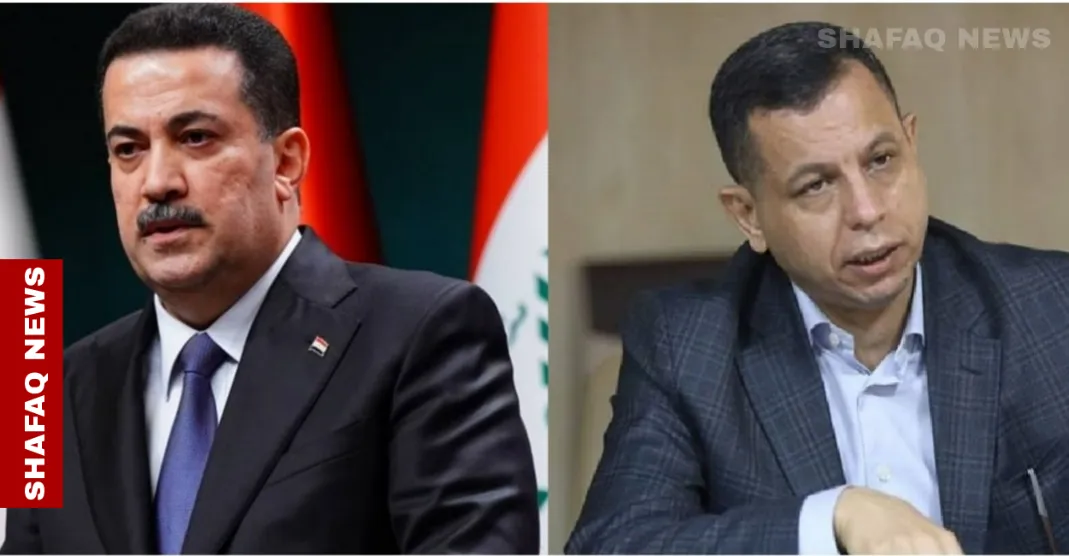
The “Amwaj” website explained in the report, which was translated by Shafaq News Agency, that the head of the intelligence service, Hamid al-Shatri, appears so far to be among the most prominent candidates to take over, without ruling out the chances of the outgoing Prime Minister, Muhammad Shia al-Sudani, who is still in the race .
According to the same website, the level of American and Iranian intervention in the current political negotiations is less than previously estimated .
Although “Amwaj” indicated in its report that the negotiations for the coordination framework and the exchange of names are taking place behind closed doors, it noted the emergence of several candidate names, and that the forces of the framework have set a series of conditions for this role that would limit the political independence of any future prime minister .
The British website relied on a report published by Shafaq News Agency, quoting Hassan Fad’am, a member of the Hikma Movement, on November 22, in which he said that the leader of the movement, Ammar al-Hakim, heads the nomination committee, and that the “criteria” for nominating the next prime minister “have been set,” noting that “most of the names being circulated are correct .”
In this context, the report addressed the names being circulated, which include Al-Sudani and Al-Shatri, in addition to former Prime Minister Nouri Al-Maliki, former Prime Minister Mustafa Al-Kadhimi, and Basra Governor Asaad Al-Eidani .
After the report discussed information published by Saudi media outlets about the existence of conditions and criteria that were set for appointing a new prime minister, including broad acceptance of him from the Iraqi political spectrum, and the ability to achieve balance in dealing with regional and international pressures, the report pointed out that the newspaper “Al-Sharq Al-Awsat” said that the prime minister-designate must adhere to a “pre-prepared political program” and refrain from establishing a new party or political bloc .
The report quotes political analyst Ali al-Bayati as saying that, given the recent regional tensions, “expect nothing but a weak prime minister.” It also quotes analyst Basim al-Khazraji as saying, regarding al-Sudani’s chances of winning a second term, that al-Sudani’s legacy of being “nothing more than a general manager” makes his chances positive .
For this reason, the report says, the much speculation about the premiership comes amid long-standing claims that Sudani is competing with prominent leaders in the coordination framework, that he has angered his Shiite allies by acting with increasing independence, and that he is seeking to marginalize them and obtain a second term in alliance with the Kurdish and Sunni blocs .
He adds that al-Sudani’s statement on November 18, that his bloc was “an essential part of the coordination framework,” reinforced the counter-narrative, which was that his goals were always “narrower than the idea of competing with his allies .”
The report explained that, from this perspective, Sudani’s electoral maneuver, referring to his running in the elections as part of a separate list, was probably primarily aimed at ensuring increased influence for him within the coordinating framework, and not outside of it .
The report continued, stating that reports indicating a consensus among the leadership of the Coordination Framework to prevent any candidate for Prime Minister from competing in the elections later, suggest that the Framework’s leaders consider the strong political position of the Sudanese to be a problem, and that any such scenario should be avoided .
According to the same report, the messages of the coordination framework are so far characterized by contradiction, recalling that several figures in the State of Law bloc led by Maliki publicly ruled out a second term for Sudani, but Maliki himself contradicted these statements in an interview conducted with him on November 22, where he said that no internal decision had been made to “deprive” Sudani of a second term .
The report also referred to a statement by a leader in the Badr Organization, who pointed out that al-Sudani “is still a candidate for the position,” adding that al-Sudani must nevertheless provide “guarantees regarding his management style” to ensure that he assumes the position again .
The report considered that the intensive activity within the coordination framework demonstrates its commitment to leading a rapid nomination process to select the Prime Minister .
The report added, quoting observers, that direct intervention by Washington or Tehran in determining the success of any candidate has diminished, at least compared to previous election cycles .
The report noted that recent statements by the US Special Envoy to Iraq, Mark Savaya, indicate that Washington supports al-Sudani, while the position of Tehran and the Arab Gulf states remains less clear .
The list of potential candidates appears to be shrinking, according to the report, which highlights Al-Shatri in particular as the most likely candidate to be nominated by the Coordination Framework, adding that observers consider Al-Shatri’s nomination to be supported by his security qualifications and his appearance as “non-partisan “.
But the report concluded by saying that, in the absence of any public confirmation of the status of any candidate, the field, it seems, remains wide open .
shafaq.com
