An American vision outlines a “roadmap” for the Gulf states’ relationship with Iraq amidst the war.
An American vision outlines a “roadmap” for the Gulf states’ relationship with Iraq amidst the war.
2026-04-24
 Shafaq News – Special Translation
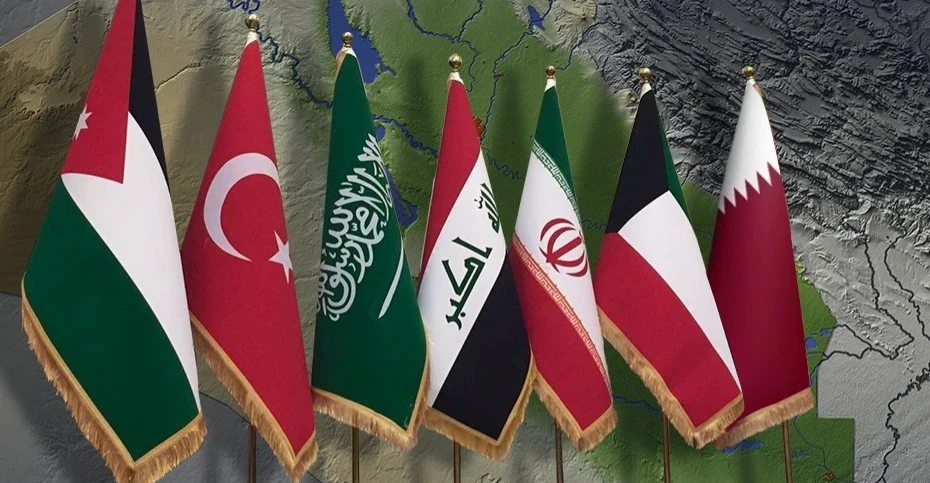
The Gulf Cooperation Council (GCC) states are taking a risk by proceeding cautiously and hesitantly in their relations with an open Iraq, fearing that Iraq may conclude that the Gulf states are not reliable partners and may turn to seek alternative partnerships, especially with Turkey, Iran, China, and others, according to the Washington-based Gulf International Forum research institute.
According to a report by the Gulf Affairs Foundation, translated by Shafaq News Agency, the fragile ceasefire between the United States and Iran did not restore the previous regional situation, but rather quietly reshaped it.
The American Institute explained in its report that Iraq, which has long been viewed through the lens of Iranian focus, may reposition its approach and policy towards the Gulf, adding that the real question is not about Iraq’s readiness, but whether the Gulf Cooperation Council countries are ready to leverage their influence to engage with Iraq as a changing regional actor before the opportunity is lost.
The report considered it important to clarify the position of Iraqi Prime Minister Mohammed Shia al-Sudani, when he informed Saudi Crown Prince Mohammed bin Salman of his refusal to use Iraq as a launching point for attacks against the Gulf states, as he was not describing the operational reality on the ground, but rather expressing a political stance during an ongoing regional war.
The report argued that the war rearranged the strategic geography of the region in ways that the Gulf has not yet fully grasped, adding that the traditional Gulf position towards Iraq was based on the idea of cautious engagement with it, with the constant assumption that it would remain an area of influence for Tehran. However, the war showed that this view was no longer in line with the facts on the ground, noting that Baghdad had moved towards the Gulf in the past 3 years more than the Gulf states had moved towards Iraq.
Therefore, the report continued, the question now for the Gulf Cooperation Council countries is whether they will meet Iraq where it stands now, or whether they will allow time to be wasted.
The report stated in this context that Sudan’s early contact with Saudi Arabia, Jordan and the UAE, which began before the war and continued through it, led to the creation of working channels that did not exist for most of the period after 2003.
Within what the report described as representing a coherent strategic direction on the part of Iraq, rather than a series of isolated signals, it addressed Iraq’s hosting of the Arab Summit in 2025, participation in every major Arab regional initiative, expanding trade participation between Iraq and Saudi Arabia via the Arar crossing, the Kingdom’s announcements regarding investment in Iraq, quiet security coordination, Iraq’s return to Arab energy infrastructure projects and hosting of tripartite meetings with Jordan and Egypt, and Iraq’s efforts to reduce dependence on Iranian gas imports.
According to the report, Al-Sudani summarized this position in an article he recently published in the American magazine “Newsweek,” where he described Iraq as a “connecting state, linking political systems, trade routes, and regional interests that others often view only through the lens of competition.”
While the report noted that all of this does not mean that “Iraq has fully met its regional obligations,” that there is a gap between Iraq’s declared positions and the actual operational reality, and that the Gulf states are right to treat it as a source of concern, the report stressed that the real question is not whether Iraq is an ideal partner, but whether it is a partner that the Gulf can afford to lose.
The report stated that “Iraq, which responds to its openness to the Gulf with caution rather than engagement, will eventually conclude that the Gulf is not a reliable partner, and will reorient its diplomacy accordingly.”
He continued, saying that “the Gulf Cooperation Council countries are not the only actors shaping Iraq’s external options,” explaining that Turkey, which is Iraq’s largest non-oil trading partner and the anchor of the development corridor, is the one that will fill the void.
In addition, the report indicated that Chinese trade partnerships will be strengthened in Iraqi sectors that Gulf investment is hesitant to enter.
He also added that “Iran will remain a destination for practical cooperation despite ongoing tensions over Iraqi sovereignty.”
The report noted that the next Iraqi political leadership will reach its own conclusions about which regional partners deserve priority.
According to the report, there are three concrete moves that would enhance relations between the Gulf Cooperation Council countries and Iraq. The first is that Kuwait should separate its maritime dispute with Iraq from the broader relationship, referring to the complex Khor Abdullah issue, which will not be resolved quickly, while Iraq refrains from escalating the issue by avoiding further unilateral demands and seeking appropriate re-ratification through the House of Representatives.
Secondly, the report argues that Saudi Arabia should translate its diplomatic engagement into structural commitments. It explains that a formal Saudi-Iraqi trade and investment framework, similar to Saudi Arabia’s existing arrangements with Egypt and Jordan, would signal that Riyadh views Iraq as a permanent partner, not an intermittent interlocutor. The report also emphasizes the importance of Saudi Arabia being prepared to facilitate Iraq’s access to the economic structures of the Gulf Cooperation Council.
Third, the report stated, the UAE must clarify whether its involvement in Iraq is primarily commercial or strategic. It continued, noting that while Emirati investment in Iraqi infrastructure and energy has grown, the political dimension of the relationship remains underdeveloped. A more explicit Emirati commitment to Iraq’s integration into the Gulf, including support for Iraqi participation in regional security dialogues, would indicate that Abu Dhabi is prepared to invest in the long-term political process in Baghdad rather than seeking short-term commercial gains.
The report concluded by saying that a temporary cessation of hostilities provides a narrow window of opportunity for the Gulf states to shape Iraq’s role in the emerging regional order resulting from the ceasefire. It added that the window of close cooperation between the Gulf Cooperation Council states and Iraq will not close completely, but rather will close due to missed meetings, postponed agreements, and the caution that ultimately produces an Iraq that no longer sees the Gulf as a serious interlocutor.
The report concluded that the current Iraqi government has moved more towards the Gulf than any of its predecessors since 2003. It stated that “whether the next government will continue this trend, and whether the Gulf will meet it, will determine Iraq’s place in the post-war regional order.”
shafaq.com
