Iraq enlists the help of “giants” to secure new oil export routes
Iraq enlists the help of “giants” to secure new oil export routes
2026-10-23
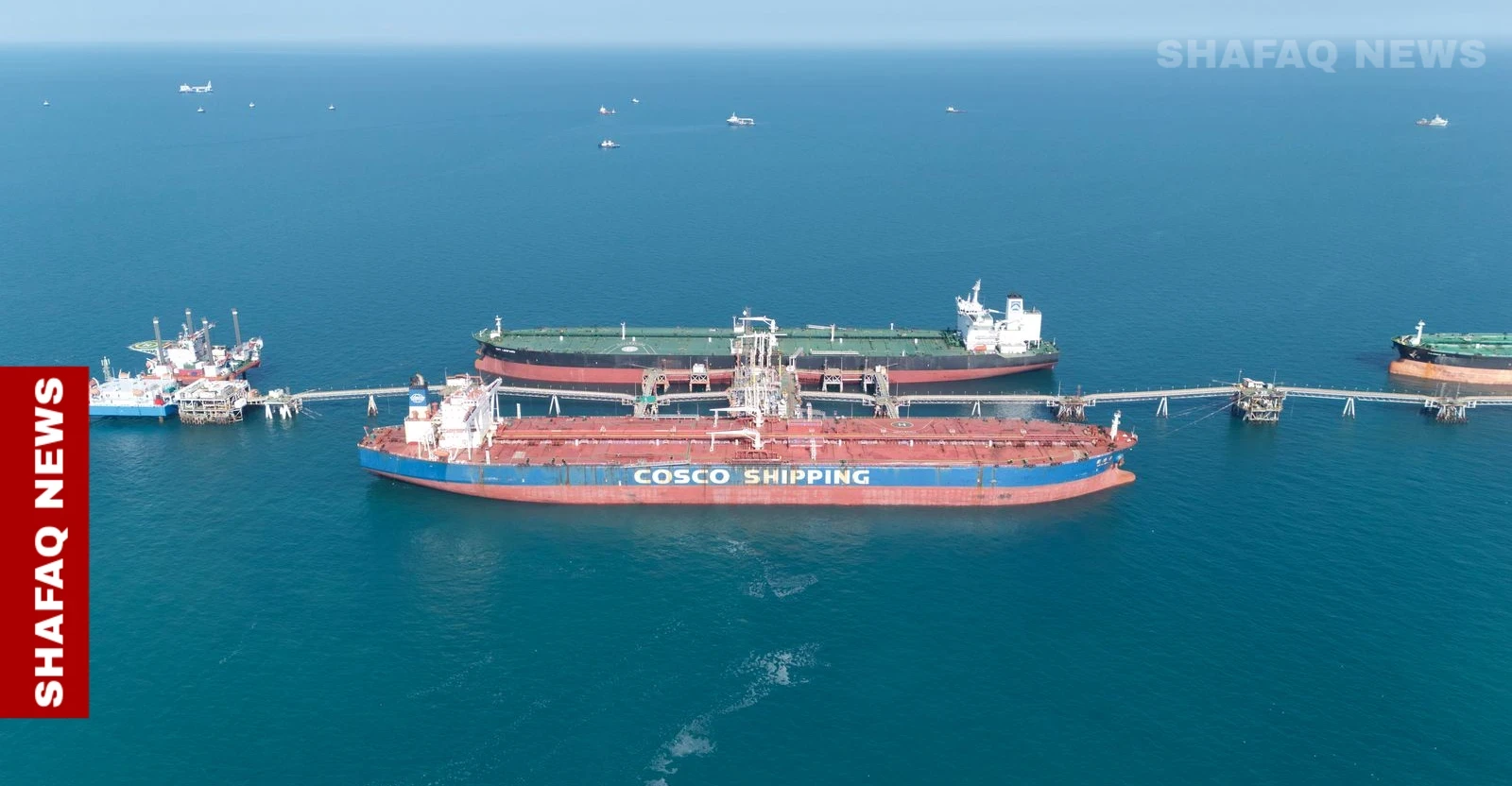 Shafaq News – Special Translation
Baghdad seeks to strengthen its economic and energy sector ties with Washington, driven by economic and strategic needs that go beyond normalizing political relations, at a time when the American companies Chevron and ConocoPhillips are moving to expand their presence in the Iraqi oil sector, through various investment paths that include producing fields and export infrastructure.
Despite the announcement of agreements and memoranda of understanding with a total value exceeding $60 billion during the US-Iraq Business Summit held in Washington in July 2026, this value does not mean that the money actually entered Iraq, as it includes binding agreements, partnerships, memoranda of understanding, and potential projects that have not yet been implemented.
According to a report published by the National Interest website and translated by Shafaq News Agency, the package of agreements announced during Iraqi Prime Minister Ali al-Zaidi’s visit to Washington included more than 50 agreements and memoranda of understanding in the energy, infrastructure, technology, finance and healthcare sectors, with the participation of companies including Chevron, ConocoPhillips, BP, General Electric Vernova, Shell and KBR.
Iraq has about 145 billion barrels of proven oil reserves, or about 9% of global reserves, but it still relies on a limited number of export routes, making it vulnerable to security and regional developments that could disrupt its oil’s access to global markets.
Kirkuk – Jihan
Most Iraqi oil exports pass through the Gulf, making them dependent on the security situation in the Strait of Hormuz. Iraq has historically had other export outlets through Turkey, Syria and Saudi Arabia, providing access to the Mediterranean and Red Seas.
The Kirkuk-Ceyhan pipeline, which extends for about 986 kilometers, is one of the most important routes for exporting Iraqi oil to the Mediterranean. After it was stopped following attacks targeting the Iraqi side in 2014, the pipeline resumed its operations in 2026, with initial flows of about 170,000 barrels per day, before the northern regime’s exports reached about 250,000 barrels per day in late September 2026.
Thus, the Kirkuk-Ceyhan pipeline is not a lost route, but rather a route that has been restarted but has not yet reached its design capacity. In contrast, the Kirkuk-Banias pipeline, which transported oil through Syria to the Mediterranean, has been out of service since 2003, despite having a design capacity of approximately 700,000 barrels per day. Furthermore, the Iraqi-Saudi pipeline known as the IPSA, with a capacity of approximately 1.65 million barrels per day, remains inoperative.
Of the three northern and western export routes that Iraq has historically relied on, the Kirkuk-Ceyhan line has become the main alternative route currently in operation.
Plans to create a new link to the Syrian port of Banias and increase flows via Kirkuk-Ceyhan are part of Baghdad’s efforts to build a more flexible export network that not only increases sales but also allows for the transport of larger quantities of oil through different outlets.
Kirkuk oil fields
Meanwhile, ConocoPhillips is pursuing a different path, focusing on redeveloping producing fields in northern Iraq.
On July 17, the company announced an agreement with BP to acquire a 42% stake in BP Energy Company of Kirkuk Limited. The deal includes the development and production of oil from the Baba and Avana domes in the Kirkuk field, along with the Bai Hassan, Jambur and Khabbaz fields, whose recoverable resources, according to initial total estimates, exceed 3 billion barrels of oil equivalent.
The deal is expected to be completed by the end of 2026, subject to obtaining the necessary approvals and meeting closing conditions.
Instead of developing a new field from scratch, ConocoPhillips is seeking to increase returns from existing infrastructure, while the deal allows BP to restructure its investment portfolio and direct capital to other areas.
The strategic difference between the two companies lies in the fact that Chevron is negotiating to take over the operation of a large oil field, while ConocoPhillips plans to participate in increasing production through a minority stake within an existing portfolio of fields.
West Qurna 2 Field
In contrast, one of Chevron’s most prominent opportunities in Iraq is the West Qurna 2 field, operated by Russia’s Lukoil, which has a production capacity of about 460,000 barrels per day.
In February 2026, the Iraqi government laid out a preliminary framework to enable Chevron to take over the field, but it did not constitute a final acquisition agreement or a complete transfer of operating rights.
On September 13, the Iraqi Ministry of Oil signed an agreement with Chevron to provide technical consulting services to the Basra Oil Company, allowing the company to participate more broadly in negotiations regarding the terms of field development. However, its operation of West Qurna 2 remains contingent upon the signing of a final contract.
Chevron’s opportunities are not limited to production volume, as the commercial viability of the investment will also be determined by the terms of cost recovery, revenue sharing, and operational flexibility.
The company’s discussions also extend to the Nasiriyah field, four exploration blocks in Dhi Qar province, and the Balad field, indicating its intention to build a broader portfolio of exploration and production activities, rather than relying on a single oil asset.
Export lines
Furthermore, Chevron’s involvement in potential export infrastructure projects lends a broader strategic dimension to its activities in Iraq. The company has been linked to an initiative exploring options for constructing pipelines connecting southern Iraq, via Haditha, to the Turkish port of Ceyhan and the Syrian port of Banias.
On July 17, 2026, Iraq and Syria signed a memorandum of understanding to rehabilitate and rebuild the Iraqi-Syrian oil pipeline. The US State Department said that an international consortium led by the United States would handle the technical and financial work, while reports indicated that Chevron, Qatar’s UCC and TI Capital were among the participating entities.
A target transport capacity of up to two million barrels per day was proposed after rehabilitation, but this quantity represents a future target and not the current capacity of the pipeline, and reaching it depends on the implementation of the project.
While linking Iraq to the port of Banias could offer strategic value, the future volume of transport and the operational timeline for the route remain uncertain. Implementation hinges on securing funding, the technical condition of the infrastructure, agreements between Iraq and Syria, and the security situation.
The oil field agreements and the pipeline project are also separate processes; progress in one does not guarantee the completion of the other, according to a National Interest report.
Contracts and Implementation
Meanwhile, the moves by Chevron and ConocoPhillips reflect that the return of American companies to the Iraqi oil sector is not following a single investment model. Chevron is combining the possibility of taking over the operation of a large field with participation in export route projects, while ConocoPhillips is focusing on a stake in the development of a group of existing fields.
Expanding the activities of American companies would strengthen economic ties between Baghdad and Washington and increase the presence of American firms in Iraq’s energy sector. However, investment decisions will depend more on contract terms, project costs, and the ability to transport production to markets, rather than solely on political consensus.
The resolution of the West Qurna 2 negotiations, the completion of the ConocoPhillips deal in Kirkuk, and progress in financing and implementing alternative export routes will be key indicators of how well the announced agreements translate into actual commercial results.
The US report concluded by noting that the main challenge facing Iraq is “transforming political and commercial commitments into feasible and economically viable projects,” as the declared value of the agreements cannot be treated as actual capital flows before the completion of contracts, financing, and infrastructure.
shafaq.com
