Al-Zaidi faces a difficult task… Iraq has become “more fragile” as a result of the regional conflict.
Al-Zaidi faces a difficult task… Iraq has become “more fragile” as a result of the regional conflict.
2026-05-24 02:55
 Shafaq News – Translation
Iraq has shown during the conflict that has shaken the Middle East that it is one of the most sensitive and complex battlefields, according to the American magazine Newsweek, which considered that if a preliminary peace agreement is reached, it will be an opportunity for the government of the new Prime Minister Ali al-Zaidi to extend its control, despite the difficulty of this task.
The magazine began by mentioning in a report translated by Shafaq News Agency, the secret Israeli military presence on Iraqi soil, the attacks launched by armed factions on Saudi Arabia and the UAE, and the continued presence of Iranian Kurdish fighters in the Kurdistan Region, considering all these elements to be present while the new government led by al-Zaidi seeks to extend its control over a “fragile nation” of about 50 million people, stuck for decades in a cycle of conflicts.
The magazine quoted Ali Al-Maamouri, a researcher at Deakin University and a former strategic communications advisor to the Iraqi Prime Minister, as saying that “Iraq’s situation is very fragile because, since 2003, it has become one of the most prominent arenas of regional and international conflicts,” adding that “the American-Iranian rivalry has always been present in Iraq, but the current war between the United States, Israel and Iran is greatly exacerbating this fragility.”
According to Al-Maamouri, information about Israeli activity in western Iraq, militia drone attacks from Iraqi territory, and the presence of Iranian Kurdish opposition groups all point to the fact that “Iraq is not immune to the war, and is an integral part of its geography, even if the Iraqi government officially tries to maintain neutrality.”
Newsweek noted that the situation Iraq finds itself in is frustrating for Iraqi officials, given the extent to which Baghdad has tried to keep itself out of the conflict, recalling what former Prime Minister Mohammed Shia al-Sudani had said: that Baghdad wants to have balanced relations with both the United States and Iran, and is trying to keep weapons in the hands of the state.
After noting that Iraq had largely escaped the scenes of destruction that befell other arenas in Gaza, Lebanon, Syria and Yemen in the aftermath of the events of October 7, 2023, the report explained that Iraqi hopes were dashed when the United States and Israel launched an unprecedented military campaign against Iran in late February, in which they killed Iranian Supreme Leader Ayatollah Ali Khamenei, who was not only the highest authority in Iran, but also a religious symbol for his Twelver Shiite followers.
The report quoted Hamza Haddad, a researcher at the Center for a New American Security and a former advisor to the president of the Iraqi Trade Bank, as saying that “despite the presence of a number of armed groups in the country, Iraq managed to distance itself from the regional war from October 2023 until February 2026,” adding that “however, after the assassination of the Iranian Supreme Leader, who also held a prominent religious title, it became difficult for the Iraqi government to maintain stability, given the response of some armed groups closely linked to Iran by launching attacks on the American presence in Iraq.”
The report quoted Sherwan Hendrin Ali, research director at the Armed Conflict Location & Event Data Project, as saying that “these militias enjoy political support within the government itself, control a large part of the economy, are well armed and funded by Iran, and are integrated into government forces to varying degrees,” noting that “confronting them militarily carries the risk of igniting an internal conflict similar to the sectarian conflict that occurred in the first decade of the second millennium, or the war with ISIS in the second decade of the second millennium.”
According to Ali, the reports about the presence of Israeli bases were “surprising but not shocking,” noting that although there was no public confirmation from the Israeli government, data showed 128 airstrikes and drone attacks in Iraq targeting pro-Iranian groups during the active phase of the current war before the ceasefire, carried out by either Israel or the United States.
After noting the attacks launched from Iraq against Gulf states, the report said that these circumstances pose a major challenge to any Iraqi leader, especially al-Zaidi, who is under pressure from multiple fronts, both external and internal, to find a successful way forward.
The report addressed Washington’s continued pressure on al-Zaidi to take more stringent measures to curb the influence of the militias, and consequently, to restrain Tehran, which also has significant interests in Iraq’s future. In this regard, Ali al-Mawlawi, director of Horizon Consulting Group, stated that “as with his predecessor, the new prime minister will have only limited ability to control the resistance factions should war with Iran resume, given the lack of a viable military solution to dismantle these groups.”
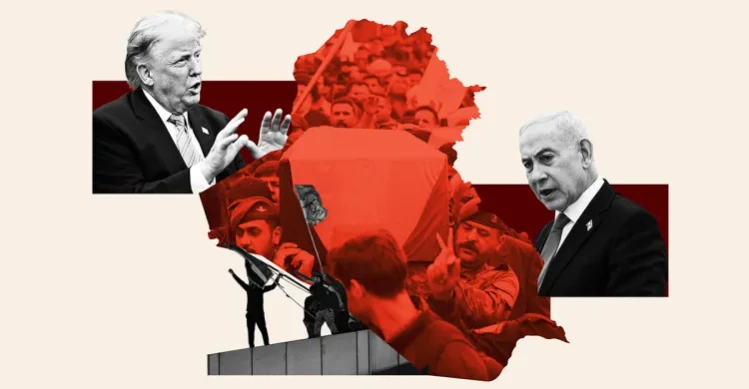
According to Mawlawi, the main difference this time is that al-Zaidi has received public support from President Trump after being endorsed by Tom Barrack, which means that the public image of both sides will be very damaging if Iraqi territory is used again as a battleground. He explained that all al-Zaidi can practically do is hope that any future agreement between the United States and Iran on a ceasefire will explicitly include Iraqi territory, as such an agreement “will create political space for Baghdad to pursue a gradual path towards bringing all weapons under state control.”
Leah Hegel, a researcher at the International Crisis Group, told Newsweek that: “Al-Zaidi’s task of curbing Iranian-backed groups will be more difficult than it was for Al-Sudani, given the increasing American pressure, while these groups become bolder after the war.”
shafaq.com
