Al-Sadr warns of a “bullet in the body of democracy,” while Al-Sudani praises participation: a remarkable step towards stability.
Al-Sadr warns of a “bullet in the body of democracy,” while Al-Sudani praises participation: a remarkable step towards stability.
2025-11-11 07:08
 Shafaq News – Baghdad/Najaf
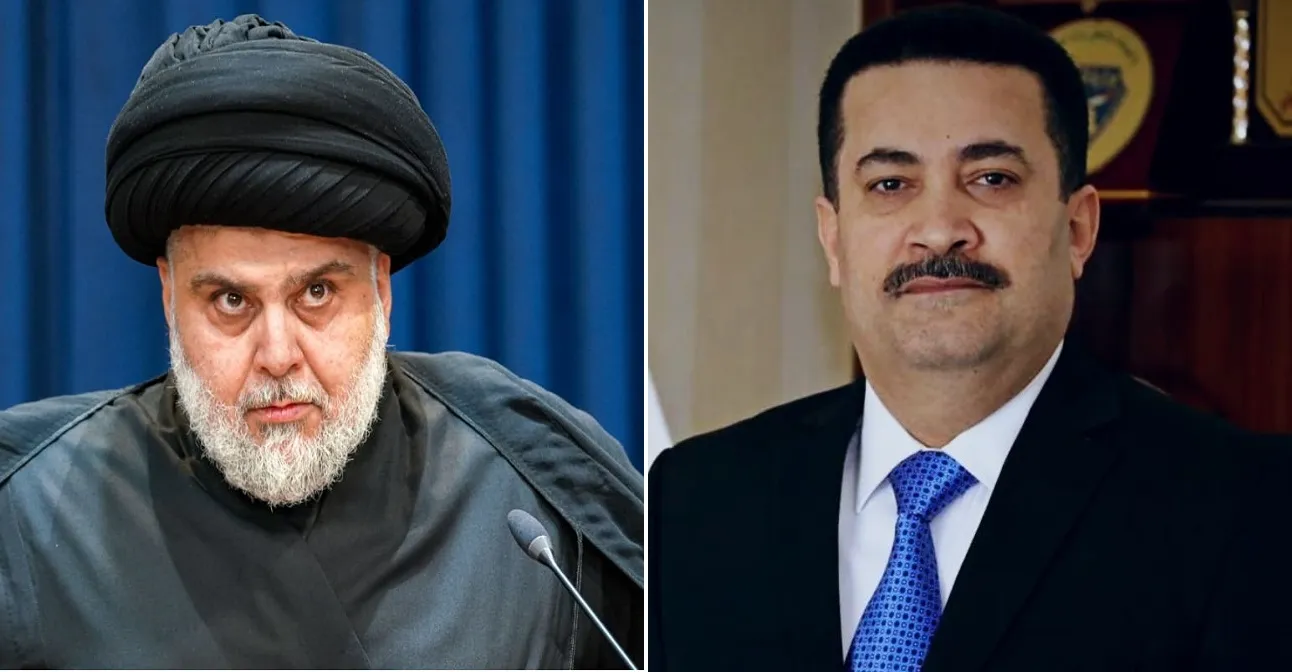
Following the conclusion of the electoral process in Iraq, Iraqi Prime Minister Mohammed Shia al-Sudani praised the participation in the general election on Tuesday evening, describing it as “a distinguished step towards stability,” while the leader of the Shiite National Movement, Muqtada al-Sadr, stressed the need for those he called “beneficiaries of voters’ voices” to strive to restore Iraq to its true path, otherwise it will be “the coup de grâce to the body of democracy.”
Al-Sudani said: “Once again, our noble Iraqi people, in all their fraternal diversity, and in every corner of our dear homeland, are taking a remarkable step, through which they are moving towards more stability and success, and consolidating the democratic system that expresses their free constitutional will and their desire to continue the approach of building the state and strengthening its institutions.”
Al-Sudani added in a statement from his office, which was received by Shafaq News Agency, that “with the successful organization and implementation of the sixth legislative elections, with its legal and executive mechanisms, and in accordance with our permanent Iraqi constitution, the government has fulfilled one of its most prominent commitments included in its executive program, in addition to its commitment to the constitutional timelines and entitlements due to ensure the peaceful transfer of power, and the decision to form it was based on the free choices of the Iraqi people.”
He continued: “On this occasion, I extend my appreciation, gratitude, and praise to every patriotic Iraqi citizen who participated and demonstrated his confidence through his national choice by casting his vote in the ballot box, believing in the difficult path of democracy, for which Iraqis have made great sacrifices that cannot be measured in price.”
He added, “Thanks are due to the legislative and judicial authorities, to our valiant armed forces, in all their branches and formations, to the Independent High Electoral Commission, the national political forces, to all public activities, social organizations, civil society organizations, media and press outlets, and representatives of international organizations, for their professional duty, participation, support and assistance, which contributed decisively to the success of the voting process.”
Al-Sadr, in a post seen by Shafaq News Agency, stated, “Despite our order to boycott, we did not try to obstruct the electoral process, as we are not seeking power but rather a project to save the nation.”
He added: “The voting process closed without any obstacles, except for the low number of voters, in favor of those who boycotted and did not participate in selling out Iraq and bringing back the tried and tested, may God reward them.”
He continued, “From here, the full responsibility will fall on those who benefit from the voters’ voices to restore Iraq to its true state and get it out of the bottleneck, as they express it, and from foreign interventions from here and there, and to protect the people from uncontrolled weapons and confine them to the hands of the security forces, including the Popular Mobilization Forces, without any uncontrolled factions, and from the external dangers surrounding the homeland without surrendering, with which the rights of the people and the mujahideen will be lost.”
Al-Sadr added, “It is also their responsibility to strive seriously and diligently to uncover corruption, the corrupt, and corruption deals, otherwise it will be the final blow to democracy, indeed to the nation, which is being battered by internal and external dangers, leading to the loss of duties and rights. We will not remain silent about this in the future, as we are still seeking reform and to save Iraq from being lost. Peace be upon you.”
The curtain has fallen on the legislative elections in Iraq, to choose new members for the sixth session of parliament, after the commission announced the end of the specified voting time, at six o’clock on Tuesday evening, and the complete closure of the polling centers.
As soon as the voting process is over, the relevant committees in the commission will begin the counting and sorting processes, in preparation for announcing the preliminary election results.
The preliminary results of the Iraqi elections are usually announced within 24 hours of the closing of the polling stations, while the final results are issued after the completion of the auditing and technical examination processes, and consideration of the complaints and appeals submitted by the commission and the competent judicial authority, to ensure the integrity and transparency of the process.
The seats are distributed according to the modified Sainte-Laguë formula (1.7), where the mechanism of this system is based on dividing the total of valid votes obtained by parties, lists or independent candidates by successive numbers starting with 1.7, then 3, 5, 7…, then the results are arranged in descending order.
The seats are distributed according to the highest number of votes until the allocated number for each district is filled, but according to observers, this formula gives the large political forces a clear advantage at the expense of the small lists and independents, who have fewer chances of winning seats.
According to the midday polling report issued by the Electoral Commission, voter turnout did not exceed 23%, but this percentage rose slightly after the afternoon hours, as polling stations witnessed an increasing turnout at the ballot boxes.
The general voting process for the sixth parliamentary session began this morning, Tuesday, as part of a democratic practice in the political process that emerged after 2003.
Approximately 21 million voters out of about 46 million Iraqis are eligible to elect 329 representatives to represent them in the next session of the House of Representatives. More than seven thousand candidates of both genders are competing, distributed across 37 political electoral alliances and coalitions in all regions and cities of Iraq.
The Shiite National Movement, led by al-Sadr, is boycotting these elections, despite attempts by prominent political figures and parties to dissuade it from this position, but these efforts have failed.
shafaq.com
