Al-Araji on restricting weapons: We need a balance to prevent sliding into chaos.
Al-Araji on restricting weapons: We need a balance to prevent sliding into chaos.
2026-05-12
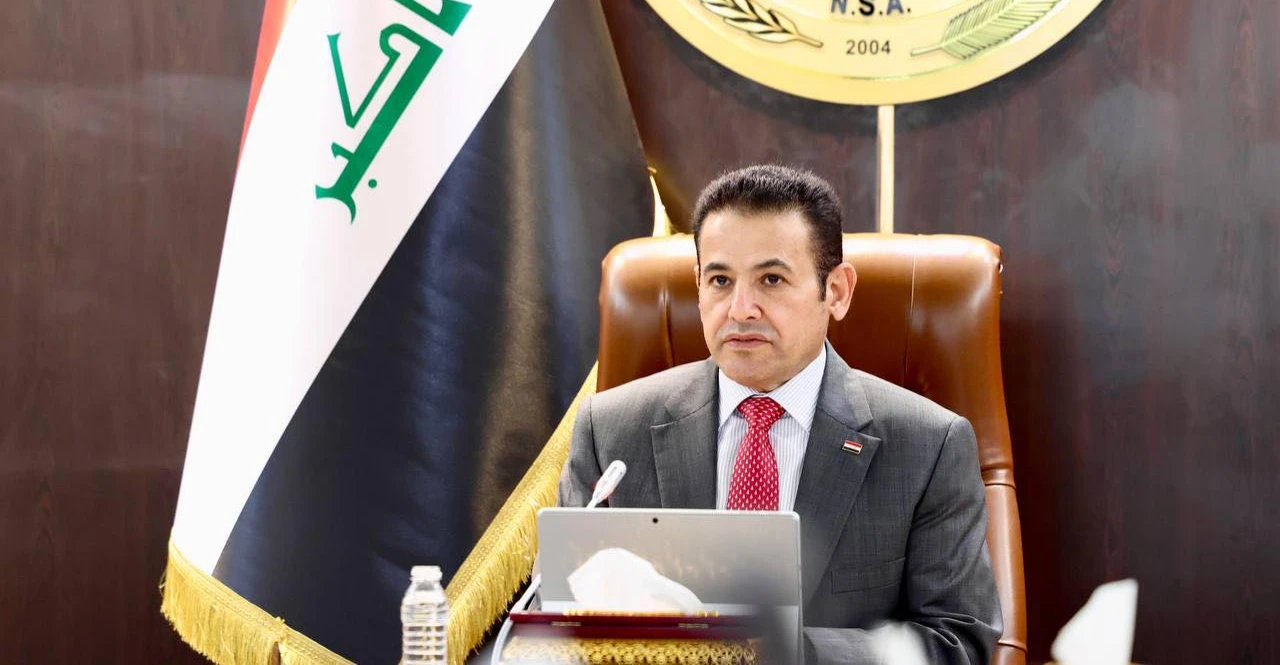 Shafaq News – Baghdad
Iraqi National Security Advisor Qasim al-Araji confirmed on Tuesday evening that the country is leveraging its good relations with both Iran and the United States to reduce tensions, noting that controlling weapons requires a delicate balance between enforcing the law and preventing a slide into chaos.
Al-Araji said during his participation in the Atlantic Council session via video conference that “Iraq did not choose to be an arena for regional and international conflict, but rather an arena for meeting and communication. The government has clearly announced its position, which is that Iraq is distancing itself from the conflict, and is instead benefiting from and investing its good relations with Iran and the United States to reduce tension and escalate the situation.”
He added that “Iraq categorically rejects the use of its territory to attack any country or party, and this is not just a diplomatic position, but a constitutional and sovereign commitment that cannot be compromised.”
He added that “the Iraqi government views the long-term institutional reform file as a major national priority, not with the logic of random clashes that threaten stability, but with the logic of the state and sovereignty.”
Al-Araji pointed out that the government launched a comprehensive reform framework based on two fundamental pillars:
First: The National Security Strategy “Iraq First” 2025–2030, which places Iraqi sovereignty and national interest above all considerations, and links security with development, stability and governance.
Second: The Security Sector Reform Strategy 2024–2032, which aims to build a professional and unified security sector, subject to civilian authority and the rule of law, and ensures that there is one military decision and one weapon under the authority of the state.
Al-Araji pointed out that “addressing the issue of restricting weapons requires containment and a delicate balance between firmness and maintaining internal stability, and between enforcing the law and preventing slipping into chaos.”
In the context of forming the next Iraqi government, he stressed that “the issue of restricting weapons will be of paramount importance, as Iraq, which wants to build a strong strategic partnership with friendly and brotherly countries and the international community, realizes that this partnership cannot be established without a strong state that monopolizes weapons and enforces the rule of law.”
He added that “official Iraq, with its institutions, constitution and elected governments, is a reliable partner that seeks stability, rejects aggression and wants balanced relations with the world,” explaining that “supporting a strong, stable and sovereign Iraq is not a political courtesy, but a real investment in the security and stability of the region.”
Al-Araji explained that “Iraq today is not asking its friends to ignore the challenges, but rather it is asking them to understand our situation that has accompanied the Iraqi state since (Al-Qaeda, ISIS and terrorist groups), and the circumstances surrounding us, and to support the reform project that the Iraqi government is steadily pursuing, no matter what the challenges may be.”
He added that “reforming the security sector is not about a passing security issue, but rather touches the core of the modern Iraqi state’s battle, the battle to impose state authority over all its territory, and to prevent any force from operating outside its legitimate framework.”
Al-Araji said: “In 2014, Iraq faced the most serious threat in its modern history when Mosul fell, and the ISIS terrorist organization expanded over large areas of the country, while state institutions were on the verge of collapse. At that pivotal moment, the Popular Mobilization Forces were formed in response to a national and religious call, and contributed with the Iraqi security forces to liberating the land and defeating terrorism.”
He concluded by saying that “the end of the war on ISIS in 2017 did not mean the end of the challenges, but rather revealed a more complex challenge, which was how the state would move from the emergency phase to the phase of complete monopoly over weapons and security decisions.”
shafaq.com
