After years of drought, the Iraqi marshes are regaining their vitality.
After years of drought, the Iraqi marshes are regaining their vitality.
2026-05-08
 Shafaq News – Special Translation
Life has been renewed in the historic marshes of Iraq, thanks to rainfall in greater quantities than in previous years, which has allowed for the strengthening of water reserves in dams, the development and increase of flow management, and thus the pumping of water into the arteries of the marshes that were almost destroyed by the long drought, according to a report by Reuters .
Reuters explained, in a report translated by Shafaq News Agency, that after years of drought that left vast areas of Iraq’s historic marshes cracked and empty, rising water levels have begun to revive these wetlands, attracting buffalo herders and hunters to previously abandoned areas.
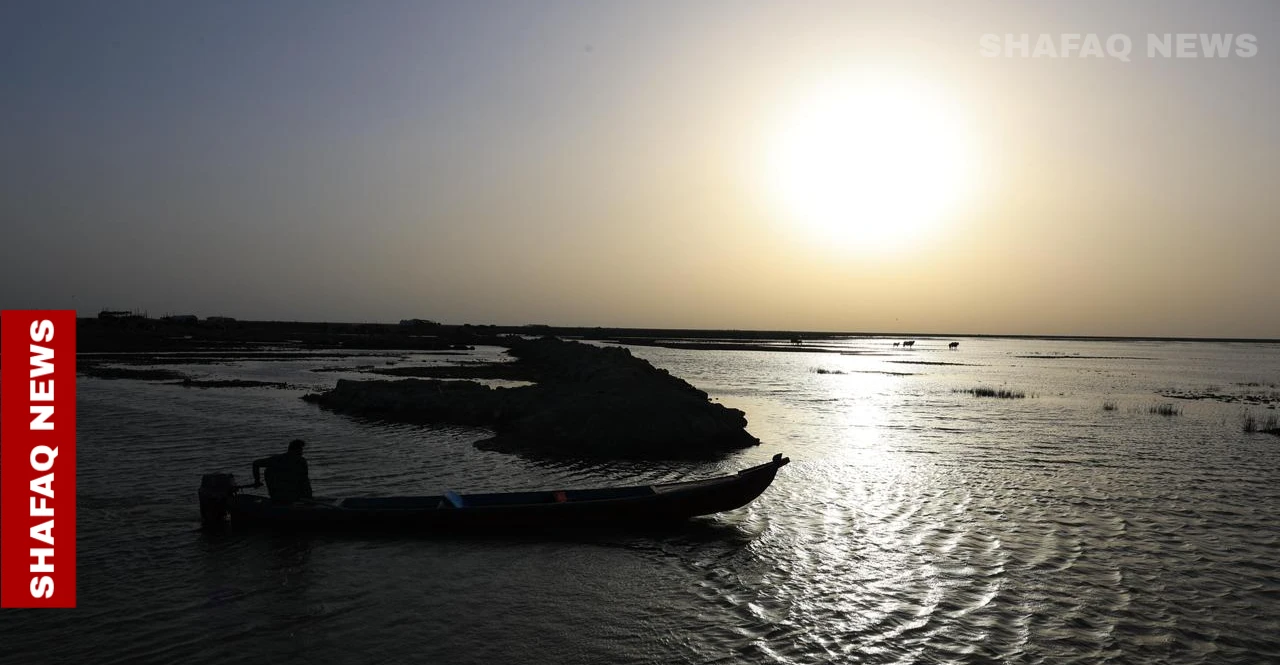
The report discussed the marshes of Al-Jubayish in southern Iraq, where boats have returned to sail through the waterways that had dried up in recent years, while water buffalo have begun to wade through the revitalized marshes, and green pastures have reappeared.
The report quoted farmer Haider Qasim, who raises buffalo in the central marshes, as saying: “A short time ago, all our livestock died and there was no water at all,” adding that “many people from our region migrated because of the drought, but the water has returned this year, the number of livestock is increasing, and some families have returned.”
He explained that “these changes in the reality of the region came after heavy winter rains boosted the levels of the reservoirs, which enabled the Ministry of Water Resources to release increasing amounts of water to the marshes, but the residents of the marshes are still hoping for additional water releases.”
According to the report, marshland expert Jassim al-Asadi said that the “Ishan Halab” area, which is part of the marshes and which some believe to be the biblical “Garden of Eden,” and which was designated a World Heritage Site by UNESCO in 2016, dried up completely between 2021 and 2025, forcing herders to abandon it.
However, conditions have improved in recent months in Ishan Halab, where some pastures have been revived, and some residents have been given the opportunity to return.
According to Al-Asadi, the percentage of flooded marshes has risen to between 32% and 36%, compared to no more than 8% during the past five years, a fact confirmed by officials in the Iraqi Ministry of Water Resources.
The report noted that the high water levels also boosted the gradual recovery of biodiversity, including fish stocks and the flourishing of plants and reeds used by residents to build traditional homes in this region, which has been inhabited by the Marsh Arabs for thousands of years, and whose livelihoods and traditions are closely linked to water.
Meanwhile, a water resources official noted that larger flows, improved water management, and stronger seasonal rainfall all contributed to boosting reserves in dams and increasing flows in the Tigris and Euphrates rivers, allowing more water to reach the marshes.
The Ministry of Water Resources had indicated that strategic reserves had increased by about 6 billion cubic meters this year, giving authorities greater flexibility to manage supplies during the summer months.
The report stated that Saddam Hussein’s regime attempted to drain the marshes, which previously covered more than 9,500 square kilometers, extensively during the 1990s, accusing the Marsh Arabs of treason during the Iran-Iraq War between 1980 and 1988, in an attempt to eliminate the insurgents.
Many of the marsh dwellers fled at that time, before beginning to return after his rule was overthrown, with Reuters estimating the number of returnees at around 250,000 people.
The report concluded by saying that for residents, such as buffalo herder Rahim Abdul Zahra, the recent improvements have helped improve daily life, quoting him as saying: “The land was dry, but now it is alive again.”
shafaq.com
