A Turkish reading of the Iraqi elections: Al-Sudani is the most likely candidate, backed by regional and international support.
A Turkish reading of the Iraqi elections: Al-Sudani is the most likely candidate, backed by regional and international support.
2025-11-03 07:25
 Shafaq News – Special Translation
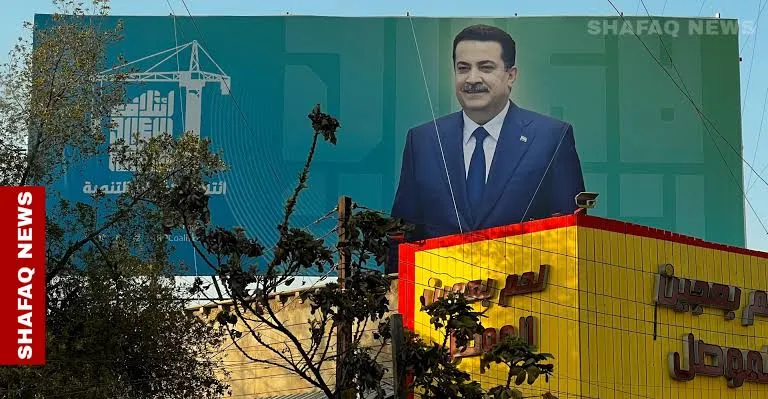
In a Turkish reading of the upcoming Iraqi elections, the Daily Sabah newspaper said that the voting process on November 11 will determine whether Iraq will remain under “dual sovereignty,” suggesting that Mohammed Shia al-Sudani is likely to win a second term if he achieves strong results in the elections.
She indicated that Sudan might receive assistance from the United States, which would provide a security umbrella, from Turkey, which would implement water-sharing arrangements, and from the Gulf states, which would provide investments.
According to the Turkish newspaper Daily Sabah, in a report translated by Shafaq News Agency, voter turnout is expected to drop to only 30%, noting that the main parties are not offering programs that attract the younger generation.
The report warned that Iraq could find itself in a financial predicament if it does not secure new and stable revenues, and that Sudani, “a technocrat capable of balancing between Washington and Tehran, will have to choose between populism and reform.”
After the Turkish newspaper pointed out that for the first time in years, Iraq is entering elections in relative calm, with a decrease in regional and local violence, it considered that this gives political blocs space to focus on internal issues instead of security crises, but it saw that the experience of the 2019 protests showed that street demonstrations can shake the system, but only the ballot boxes are capable of changing it.
However, the report said that this hope is undermined by a system that benefits from low voter turnout, noting that only 70% of adults have biometric voter cards, leaving 9 million disenfranchised. It added that if Sadrists, Generation Z voters, and frustrated Sunnis stay home, turnout could drop to 30%.
The report noted that the main parties do not offer any credible programs for the younger generation, while more than 60% of Iraqis are under the age of thirty, and the unemployment rate among young people reaches 25%, while the poverty rate is approaching 30% in some governorates.
The report described Sudan as having rebranded itself as a “service government,” focusing on roads, electricity, schools, and infrastructure, portraying itself as a balancing force between Washington and Tehran, between Shiite factions, and between Arabs and Kurds, noting that it avoided escalation during the Gaza war and the Israeli-Iranian wars.
The report noted that his message was characterized by “patriotism and distance from sectarianism,” which earned him a good reputation among Sunnis.
After pointing out “some negatives” in his economic policy, where he increased the salaries of state employees by about one million jobs and raised subsidies to unsustainable levels, the report said that without securing new and stable revenues, Iraq faces the risk of falling into a financial predicament.
He pointed out that the Sudanese are approaching the moment when they will have to choose between populism and reform.
While the report indicated that Sudani’s list could win between 50 and 60 seats, which would give him a strategic advantage, it considered that the support of the Shiite cleric Muqtada al-Sadr could make it a landslide victory, describing al-Sadr as one of the most influential figures in Iraq, and that by withdrawing from the political process he took millions of votes with him.
The report continued that Al-Sudani insists on the necessity of the militias entering the political arena and “renouncing weapons,” adding that his removal of the leaders of the Kataib Hezbollah was symbolic, but that symbolism does not contribute to dismantling the parallel armies.
He argued that this outcome would determine whether Iraq would remain under dual sovereignty, or whether Baghdad would be able to assert a state monopoly on force.
The report said the elections would not eliminate the sectarian and ethnic “quota system” that has ruled Iraq for two decades since 2003, noting that Iraq has moved from a dictatorship of one man to a group of sectarian and ethnic leaders.
The report explained that if Sudani is re-elected through a strong performance in the elections, Washington, Ankara and the Gulf capitals are ready to offer him their support, provided that he guarantees basic services and geopolitical stability.
He pointed out that al-Sudani is perfectly suited to this role, as his technocratic personality and ability to balance between Washington and Tehran make him acceptable to multiple parties, indicating that the external powers exhausted by Iraqi instability are seeking predictability, not transformation.
The report went on to say that it “highlights an implicit sharing of diplomatic relations, whereby the United States will provide a security umbrella, Turkey will offer arrangements for sharing water, and the Gulf states will provide investments,” but added that all of this hinges on the next leader undertaking sufficient reforms to maintain progress.
However, the report pointed out that this strategy ignores structural issues that no external guarantee can resolve.
The report addressed Iranian influence and noted that Iraq’s sovereignty remains vulnerable to Iranian-backed factions, but said that a weakened Iran is “not defeated,” and that once it regains its balance, it will reactivate its assets, including through Iraqi militias.
The report continued that if “Sudan collapses,” Western and Gulf powers may face the question of whether striking a deal with al-Sadr, whose actions are unpredictable, is better than dealing with hardliners allied with Iran.
The report concluded that a government with substantive governance could achieve reform by curbing militias, protecting institutions, investing in youth, and achieving Iraqi interests.
He went on to say that in a fragmented Middle East, Iraq could be a bridge between competing powers and exploit resources to achieve national gains, but that requires breaking the traditions that have governed Iraq since 2003, such as sectarian division, acceptance of parallel sovereignty, and the possibility of reform under power-sharing. He warned that the greatest threat to Iraq’s future is not the external enemy, but rather the system that maintains a divided state, an exhausted people, and an incomplete homeland.
shafaq.com
